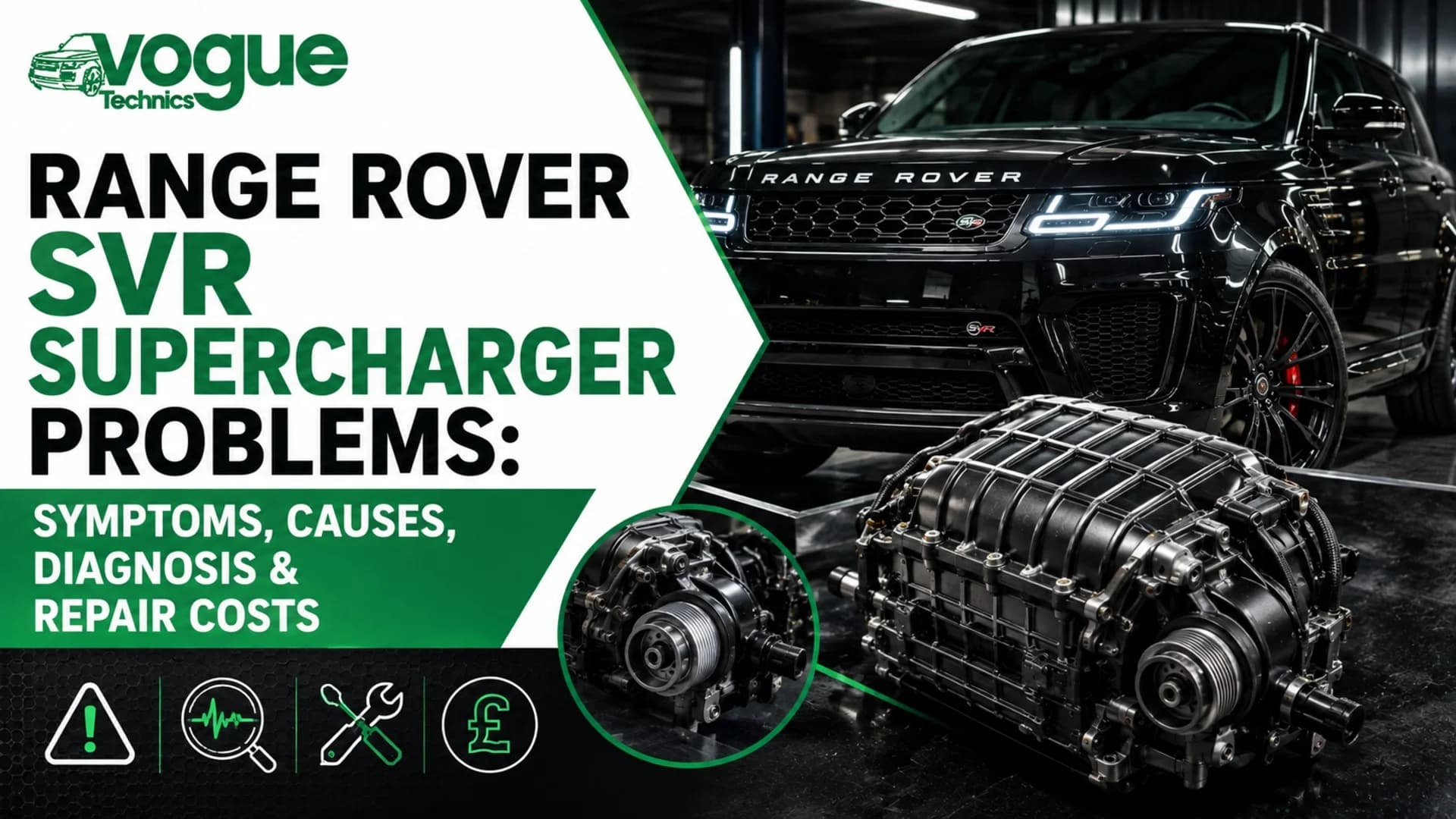
Range Rover SVR Supercharger Problems: Symptoms, Causes, Diagnosis & Repair Costs
You're driving your Range Rover Sport SVR and something's off. Maybe it's a whine that wasn't there last month. Maybe the power delivery feels flat when you put your foot down. Or maybe a warning light just lit up the dash and you're wondering whether this is a five-minute fix or the start of an expensive conversation.
Here's the first thing worth knowing: the SVR doesn't use a turbo. It runs an Eaton TVS supercharger bolted straight onto the AJ133 5.0-litre V8, and that difference matters. Supercharger problems behave differently from turbo problems, they sound different, and they get diagnosed differently. If you've been searching for "SVR turbo problems," you're actually looking for the wrong system, this guide covers what's really happening under that bonnet.
Below, we'll walk through the supercharger's most common failure points, what each one sounds and feels like, how a proper diagnosis is done, and what repair or replacement typically involves. This is written for SVR and Range Rover Sport owners in the UK who want a clear, honest picture, not a sales pitch dressed up as advice.
What Are the Most Common Range Rover SVR Supercharger Problems?
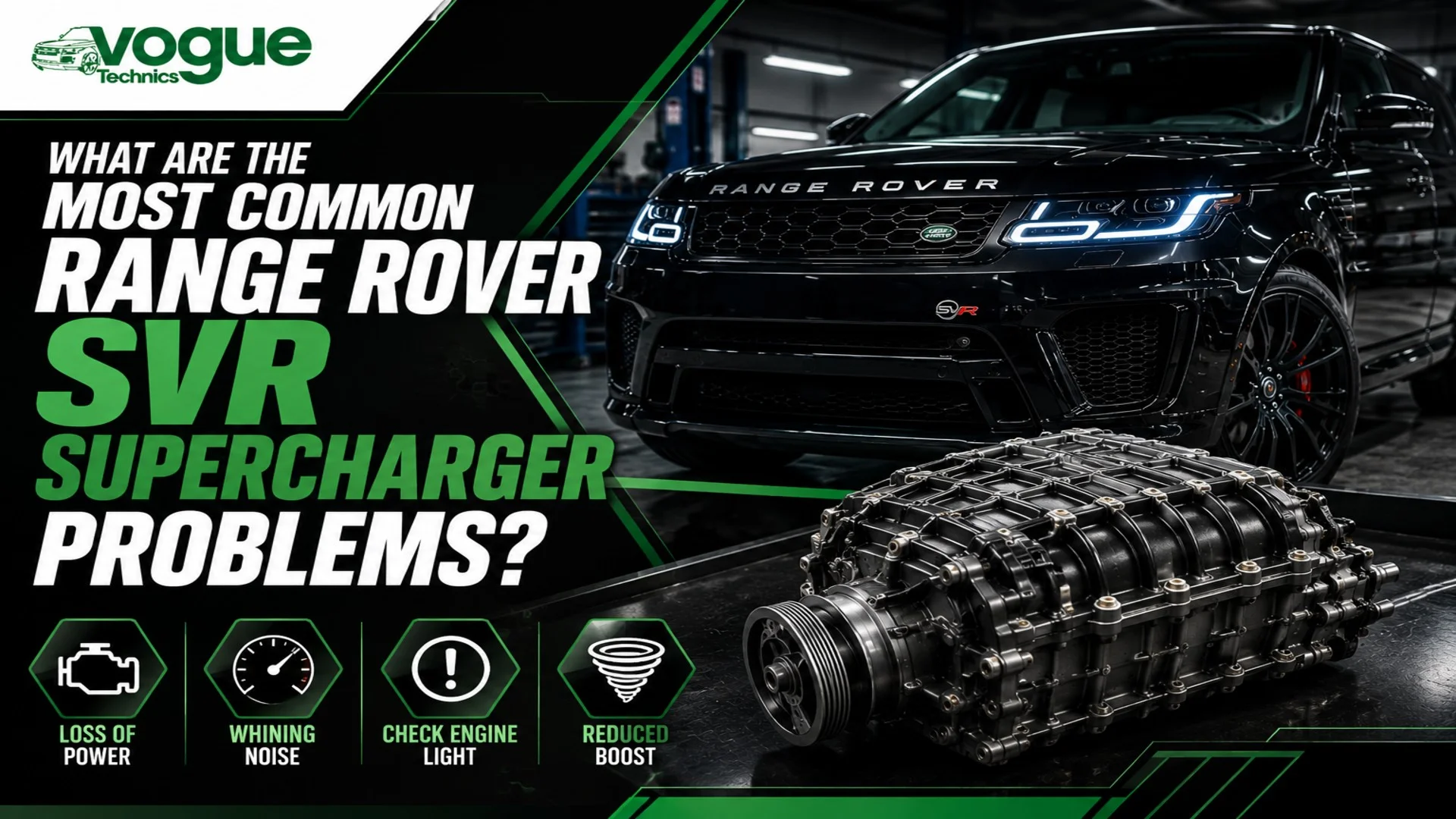
The AJ133's Eaton TVS R1900 supercharger is a twin-vortex, Roots-type unit, a genuinely strong piece of engineering, but not immune to wear. Most of the complaints we hear from SVR owners fall into a handful of categories: unusual noise, reduced power, boost loss, and warning lights.
What Does a Bad Range Rover SVR Supercharger Sound Like?
A failing supercharger rarely fails silently. The sound is usually the first clue.
- A rising whine under acceleration that gets louder and higher-pitched than usual can point to internal wear on the rotor assembly or bearings.
- A metallic rattle at idle often traces back to the coupler or isolator, the components that connect the supercharger drive to the engine.
- A grinding noise, particularly under load, is one of the more serious signs and often means bearing failure.
- A high-pitched squeal on start-up or acceleration usually points to the drive belt or pulley rather than the supercharger itself.
- A hissing sound around the intake area often means a boost leak, not a supercharger fault at all.
The location and timing of the noise, idle versus acceleration, cold start versus warm engine, tells a trained ear a lot about where to look first.
Is Supercharger Whine Normal on an SVR, or a Warning Sign?
Some whine is completely normal. The Eaton TVS design produces a characteristic hum under load, that's just how Roots-type superchargers work, and it's part of the SVR's soundtrack when you're on the throttle.
What isn't normal is a whine that's:
- Noticeably louder than it used to be
- Present at idle, not just under load
- Changing in pitch unpredictably
- Accompanied by reduced power or a warning light
If the noise has changed in character rather than just being a bit louder, that's usually the more meaningful signal. A supercharger doesn't fail overnight in most cases, it degrades, and the noise profile shifts as it does.
Why Is My Range Rover SVR Losing Boost or Power?
Boost loss and sluggish acceleration are among the most common reasons SVR owners book a diagnostic. The causes tend to fall into three buckets:
- Mechanical wear inside the supercharger itself, worn rotors, bearings, or coupler
- Boost or intake leaks, cracked hoses, loose clamps, or a compromised intake duct letting pressure escape before it reaches the engine
- Cooling-related faults, the charge-air cooling system struggling to keep intake temperatures in check, which can trigger the ECU to pull timing and reduce power protectively
It's worth noting that low fuel pressure and exhaust restriction can also mimic supercharger symptoms, which is exactly why a proper diagnostic sequence matters more than guessing.
SVR Supercharger Rattle vs Timing Chain Rattle, How to Tell the Difference
This is one of the most common mix-ups we see, and it matters because the two faults are wildly different in cost and urgency.
Characteristic | Supercharger Rattle | Timing Chain Rattle |
| When it's heard | Mostly at idle, from the top/front of the engine | Often on cold start, easing as oil pressure builds |
| Sound quality | Sharper, more metallic, tied to coupler/isolator wear | Deeper, chain-like clatter |
| Changes with RPM | Yes, pitch shifts with engine speed | Less RPM-dependent, more time-dependent (worsens as it warms) |
| Typical cause | Worn coupler, isolator, or bearing | Stretched timing chain or worn tensioner |
If you're unsure which you're hearing, that's completely normal, the two can sound similar to an untrained ear, which is exactly why a proper listening and diagnostic check matters before any parts get ordered.
What Causes Range Rover SVR Supercharger Failure?
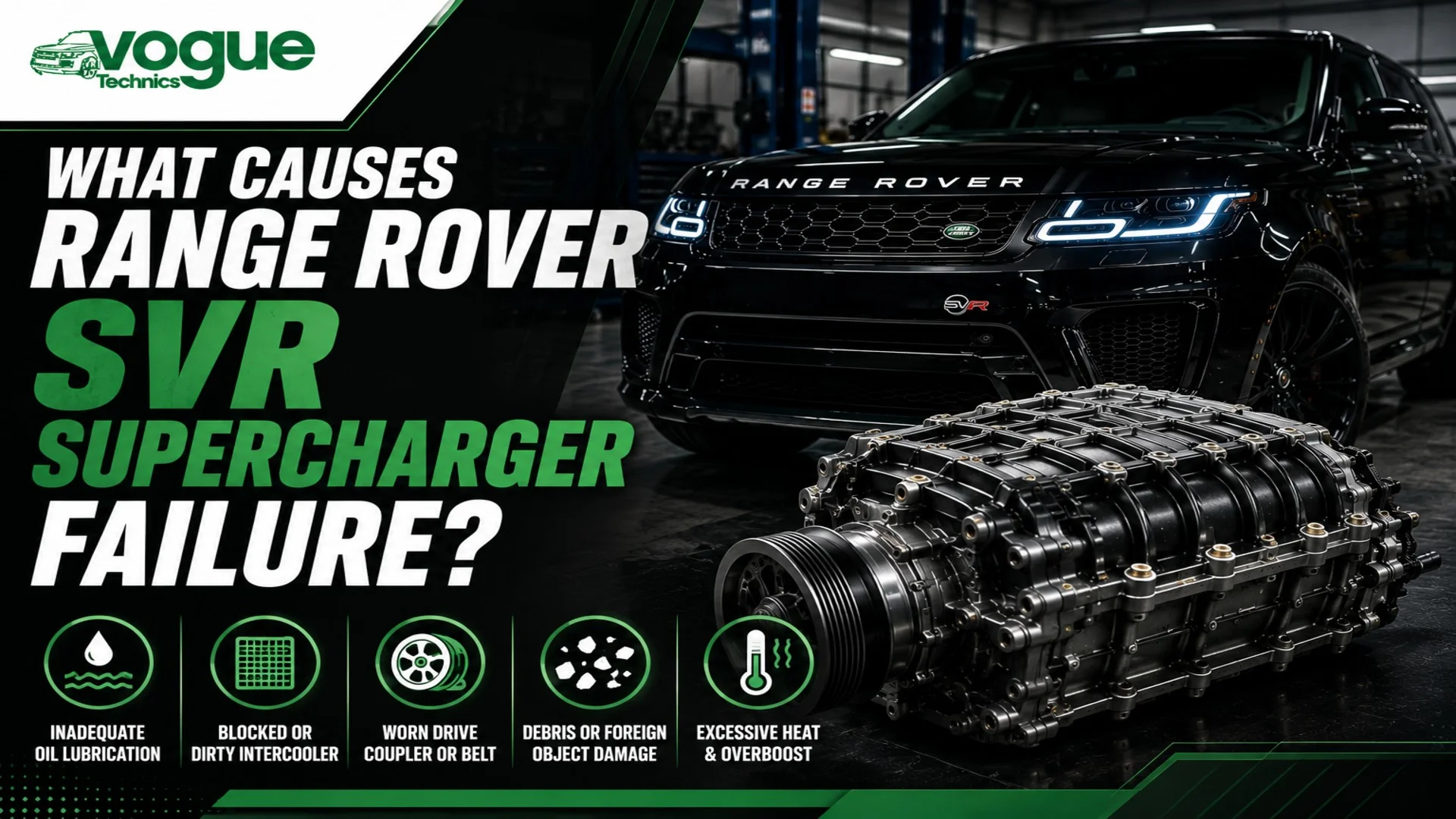
Understanding the "why" behind supercharger failure helps you catch problems earlier and make better decisions about repair versus replacement.
Worn Supercharger Coupler and Isolator Problems
The coupler and isolator sit between the supercharger and its drive mechanism, absorbing vibration and torque. Over time, particularly with spirited driving, which SVR owners are rarely shy about, these components wear and develop play.
A worn coupler typically shows up as a rattle at idle that reduces or disappears once revs climb. It's a relatively contained repair compared to a full supercharger replacement, and catching it early usually prevents further damage to the drive assembly.
Supercharger Bearing Wear and Failure Symptoms
The bearings support the rotor assembly as it spins at very high speed. When they wear, you'll typically notice:
- A grinding or growling noise, often getting worse under load
- Increased whine that doesn't match the engine's usual character
- In advanced cases, physical play or looseness detectable during inspection
Bearing failure is progressive. Left unaddressed, it can lead to more significant internal damage, which is why noise changes shouldn't be brushed off as "just an old car doing old car things."
Belt, Pulley and Boost Leak Issues
Not every supercharger-area problem is the supercharger's fault.
- Drive belt wear causes squealing and, in worse cases, slipping, which directly reduces boost pressure and power.
- Pulley misalignment or damage produces noise and uneven belt wear.
- Boost leaks, from a cracked hose or a loose intake connection, let pressurised air escape before it does its job, causing power loss and sometimes a check engine light without any internal supercharger damage at all.
This is exactly why symptom-only diagnosis is risky, a boost leak and a failing bearing can both produce "reduced power and unusual noise," but the fixes couldn't be more different in cost.
Where Is the Noise Coming From? Quick Reference
Noise or Symptom | Likely Source |
| Light whine, increasing with RPM | Supercharger rotor/bearing wear |
| Metallic rattle at idle | Coupler or isolator |
| Grinding noise | Bearing failure |
| Squealing | Belt or pulley |
| Hissing | Boost or intake leak |
| Coolant smell or overheating | Charge-air cooling system |
How Do You Diagnose a Range Rover SVR Supercharger Fault?
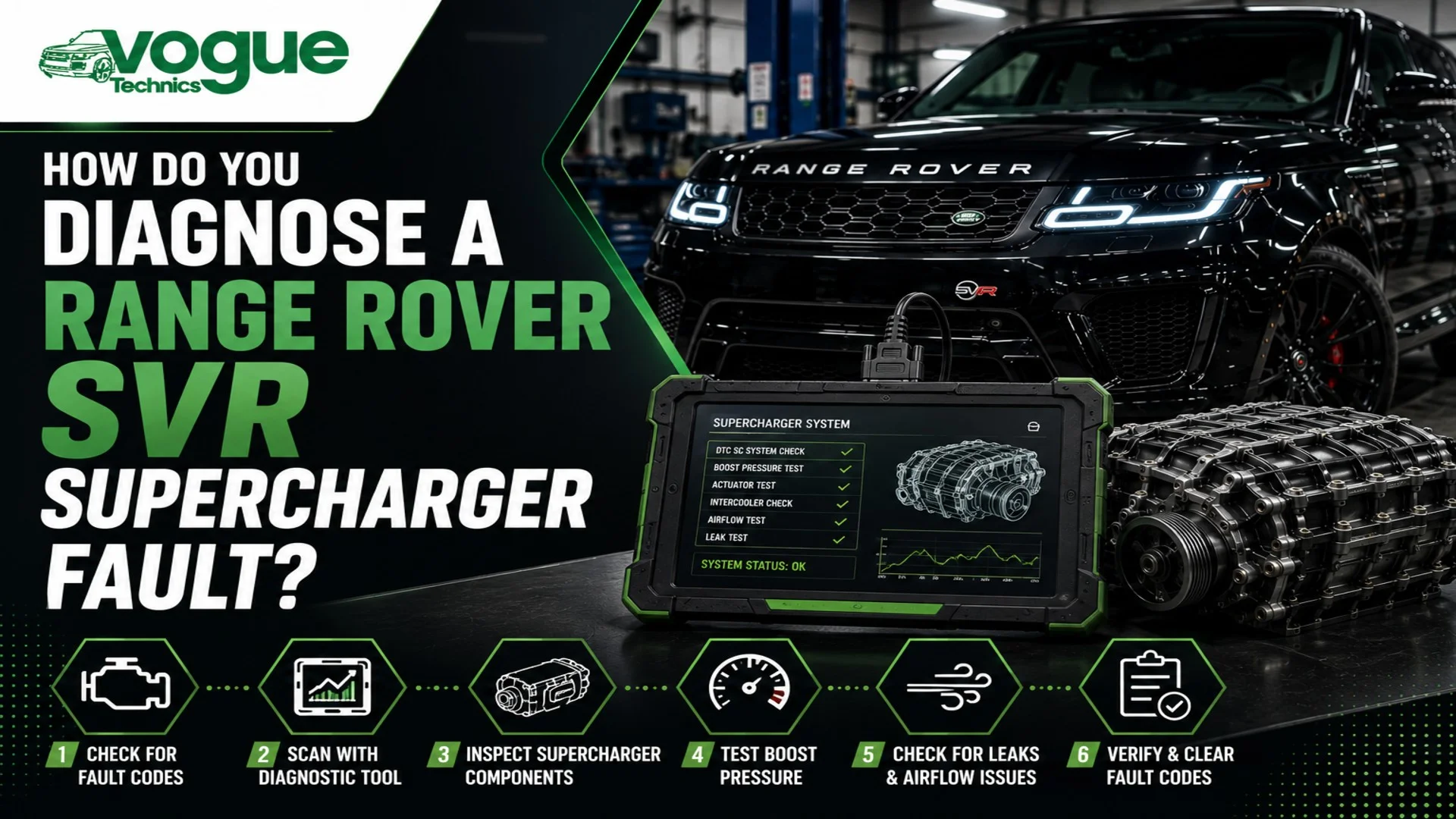
Guessing is expensive on a car like this. A proper diagnostic sequence protects you from paying for a supercharger replacement when the real problem was a £40 hose.
OBD Scan, Fault Codes and Live Data Checks
The first step is always an OBD-II scan for stored diagnostic trouble codes. On an SVR, relevant codes can relate to boost pressure, lean intake conditions, misfires, or general engine performance faults.
It's important to say this clearly: a fault code doesn't automatically mean the supercharger has failed. Boost-related and lean-mixture codes are frequently caused by intake leaks or sensor faults rather than internal supercharger wear. Live data, watching boost pressure, fuel trims, and intake readings in real time while the engine runs, tells a much fuller story than a code alone.
Boost Pressure Testing and Smoke Testing for Intake Leaks
Once codes and live data point toward a boost or performance issue, the next step is physical testing:
- Boost pressure testing confirms whether the supercharger is actually building the pressure it should under load.
- Smoke testing the intake system reveals leaks that wouldn't otherwise be visible, a cracked hose or loose clamp will show smoke escaping under light pressure.
- Visual inspection of the belt, pulley, coupler, and accessible housing catches obvious wear before anything gets dismantled.
Only once mechanical wear inside the supercharger itself is confirmed, rather than assumed, does it make sense to talk about rebuild or replacement.
Repair or Replace? How to Decide What Your SVR Needs
This is the question that matters most once a fault is confirmed, and the honest answer is: it depends on which component has failed and how far the wear has progressed.
When a Supercharger Rebuild Is Enough
A rebuild, replacing worn bearings, coupler, or isolator while reusing the housing and rotor assembly, is often the right call when:
- The core rotor assembly is still in good condition
- Wear is isolated to bearings, coupler, or seals
- The fault was caught early, before secondary damage occurred
This route is typically more cost-effective and faster than a full unit replacement.
When Complete Replacement Makes More Sense
Full replacement, with either a reconditioned or new unit, tends to be the better path when:
- The rotor housing itself is damaged
- Wear has progressed to the point of contamination or secondary internal damage
- The car's usage or mileage makes a reconditioned unit a more durable long-term investment than a partial repair
A reconditioned supercharger, properly sourced and tested, can offer a strong middle ground between cost and long-term reliability compared to a brand-new unit.
Range Rover SVR Supercharger Repair Costs & Services at Voguetechnics, Grays
How Much Does Range Rover SVR Supercharger Repair Cost in the UK?
Costs vary significantly depending on what's actually wrong, so treat any flat figure with caution. As a general guide:
- Coupler or isolator replacement sits at the lower end of the cost scale, a contained job with parts and labour rather than a full strip-down.
- Bearing replacement costs more, since it usually involves partial disassembly of the supercharger unit.
- Belt and pulley replacement is comparatively affordable and often resolves squealing complaints entirely.
- Boost leak repairs can range from a simple hose replacement to more involved intake work, depending on where the leak sits.
- Full supercharger replacement, whether reconditioned or new, represents the highest cost bracket but also the most complete fix for advanced wear.
The only reliable way to know which bracket applies to your SVR is a proper diagnostic, which is exactly where we'd start.
Why Choose Voguetechnics for Your Range Rover SVR
We work on Range Rover, Range Rover Sport, and Jaguar SVR models day in and day out at our Grays, Essex workshop, with a specific focus on the AJ133 5.0-litre supercharged V8 and its Eaton TVS supercharger. That focus matters, this isn't a generic engine, and generic diagnosis leads to generic (and often wrong) conclusions.
When your SVR comes to us, we don't jump straight to parts. We run OBD diagnostics, check live data, and where needed, carry out boost and smoke testing to confirm exactly where a fault sits before recommending any repair. If a rebuild will genuinely solve the problem, we won't push you toward a full replacement, and if replacement really is the right call, we'll explain why, in plain terms.
We supply and fit reconditioned AJ133 superchargers, carry out coupler, bearing, belt, and pulley repairs, and handle the full diagnostic-to-repair journey for Range Rover and Jaguar SVR owners across Essex and the wider UK.
Frequently Asked Questions
Is the Range Rover SVR supercharger reliable?
Generally, yes, the Eaton TVS unit is a robust piece of engineering. Most failures relate to wearable components like the coupler, isolator, or bearings rather than catastrophic internal failure, and many issues are caught and resolved before they become serious.
How long does an SVR supercharger typically last?
There's no fixed mileage figure, since it depends heavily on driving style, maintenance history, and how early issues are caught. Regular inspection and addressing noise changes promptly go a long way toward maximising lifespan.
Can I still drive my SVR with a failing supercharger?
For minor noise issues, short-term driving is usually fine, but we'd recommend getting it checked promptly. If you're experiencing significant power loss, overheating, or a persistent warning light, it's best to get the car diagnosed before continuing to drive it hard.
Can a bad supercharger cause a check engine light?
Yes, though not always directly, boost-related fault codes, lean mixture codes, and misfire codes can all be triggered by supercharger issues, intake leaks, or cooling faults. This is why code reading alone isn't enough; live data and physical testing confirm the actual cause.
Is a reconditioned supercharger a reliable option?
Yes, when properly sourced and tested. A quality reconditioned unit can offer a durable, cost-effective alternative to a brand-new supercharger, particularly for owners who want a complete fix without the premium price tag of a new unit.
The Bottom Line
Supercharger problems on a Range Rover SVR are rarely as simple as "the supercharger is dying." More often than not, the real cause is a worn coupler, a tired belt, or a boost leak that's mimicking something far more serious, and the only way to know for sure is a proper diagnostic sequence rather than a guess based on noise alone.
If your SVR has started sounding different, losing power, or throwing warning lights, don't wait for it to get worse. Get in touch with our team at Voguetechnics in Grays, Essex, we'll diagnose the actual cause, walk you through your options honestly, and get your Range Rover or Jaguar SVR back to the way it's meant to feel.