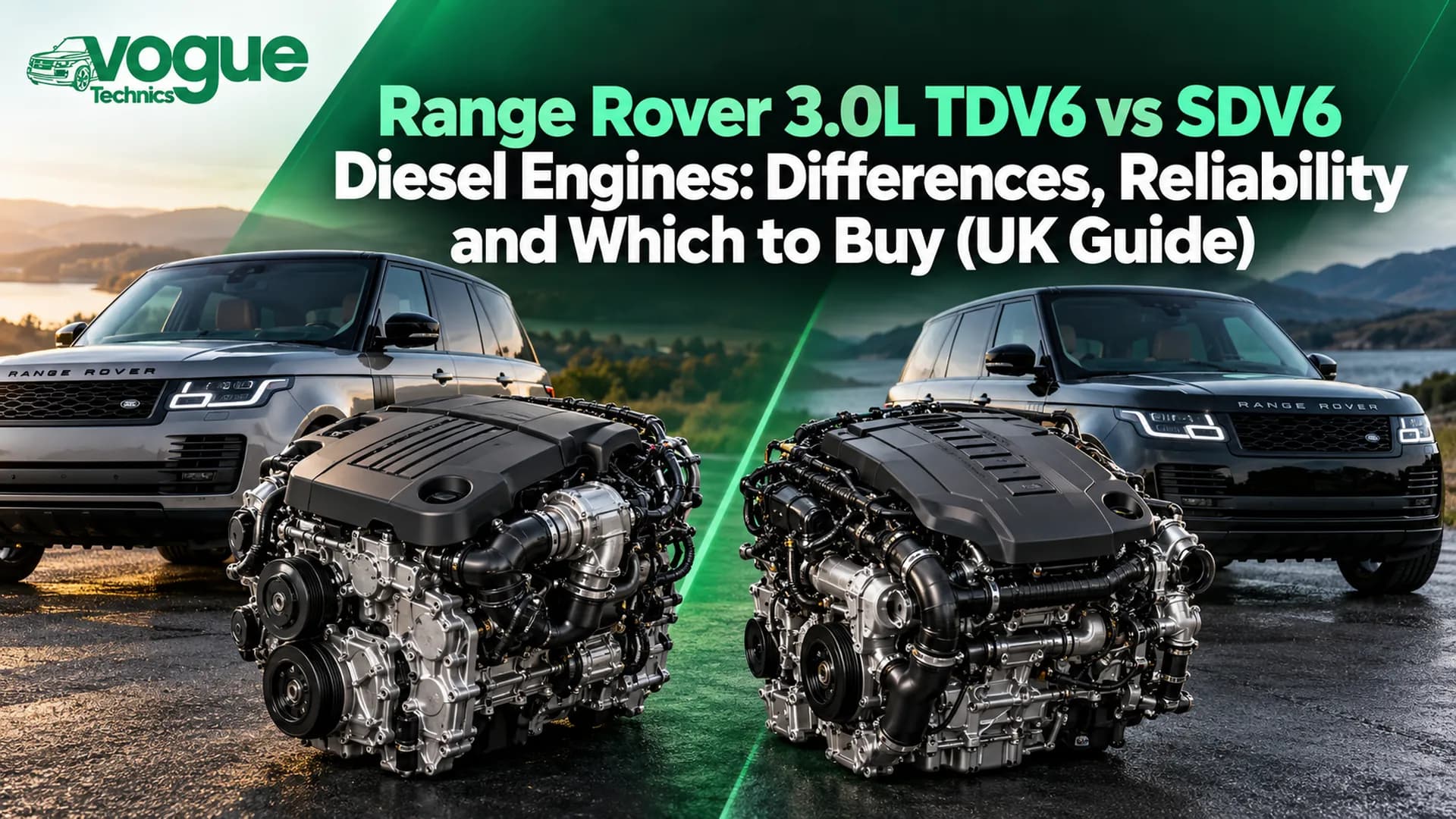
Range Rover 3.0L TDV6 vs SDV6 Diesel Engines: Differences, Reliability and Which to Buy (UK Guide)
You've found a Range Rover, Range Rover Sport or Discovery 4 you like. The listing says "3.0 TDV6," the one down the road says "3.0 SDV6," and the price gap doesn't explain much. So which engine do you want, and which one could cost you £8,000 in year two?
Here is the short answer. The 3.0 TDV6 and SDV6 are the same 3.0-litre V6 diesel family (engine code 306DT). The real differences are the turbo setup, the power output and the model year. The reliability risks, mainly timing chain wear, injector seal leaks, oil condition and turbo or EGR faults, apply to both. How the car was serviced matters more than which badge it wears.
This guide comes from the experience of the team at Vogue Technics in Grays, Essex, who see these engines on the bench and on the ramp. It covers what separates the two engines, where they go wrong, what to check before buying, and what your options are if one fails.
What Is the Difference Between the 3.0L TDV6 and SDV6 Engines?
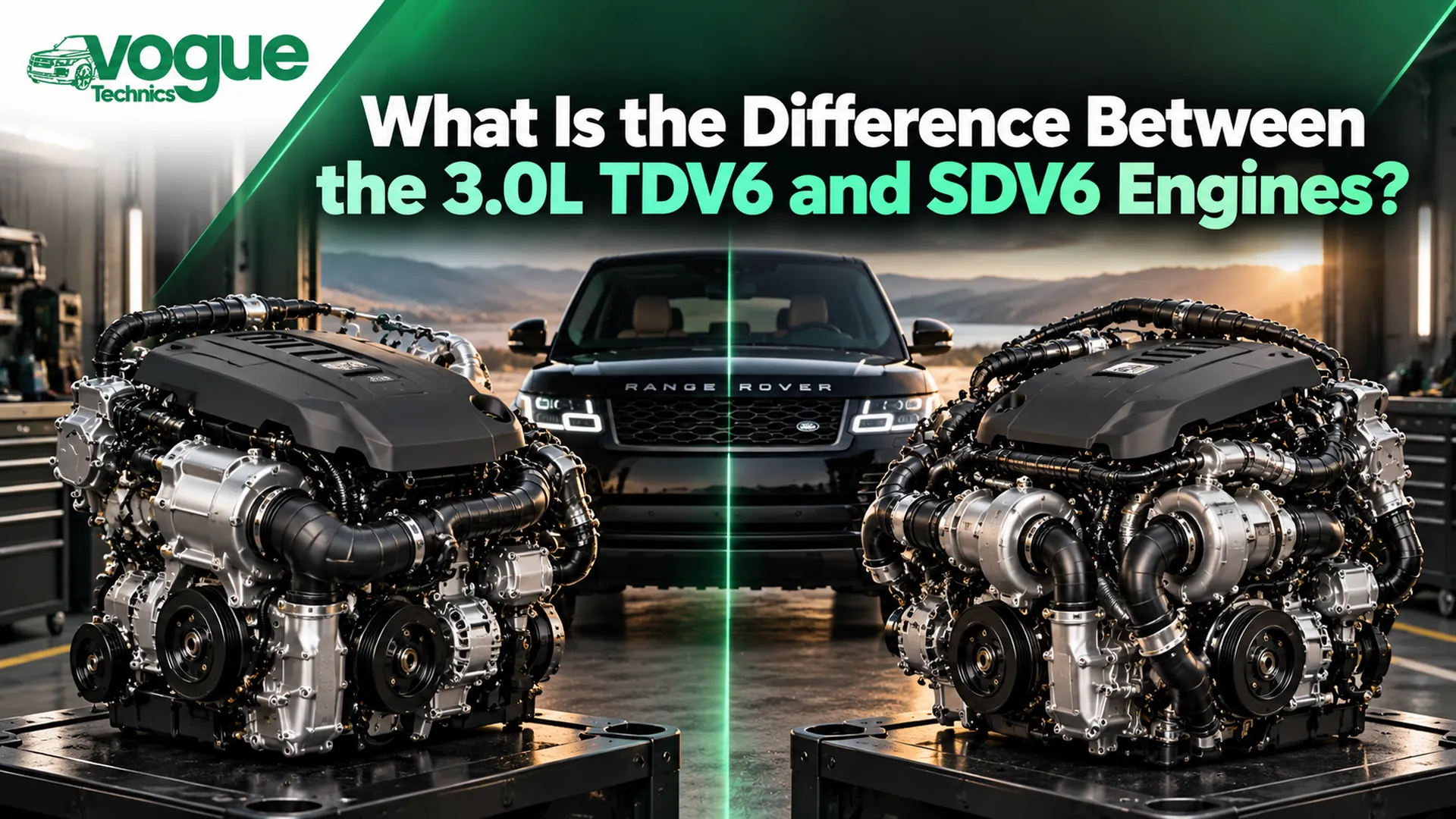
Land Rover's badging confuses plenty of buyers. In practice, TDV6 and SDV6 are model-level labels on one engine family, not two separate engines.
Is the 3.0 TDV6 the Same Engine as the 3.0 SDV6 (306DT)?
Largely, yes. Both use the 306DT 3.0-litre V6 diesel, developed within the Ford/PSA "Lion" engine family and used across Land Rover and Jaguar. You'll find it in:
- Range Rover (L322 and L405)
- Range Rover Sport (L320 and L494)
- Land Rover Discovery 3 and Discovery 4
- Jaguar XF, XJ and F-Pace (in various tunes)
Both engines share the same block, the same rear-mounted timing chain layout and the same ZF automatic gearbox pairing, including the later ZF 8HP. The "SDV6" label generally means the higher-output version. The "TDV6" generally means the lower-output version. Because Land Rover changed the tune and hardware more than once between 2009 and the mid-2010s, always check the specific year and power figure rather than trusting the badge alone.
TDV6 vs SDV6 Power, Torque, Fuel Economy and Towing: Which Performs Better?
The SDV6 is the stronger performer, but the gap is smaller in real driving than on paper. Treat the table below as a guide only, because outputs vary by model, model year and market.
Feature | 3.0 TDV6 | 3.0 SDV6 |
| Engine code | 306DT | 306DT |
| Typical turbo setup | Single turbocharger | Sequential twin turbo |
| Typical power | Roughly 245 to 258 PS | Roughly 255 to 306 PS |
| Torque | Around 600 Nm | Around 600 Nm or more |
| Acceleration | Strong for its size | Noticeably quicker from a roll |
| Towing | Up to 3,500 kg on most models | Up to 3,500 kg on most models |
| Fuel economy | Slightly better in steady driving | Similar, can dip if driven hard |
The torque figures are close, which is why both engines tow so comfortably. The SDV6 pulls harder through the mid-range and feels more effortless when overtaking, while the TDV6 still feels quick and settled on long motorway runs. In real-world use, expect high 20s to low 30s mpg from either engine. Your driving style and the vehicle's weight affect that more than the badge does.
Single-Turbo vs Twin-Turbo Configuration: Why It Changes the Driving Experience
A single variable-geometry turbo is simpler. It has fewer parts to fail and a lower repair bill if something goes wrong.
The SDV6's sequential twin-turbo setup uses a smaller turbo for low-rpm response and a larger one for top-end power. The result is less lag, a smoother surge of power and a more refined feel. The trade-off is more plumbing, more actuators and more components that can age, such as turbo actuators, vanes, intercooler pipes and the intake manifold flaps.
If you tow regularly or want effortless overtaking, the twin-turbo SDV6 is the better fit. If you prefer simplicity and lower running costs, a well-maintained TDV6 makes sense.
Are the TDV6 and SDV6 Reliable? Common Problems and Failure Points
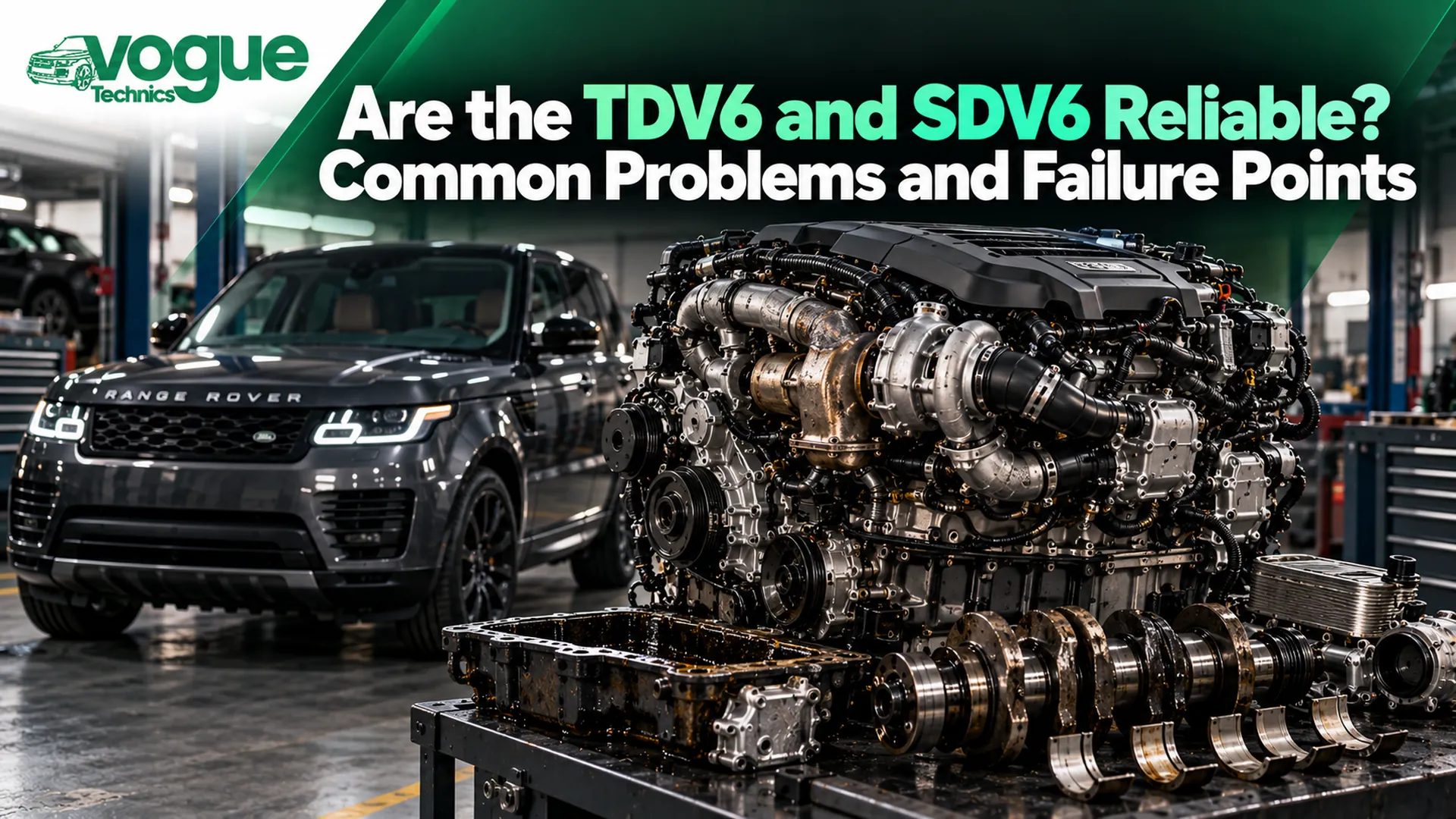
Neither engine is bad. Both are capable and long-lived when cared for. They also punish neglect, and they don't forgive skipped oil changes. Here are the faults we see most often.
What Problems Does the 3.0 TDV6 and SDV6 Have? (Crankshaft, Timing Chain, Oil Pump)
The most common issues fall into a few groups.
Timing chain, tensioner and guides. The timing chain sits at the rear of the engine, so a failing tensioner or worn guide is a major job. Chain stretch usually shows up as a rattle or a fault code well before total failure. Ignore it and the damage multiplies.
Oil pressure, oil pump and crankshaft bearings. Poor lubrication is what takes these engines out. Dirty or overdue oil can starve the main bearings and damage the crankshaft. Bottom-end failures are better documented on the older 2.7 TDV6, but they are not unknown on the 3.0, and they are expensive when they happen. Cold-start rattle and a flickering oil pressure warning should never be dismissed.
Injector seal leaks. Worn seals can let fuel and combustion gases escape around the injectors. This is a recognised problem on the SDV6 and the TDV6 alike. Left unaddressed, it can contaminate the oil, leave carbon deposits and, in the worst cases, create a fire risk. If you smell diesel in the engine bay, act quickly.
Turbocharger, actuator and intake issues. Sticking turbo actuators, worn vanes, split intercooler hoses and split intake manifolds all cause power loss. Fault codes such as P1247 or P0488 often point toward these areas.
EGR valve, EGR cooler and DPF. Short urban trips clog the EGR system and the diesel particulate filter (DPF). Failed regeneration cycles lead to warning lights and restricted performance.
Warning Signs Your 3.0 Diesel Needs Attention
Look out for any of the following:
- Cold-start rattle or ticking from the engine
- Knocking under load
- Limp mode or "restricted performance" messages
- Engine warning light with stored fault codes
- Noticeable loss of power or hesitation
- Rough idle or misfire
- Excessive smoke or sudden poor fuel economy
- A low oil pressure warning, even briefly
- Coolant loss without a visible leak
Any one of these deserves a proper diagnostic scan. Several at once usually means you should stop driving and have it inspected.
How Long Does a 3.0 SDV6 Engine Last, and What Mileage Is Too High?
There is no magic figure. Well-maintained 3.0 diesels regularly pass 150,000 miles, and plenty go further. Neglected ones can fail much earlier.
Rather than fixate on mileage, we'd look at three things:
- Service history showing regular oil changes (ideally every 6,000 to 10,000 miles rather than the longer official intervals)
- Timing chain evidence: has it been inspected or replaced, and is there any noise?
- Driving pattern: motorway miles are kinder than short, cold urban trips
A 110,000-mile car with full history is usually safer than a 70,000-mile car with gaps.
Which Is More Reliable, TDV6 or SDV6?
Neither has a clear reliability advantage. The TDV6's simpler single-turbo setup means fewer parts to fail, while the SDV6's twin-turbo hardware adds more components that can age. The core weaknesses (timing chain, oil condition, injector seals) are shared. Buy the car with the better history, not the better badge.
TDV6 vs SDV6: Which Should You Buy, and What If the Engine Fails?
Is a Range Rover 3.0 Diesel Worth Buying? What to Check Before You Commit
Yes, if you buy carefully. These engines offer strong torque, good towing ability and long-legged motorway comfort. A bad example, though, can cost more than the savings you made at purchase.
Before you hand over any money, work through this checklist.
Pre-purchase inspection checklist:
- Engine oil: check colour, level and smell. Black, sludgy or fuel-smelling oil is a red flag.
- Cold start: insist on seeing the engine start from cold. Listen for rattle or chain noise in the first few seconds.
- Fault codes: a full diagnostic scan, not just a glance at the dashboard.
- Service history: dated stamps or invoices showing regular oil changes.
- Turbo behaviour: smooth boost with no whistle, hesitation or smoke.
- Injector area: look for oily residue or fuel smell around the injectors.
- Cooling system: check for coolant loss, which can point to EGR cooler problems.
- DPF and EGR: ask how the car has been used, and whether regeneration issues have appeared.
If you're buying from a private seller or a dealer who can't answer these questions, take a specialist along or book an independent inspection. A couple of hours with an expert can save thousands.
Repair, Rebuild or Replace: What Does a 3.0 Diesel Engine Cost in the UK?
When a 3.0 diesel fails, you generally have three options:
Option | Best when | Typical consideration |
| Repair | The fault is isolated (injector seals, turbo, EGR, timing chain caught early) | Lowest cost, fastest turnaround |
| Rebuild | The block is sound but internals are worn | Moderate cost, depends on parts needed |
| Reconditioned replacement | Bottom-end damage, crankshaft or bearing failure, or widespread wear | Higher upfront cost, but often the best long-term value and usually comes with a warranty |
Costs vary widely depending on the vehicle, the extent of the damage and the parts required. As a broad guide, a major engine job on a 3.0 diesel runs into the thousands of pounds, which is why diagnosing early and servicing on time pays off.
Here is a simple rule of thumb. If repairing the engine costs more than half the value of the car, a reconditioned replacement is usually the smarter long-term choice. If the rest of the vehicle is in good shape, a quality reconditioned unit with a warranty can give you years of further use.
Need a straight answer on your engine? The team at Vogue Technics in Grays, Essex can diagnose the fault and explain your options honestly, whether that means a repair, a rebuild or a reconditioned replacement. We supply and fit locally and can arrange delivery across the UK. Enter your vehicle registration for a quote, or call us to talk it through.
3.0 TDV6 and SDV6 FAQs
Is the Range Rover 3.0 SDV6 reliable?
Yes, if maintained properly. It's a capable, long-lived engine, but it relies on clean oil, healthy timing chain components and good injector seals. Skipped services are the main cause of early failure.
Is the 3.0 TDV6 a good engine?
Yes. It offers strong torque and good economy, and its simpler single-turbo layout can mean fewer parts to go wrong. It shares the same core weaknesses as the SDV6, so condition and history matter more than the badge.
What is the difference between TDV6 and SDV6?
They are variants of the same 3.0-litre V6 diesel (306DT). The SDV6 is generally the higher-output, twin-turbo version, while the TDV6 is the lower-output version, typically with a single turbo.
Does the SDV6 have timing chain problems?
It can. The timing chain is at the rear of the engine, so wear in the chain, tensioner or guides is costly to fix. Rattling or fault codes should be investigated early.
How often should a 3.0 SDV6 be serviced?
Many specialists recommend an oil and filter change every 6,000 to 10,000 miles or annually, which is more frequent than extended manufacturer intervals. Fresh oil is the cheapest protection for the bottom end.
What mileage is too high for a Range Rover SDV6?
There's no fixed limit. A well-serviced example can pass 150,000 miles without major trouble, while a neglected one can fail much sooner. Service history is a better guide than the odometer.
Can a 3.0 SDV6 engine be rebuilt?
Often, yes, depending on the damage. A sound block can be rebuilt, but severe crankshaft or bearing damage often makes a reconditioned replacement the more cost-effective route.
How can I prevent SDV6 or TDV6 engine failure?
Change the oil more often, use the correct specification, act on warning signs quickly, avoid constant short trips, and have the timing chain, injector seals and EGR system checked as the car ages.
Final Thoughts: Which 3.0 Diesel Is Right for You?
The TDV6 and SDV6 are close relatives. Choose the SDV6 if you want stronger mid-range pull and more refinement. Choose the TDV6 if you value simplicity and slightly lower running costs. In both cases, the best engine is the one with the better service history.
Buy carefully, service often and never ignore a warning light. If you're weighing up a purchase or facing an engine problem right now, Vogue Technics can help.
Contact Vogue Technics in Grays, Essex today for an honest diagnosis, a clear quote and a solution that fits your Range Rover.