
Td5 Engine Problems: Common Faults, Symptoms and Fixes

The Td5 has a strong reputation, and it deserves it. Its faults are well known, though, and a few of them can wreck the engine with little warning.
The Td5 engine problems that matter most are:
- oil soaking through the injector wiring loom into the ECU;
- the oil pump drive coming loose;
- the cylinder head shifting on worn plastic dowels;
- diesel leaking into the sump.
Most other faults, such as the crank pulley squeal, coolant drips and the wastegate modulator, are cheaper to fix if they are dealt with early.
This guide ranks the faults by seriousness and explains what to check.
What Is the Td5 Engine?
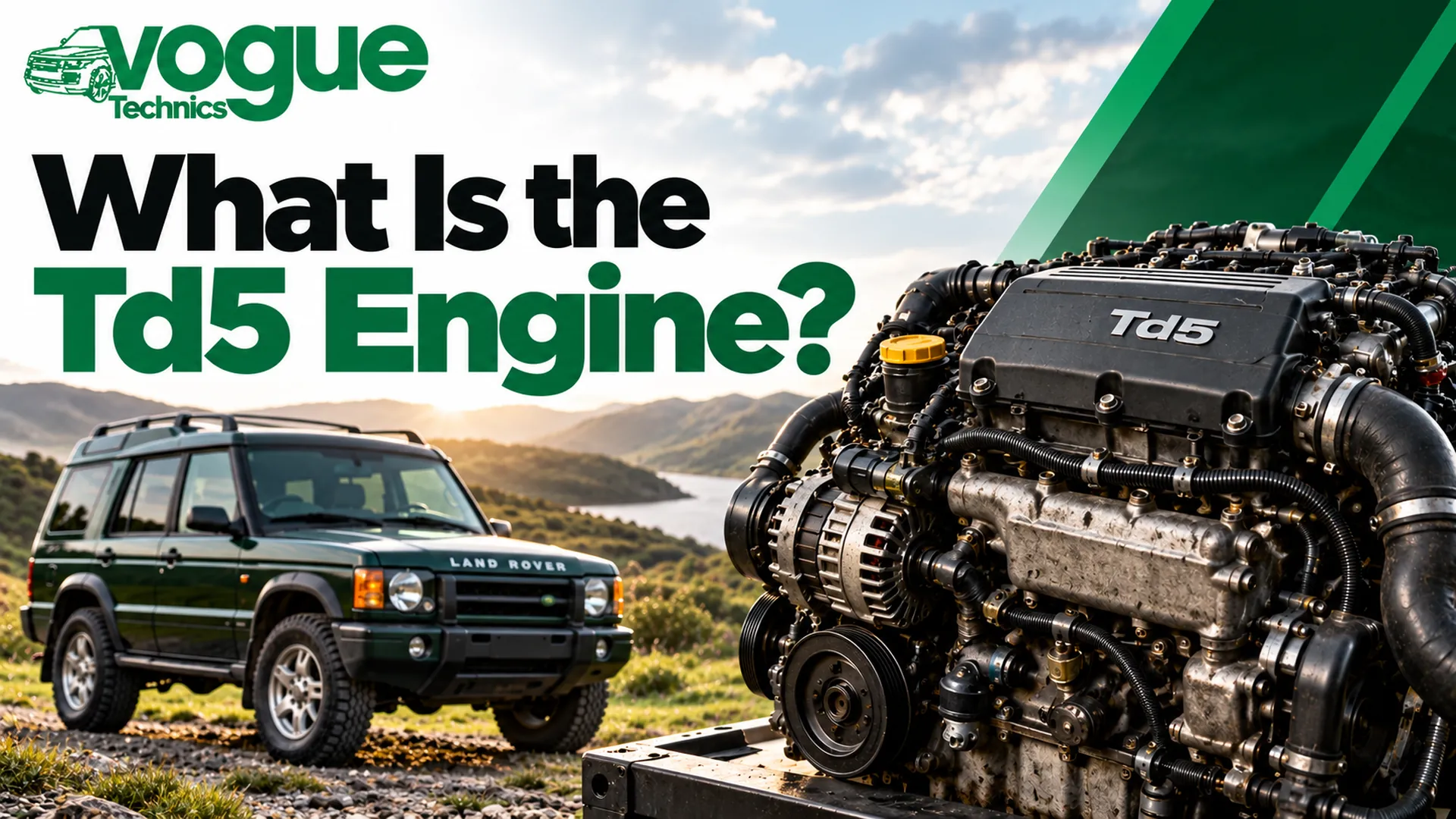
The Td5 is Land Rover's 2.5-litre five-cylinder turbodiesel. It uses electronically controlled unit injectors and a timing chain. It replaced the 300Tdi and was itself replaced by the Puma TDCi in the Defender.
10P vs 15P and Where It Was Fitted
Detail | |
| Vehicles | Defender (about 1998–2007) and Discovery 2 (about 1998–2004) |
| Layout | 2.5-litre, five cylinders, turbocharged diesel |
| Fuel system | Unit injectors controlled by the engine ECU |
| Timing drive | Chain |
| Versions | Early "10P" and later "15P" engines, which differ in emissions calibration and some components |
The 10P and 15P versions are not interchangeable in every respect. Their ECUs and some parts differ. If you are replacing an engine or ECU, confirm the code on your vehicle first.
The faults described below apply broadly to both versions.
Vogue Technics has a separate guide to the Td5 timing chain, and a wider history of Defender engines.
The Most Common Td5 Engine Problems
Serious Faults That Can Destroy the Engine
1. Oil pump drive failure
- What happens: the oil pump sprocket is held by a single bolt and located by a small plastic dowel. If the dowel breaks down and the bolt backs out, the sprocket can spin without driving the pump (JLR Engines).
- Symptoms: sudden loss of oil pressure, knocking or seizure, often with little or no warning beforehand.
- Fix: specialists recommend an upgraded bolt and locking arrangement as a preventative job. It is worth checking whether yours has already been done.
2. Diesel in the oil (injector washers or a cracked fuel rail)
- What happens: the fuel rail on the Td5 runs inside the cylinder head. Leaking injector sealing washers, or a cracked rail, can let diesel into the sump (K Motors).
- Symptoms: the oil level rises on the dipstick and the oil smells of diesel.
- Why it's dangerous: diluted oil lubricates poorly. In severe cases an overfilled sump can let the engine run on its own oil and over-rev ("runaway").
- Fix:
- Leaking injector washers: replace the washers.
- Cracked fuel rail: a replacement cylinder head or engine is needed.
3. Head gasket failure and cylinder head "shuffle"
- What happens: early engines used plastic locating dowels for the cylinder head. These can break, which lets the head shift. Separately, the head can crack between the valve seats, and plastic coolant pipes under the inlet manifold can split.
- Symptoms:
- coolant loss with no visible leak;
- white, sweet-smelling smoke;
- a pressurised expansion tank;
- overheating.
- Fix: take the head off and pressure-test it, refit it with metal dowels and new bolts, and replace any brittle coolant pipes. Vogue Technics carries out head gasket replacement with pressure testing.
Common Faults That Are Cheaper to Fix
4. Oil in the injector wiring loom
- What happens: the injector loom runs through the rocker cover. When its seals harden, hot engine oil can wick along the wires to the "red plug" connector, and in time into the ECU.
- Symptoms:
- misfire, rough running and hard starting;
- limp mode;
- sometimes unrelated warning lights.
- Fix: replace the loom and seals, clean the connectors, and check the ECU for oil. K Motors advertises loom replacement from £95, including parts, labour and VAT. That figure is not a Vogue Technics price.
5. Crankshaft pulley damper
- What happens: the rubber in the pulley damper wears.
- Symptoms: a squeal when the engine stops, and later a rattle at idle.
- Fix: replace the pulley before it breaks up.
6. Coolant drips from the fuel cooler O-ring
- What happens: a compressed O-ring on the fuel cooler end cap lets coolant out.
- Symptoms: small drips of pink coolant.
- Fix: replace the O-ring.
7. Turbo overboost and wastegate modulator
- What happens: a faulty wastegate modulator lets boost run too high. The ECU then cuts fuel to protect the engine (Motor Hungry).
- Symptoms: power drops out briefly under load.
- Fix: the modulator is an inexpensive part and is usually replaced.
8. Oil and fuel leaks
- Common leak points: the rocker cover, the sump, the turbo oil feed seals and the fuel pressure regulator.
- Why it matters: oil dripping onto the exhaust is a fire risk, so trace and repair leaks promptly.
Is the Td5 a Good Engine?

Yes. It is generally considered tough and capable of high mileages when maintained. Its known faults are well documented and mostly preventable.
The bigger risk is age. Most Td5s are now more than 18 years old, so seals, wiring and cooling parts are often original and tired.
Fault | Severity | Typical action |
| Oil pump drive | Critical | Preventative upgrade; stop immediately if oil pressure warning |
| Diesel in oil | Critical | Stop driving; diagnose washers vs fuel rail |
| Head / head gasket | High | Pressure test; repair before overheating damage |
| Injector loom oil | Medium | Replace loom; check ECU |
| Pulley, O-ring, modulator, leaks | Low–medium | Repair at next opportunity |
If the engine has already suffered serious damage, an engine rebuild may be viable. A rebuild depends on the block and crankshaft being salvageable.
Warning Signs, Prevention and When to Stop Driving
Stop driving immediately and arrange recovery if you see:
- an oil pressure warning;
- knocking;
- a rising oil level, or a diesel smell in the oil;
- milky residue in the oil;
- overheating;
- the engine racing on its own. If this happens, do not try to keep driving.
Book an inspection if you notice:
- misfire or limp mode;
- oil at the red plug;
- slow coolant loss;
- a squeal when the engine stops.
Prevention:
- Change the oil on time and check its level regularly.
- Inspect the red plug connector for oil.
- Replace ageing coolant pipes.
- Confirm whether the oil pump drive upgrade has been done.
A specialist engine health check is also worthwhile before buying a Td5 vehicle.
Frequently Asked Questions
Td5 Engine Problems FAQs
What are the common Td5 engine problems?
The main faults are oil in the injector wiring loom, oil pump drive failure, head gasket and cylinder head problems, diesel leaking into the oil, crank pulley wear, coolant O-ring leaks and wastegate modulator faults.
Is the Td5 engine reliable?
It is generally regarded as a durable engine. Many Td5s have covered high mileages. Reliability now depends mostly on whether the known weak points have been addressed and how well the engine has been maintained.
What are the Td5 15P engine problems?
The 15P shares the main Td5 faults: loom oil, the oil pump drive, the cylinder head, and fuel leaking into the oil. Its ECU and calibration differ from the 10P, so confirm compatibility before swapping an engine or ECU.
Why is the oil level rising on my Td5?
Diesel is probably leaking into the sump, usually through injector washers or a cracked fuel rail. Stop driving and have it diagnosed promptly.
Does the Td5 have a timing belt or chain?
A chain. It does not have a fixed replacement interval like a belt, but it should be checked if it becomes noisy.
If your Defender or Discovery 2 Td5 shows any of these symptoms, contact Vogue Technics on 01375 531355. Please give your registration, mileage, symptoms and any fault codes.