SVR Supercharged Engine Reliability: How Long the AJ133 V8 Really Lasts (UK Owner's Guide)

There's a moment every prospective SVR owner faces. You've found the car, 575bhp, that unmistakable exhaust note, a price that suddenly looks very reachable on the used market. Then you open the forums, and the horror stories start: seized engines, £15,000 rebuild quotes, coolant leaks that "kill them all eventually."
Here's the honest answer, from a workshop that sees these engines on the ramp week in, week out: the SVR's supercharged engine is more reliable than its reputation suggests, but only when it's maintained properly. The AJ133 5.0-litre V8 is a strong, well-engineered unit with a handful of known weak points. Owners who understand those weak points and stay ahead of them routinely see six-figure mileages. Owners who skip services and ignore early warning signs are the ones writing those forum posts.
At Vogue Technics in Grays, Essex, we've stripped, diagnosed, rebuilt and replaced enough of these engines to know exactly where they fail, why they fail, and, more importantly, how to stop yours joining the list. This guide covers all of it.
Is the SVR Supercharged Engine Reliable? What Owners Should Actually Expect

Let's set realistic expectations before getting into specifics.
The Range Rover Sport SVR isn't a Toyota Corolla, and nobody buys one expecting Corolla running costs. It's a 2.3-tonne performance SUV making supercar power. That means heat, stress, and complexity, and complexity always brings maintenance demands.
But "demanding" isn't the same as "unreliable." The distinction matters. Most of the catastrophic failures we see share a common thread: a patchy maintenance history, a missed coolant leak, or an oil service stretched well past its interval. A cared-for SVR is a genuinely dependable daily driver. A neglected one is a rolling invoice.
What Engine Does the Range Rover SVR Have?
Every Range Rover Sport SVR runs Jaguar Land Rover's AJ133 engine, a 5.0-litre supercharged V8 developed in-house (no, it's not a BMW engine, despite the persistent myth). The same basic unit powered the Jaguar F-Pace SVR, XFR and XJR, which is why parts knowledge transfers well across the JLR performance range.
Key specifications at a glance:
Specification | Detail |
| Engine code | AJ133 |
| Configuration | 5.0L V8, direct injection |
| Forced induction | Eaton TVS supercharger (twin-vortex) |
| Power (SVR) | 542–575 bhp depending on year |
| Oil capacity | Approx. 7.7 litres |
| Recommended oil | 5W-20 (JLR specification) |
| Fuel requirement | Premium unleaded, 97+ RON |
The Eaton TVS supercharger deserves a special mention. Unlike turbochargers, it's a mechanically simple, belt-driven unit with no exhaust-side heat stress, and it's genuinely one of the most durable parts of the whole engine. Supercharger failures are rare; it's usually the belt, tensioner and pulleys around it that need attention.
How Long Does an SVR Engine Last? Reliability by Mileage
This is the question we get asked most, and it's the one competitor guides almost never answer properly. Engine lifespan isn't a single number, it's a curve, and where your car sits on that curve depends almost entirely on history.
What Happens at 50k, 100k and 150k+ Miles?
0–50,000 miles: The honeymoon period, mostly. The main jobs here are consumables, supercharger belt inspection, spark plugs around the 60k mark, and keeping to strict oil intervals. The one thing to watch even at low mileage is the cooling system, because plastic coolant components degrade with age and heat cycles, not just miles.
50,000–100,000 miles: This is where the AJ133's known issues start appearing. Water pumps typically weep or fail somewhere in this window. Thermostat housings crack. Early signs of timing chain tensioner wear can show up as a brief rattle on cold start. Cars that sail through this band cleanly are almost always the ones on shortened oil intervals with documented coolant system work.
100,000–150,000 miles: Perfectly achievable, we regularly see AJ133s at this mileage running strong compression across all eight cylinders. But by now the cooling system should have been substantially refreshed, and carbon build-up on the intake valves (a direct-injection trait) may be affecting smoothness and economy if it's never been addressed.
150,000+ miles and beyond: Can the AJ133 reach 200,000 miles? Yes, we've seen it. But every high-mileage survivor we've inspected has the same profile: full service history, premium fuel throughout, proactive cooling repairs, and an owner who investigated noises rather than turning the radio up.
What Are the Most Common AJ133 Engine Problems?

Every engine has a failure pattern. Know the AJ133's, and you're ahead of 90% of owners. These are the issues we diagnose most often in the workshop, in rough order of frequency.
Why Does the AJ133 Overheat? Water Pump, Thermostat and Coolant Leaks
If the AJ133 has an Achilles heel, this is it. Cooling system failures cause more AJ133 engine damage than everything else on this list combined.
The engine runs hot by design, a supercharged V8 in a heavy SUV generates enormous thermal load. Over time, that heat attacks the plastic components in the cooling circuit:
- Water pump failure, the most common single fault. It usually starts as a slow weep from the weep hole before the bearing lets go entirely. Caught early, it's a manageable repair; caught late, it means overheating, and overheating means potential head gasket failure or worse.
- Thermostat housing cracks, the plastic housing becomes brittle with age and heat cycling. A hairline crack can dump coolant quickly.
- Coolant pipe and reservoir leaks, various plastic pipes and the coolant reservoir itself are known weak points on higher-mileage cars.
The warning signs are simple: coolant level dropping between checks, the sweet smell of coolant after a drive, temperature gauge creeping above centre, or steam from the engine bay. Never keep driving an SVR that's running hot. Aluminium engines tolerate overheating very poorly, the difference between a £600 water pump job and a £12,000 engine replacement is often just a few miles of "I'll get it home first."
Our standing advice to every SVR owner: check your coolant reservoir weekly. It takes ten seconds and it's the single cheapest piece of preventive maintenance you'll ever do.
Does the AJ133 Have Timing Chain Problems?
Yes, though it's more accurate to say the AJ133 has timing chain tensioner problems, particularly on earlier engines.
The classic symptom is a rattle on cold start that disappears after a second or two. That's the chain running slack before oil pressure builds and takes up the tension. Left alone, tensioner and guide wear accelerates, chains stretch, and valve timing drifts, which the ECU logs as camshaft correlation fault codes long before anything lets go.
Two things make the difference here:
- Oil quality and intervals. Timing chain wear on this engine correlates strongly with extended oil changes. The tensioners are hydraulic; degraded oil is their enemy. We recommend changing the oil every 7,000–8,000 miles with the correct 5W-20 specification, regardless of what the service indicator says.
- Acting on the rattle. A cold-start rattle investigated early means tensioners and guides. Ignored for a year, it can mean chains, sprockets and a much bigger bill, and in the worst neglect cases, valve-to-piston contact.
JLR did improve the timing chain components on later engines, which is one reason post-2016 cars have a stronger reliability record in this area.
Supercharger, Oil Consumption and Carbon Build-Up: What Should You Watch For?
Three smaller issues round out the AJ133's known-fault list. None is usually catastrophic, but each is worth understanding.
Supercharger drive components. The Eaton TVS unit itself rarely fails, we'd rate it among the most reliable parts of the engine. What does wear is the belt, tensioner and idler pulleys driving it. A chirping or whining noise from the front of the engine, especially under load, usually points here. It's a straightforward, inexpensive fix when caught early. The supercharger coupler can also wear over big mileages, producing a light rattle at idle.
Oil leaks and consumption. Common leak points include the valve covers, the vacuum pump gasket and the PCV system. Some oil consumption is normal on a hard-driven supercharged V8, but if you're topping up more than a litre between services, it's worth a proper diagnosis rather than just carrying a bottle in the boot. A failing PCV valve can also cause rough idle and misfires, and it's a cheap fix that's often misdiagnosed as something worse.
Carbon build-up and misfires. Direct injection means fuel never washes over the intake valves, so carbon deposits accumulate over time, typically noticeable from 60k–80k miles as hesitation, rougher cold idle and slightly worse fuel economy. Walnut blasting the intake valves restores things completely. Misfires on this engine otherwise usually trace back to tired ignition coils and spark plugs; if you're chasing a misfire fault code, these are the first suspects, and using premium 97+ RON fuel consistently helps keep combustion clean in the first place.
How Do You Keep an SVR Engine Reliable? Maintenance and Buying Advice
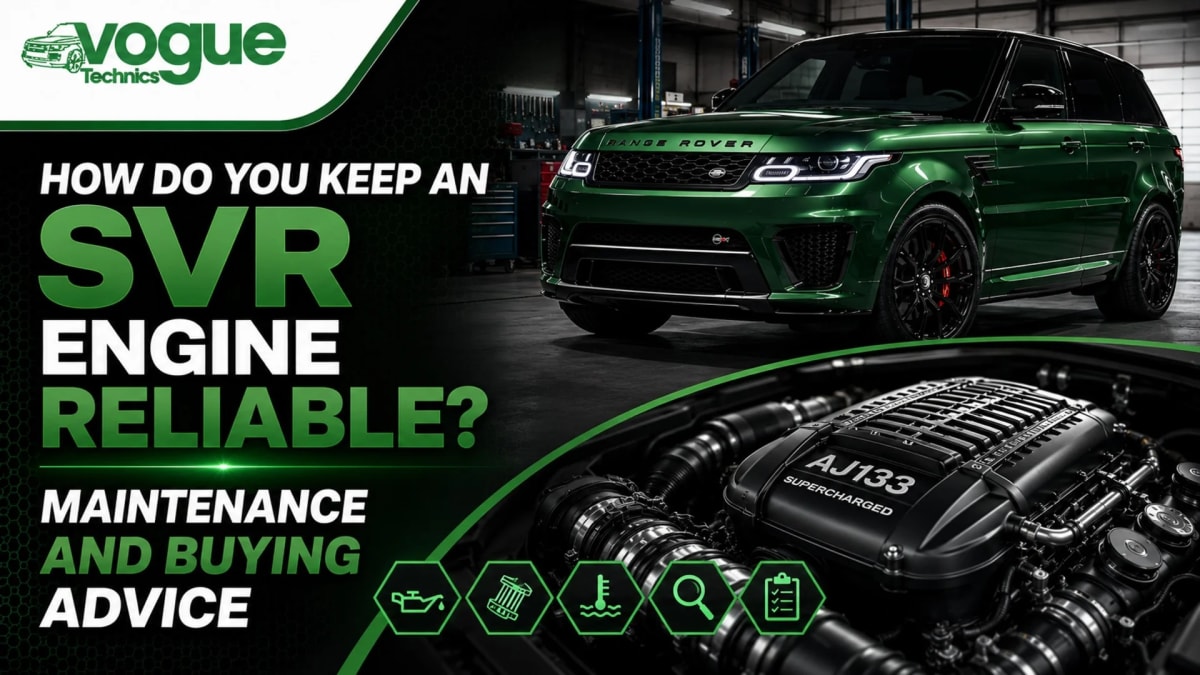
Here's the part that actually determines whether you'll love or regret SVR ownership. The gap between a reliable AJ133 and a problem AJ133 is almost never luck, it's maintenance discipline.
What Does a Preventive Maintenance Schedule Look Like?
Forget the standard JLR service schedule as your only guide. It's written for average use, and nothing about a 575bhp SUV is average. This is the schedule we recommend to our SVR customers, built from what we actually see failing:
- Engine oil and filter, every 7,000–8,000 miles (correct 5W-20 spec, always). This is the single biggest lever you have on timing chain and tensioner life.
- Coolant level check, weekly. Any unexplained drop gets investigated immediately, not "at the next service."
- Cooling system pressure test, annually from 5 years or 50k miles. Finds weeping pumps and cracking housings before they strand you.
- Spark plugs, every 60,000 miles, ignition coils inspected at the same time.
- Supercharger belt, tensioner and pulleys, inspect every service, replace on condition.
- Premium fuel only, every tank. The ECU adapts to lower octane by pulling timing, you lose performance and increase knock risk. It's a false economy.
- Intake carbon clean, around 70,000–80,000 miles, or when drivability symptoms appear.
Follow that list and you've addressed the root cause of nearly every major AJ133 failure we see. It genuinely is that pattern-driven.
Should You Buy a Used Range Rover SVR? Pre-Purchase Checklist
A used SVR can be one of the great performance bargains, depreciation has made cars that cost £100k+ new remarkably attainable. But you're buying the previous owner's habits along with the car.
What to know about model years: the SVR ran from 2015 to 2022 (replaced by the Range Rover Sport SV, with the Defender OCTA carrying the performance-SUV torch on a different engine). Broadly, 2018-onwards facelift cars (575bhp) are the sweet spot, they benefit from running improvements to the timing chain components and cooling parts, plus general production maturity. Early 2015–2016 cars aren't bad buys, but they demand extra scrutiny on chain and cooling history because they carry the earlier-specification parts.
Before handing over money, insist on:
- Full documented service history, with oil changes at sensible intervals, not just stamps. Gaps in history on this engine are a genuine red flag, not a haggling point.
- Evidence of cooling system work on any car past 60k miles. If the water pump and thermostat have never been touched, budget for them immediately.
- A cold start. Arrive before the seller warms it up. Listen for chain rattle in the first seconds and watch for smoke.
- A professional pre-purchase inspection including a fault code scan and ideally a compression test. Stored camshaft correlation or misfire codes tell you things the seller might not.
- Coolant and oil condition checks, mayonnaise under the oil cap or oil traces in the coolant reservoir mean walk away.
The right high-mileage SVR with impeccable history is a better buy than a low-mileage example with gaps. We'd choose an honest 90k-mile car with a folder full of invoices over a 45k-mile mystery every time.
SVR Engine Rebuild vs Replacement: Costs and Expert Help in the UK

Sometimes prevention comes too late, you've bought a car with hidden problems, or a failure has already happened. Here's what the realistic options and numbers look like in the UK.
How Much Does an AJ133 Engine Rebuild or Replacement Cost?
The right route depends on what's failed, the condition of the core engine, and your plans for the car:
Option | Typical UK cost | Best when |
| Targeted repair (pump, tensioners, gaskets) | £500 – £3,000 | Fault caught early, engine internals healthy |
| Full engine rebuild | £7,000 – £12,000+ | Internal damage but block/crank serviceable; you're keeping the car long-term |
| Reconditioned/remanufactured AJ133 engine | £8,000 – £14,000 fitted | Core engine too damaged to rebuild economically |
| Used engine (supply and fit) | £5,000 – £9,000 | Budget-driven; quality depends heavily on donor history |
A word of caution on used engines: you're inheriting an unknown history, and on the AJ133 that's a gamble. A properly executed rebuild, new chains, tensioners, guides, bearings, gaskets, refreshed cooling components, gives you a known-quantity engine that's often more reliable than it left the factory, because it goes back together with the updated parts.
Two takeaways worth repeating. First, diagnosis before decisions: we regularly see owners quoted for full engine replacement when the actual fault was a failed water pump or a tired PCV valve. A proper diagnostic session with compression and leak-down testing costs a fraction of an unnecessary engine and tells you exactly what you're dealing with. Second, the cheapest engine work is the work you never need, which brings everything back to that maintenance schedule above.
If you're in Essex, London or the wider South East, Vogue Technics in Grays specialises in JLR supercharged V8s, diagnostics, preventive maintenance, timing chain work, cooling system overhauls, and full AJ133 rebuilds. Whether you're chasing a cold-start rattle, weighing up a used SVR purchase, or facing a big repair decision, book an inspection with us before committing to anything. An hour of proper diagnosis has saved our customers five-figure sums more times than we can count.
Frequently Asked Questions
Can the AJ133 reach 200,000 miles?
Yes, with disciplined maintenance. The engines that get there share the same profile: shortened oil intervals, proactive cooling system repairs, premium fuel throughout, and owners who investigate symptoms early. Neglected examples rarely see 120,000.
Is the Range Rover SVR expensive to maintain?
It's a performance V8 SUV, so budget accordingly, realistic owners set aside £1,500–£2,500 per year for servicing and wear items on an out-of-warranty car. That's far cheaper than reactive ownership, where a single ignored coolant leak can cost more than five years of proper maintenance.
What fuel should the SVR use?
Premium unleaded, 97 RON or higher, every fill. Lower-octane fuel forces the ECU to retard ignition timing, costing performance and increasing long-term knock and carbon risk.
Does the AJ133 burn oil?
Modest consumption is normal for a supercharged direct-injection V8 driven hard. More than about a litre between services warrants investigation, usually the PCV system or an external leak rather than worn internals.
Should I buy an extended warranty for an SVR?
On an out-of-manufacturer-warranty car, a quality warranty that explicitly covers the engine, supercharger and cooling system is worth serious consideration, a single water pump failure caught late can exceed several years of premiums. Read the exclusions carefully; some policies carve out exactly the components that matter.
What's the most common warning sign of AJ133 trouble?
Dropping coolant level. It precedes the majority of serious failures we see. A weekly reservoir check and immediate investigation of any loss is the best habit an SVR owner can build.
Is the SVR reliable enough for daily driving?
Genuinely, yes, a well-maintained example is a comfortable, dependable daily. The engine actually prefers regular use over sitting; short, infrequent journeys are harder on it than daily motorway miles.
The Verdict: A Strong Engine That Rewards the Right Owner
So, is the SVR supercharged engine reliable? The AJ133 is a robust, characterful V8 with a short and well-understood list of weak points, cooling components, timing chain tensioners, and the usual direct-injection carbon habit. None of them is a mystery, and every one of them is preventable or catchable with the right maintenance approach.
The forum horror stories are real, but they're stories about neglect, not about a fundamentally flawed engine. Buy on history, service ahead of schedule, watch your coolant, and the SVR delivers exactly what it promised: one of the great performance SUV experiences, with reliability to match.
Ready to protect your SVR, or checking one before you buy? Get in touch with Vogue Technics in Grays, Essex to book a diagnostic inspection, pre-purchase check, or a chat about preventive maintenance for your AJ133. It's what we do every day.