Reconditioned Range Rover Engines Supplied and Fitted in the UK, Fully Tested and Warranty-Backed
Your Range Rover has gone into limp mode, started knocking, or simply won't start. The main dealer has quoted you a price for a new engine that's close to what the car is worth. Now you're stuck between scrapping a vehicle you love and gambling on a cheap used engine from a breaker's yard.
There's a better option. Reconditioned Range Rover engines give you a properly rebuilt, fully tested unit with a warranty, at a fraction of the cost of a brand-new JLR engine.
At Vogue Technics, our workshop in Grays, Essex focuses on Range Rover and Land Rover engines. We strip, machine, rebuild and test engines for every major Range Rover model, then either supply them to your garage or fit them ourselves.
This guide covers what you need to know before you buy:
- Which engines we recondition
- What a replacement really costs
- How our rebuild and testing process works
- Which Range Rover engines are worth keeping, and which ones to approach with caution
👉 Want a price right now? Enter your registration on our [quote page] and we'll match the correct engine code to your vehicle.
Reconditioned Range Rover Engines for Sale, Supplied and Fitted Across the UK
A reconditioned engine is your existing engine type, rebuilt to manufacturer tolerances with new wear parts. It isn't a pulled-and-hoped-for used engine. It isn't a generic "rebuild" either, where only the obvious failure gets fixed.
We offer three routes, depending on what suits you:
- Supply and fit: We collect or receive your vehicle, remove the failed engine and fit a reconditioned replacement. We then code, test and road-check the car before handing it back. This is the most popular option.
- Supply only: We deliver a ready-to-fit reconditioned engine to your own garage anywhere in the UK. This suits independent workshops and experienced home mechanics.
- Engine exchange service: We rebuild an exchange engine and take your old unit as a core. This often reduces both the price and the time your car is off the road.
Most customers choose supply and fit. With that route, one specialist is responsible for the engine and the installation, and the warranty covers the whole job.
Which Range Rover Models and Engine Codes Do You Recondition?
Range Rover has used a wide mix of engines over the years. These include Ford/PSA-derived diesels, BMW units in early L322s, Jaguar's AJ V8s and JLR's own Ingenium family. Getting the exact engine code right matters. The 3.0 diesel in a 2012 Range Rover Sport and the 3.0 diesel in a 2020 model are completely different engines.
Here's a guide to the engines we rebuild most often:
Model | Years | Common engines (codes) |
| Range Rover Vogue L322 | 2002–2012 | 3.0 Td6 (BMW M57), 3.6 TDV8 (368DT), 4.4 TDV8 (448DT), 4.4 V8 petrol, 4.2 & 5.0 supercharged V8 |
| Range Rover L405 | 2013–2021 | 3.0 TDV6/SDV6 (306DT), 4.4 SDV8 (448DT), 5.0 supercharged V8, 2.0 P400e, 3.0 Ingenium six |
| Range Rover Sport L320 | 2005–2013 | 2.7 TDV6 (276DT), 3.0 TDV6/SDV6 (306DT), 3.6 TDV8, 4.2 & 5.0 supercharged |
| Range Rover Sport L494 | 2013–2022 | 3.0 SDV6 (306DT), 4.4 SDV8, 2.0 Ingenium (204DTD/AJ200D), 3.0 Ingenium six |
| Range Rover Evoque L538 / L551 | 2011–present | 2.2 diesel (224DT), 2.0 Ingenium diesel & petrol (204DTD, 204DTA, AJ200P) |
| Range Rover Velar L560 | 2017–present | 2.0 Ingenium, 3.0 V6 diesel, 3.0 Ingenium six |
We also handle newer L460 and L461 models and Land Rover Discovery engines that share the same codes. These include the Discovery 4 and Discovery 5 with the 306DT, and the Discovery Sport with the AJ200D.
Not sure which engine you have? The engine size on your logbook isn't enough, so send us your registration. We'll confirm the exact code before quoting. Getting this right is one of the most common reasons a cheap online engine turns into an expensive mistake.
Internal link opportunities:
- Range Rover Vogue reconditioned engine page
- 306DT engine page
- Range Rover 4.4 TDV8 engine for sale page
How Much Does a Range Rover Engine Replacement Cost in the UK?
This is usually the first question people ask, and the honest answer is that it depends on the engine code. Here are typical guide prices for a reconditioned engine supplied and fitted in the UK:
Engine | Typical supply & fit (reconditioned) | Typical main dealer new engine |
| 2.0 Ingenium diesel/petrol (Evoque, Velar, Sport) | £3,000 – £4,500 | £8,000 – £12,000+ |
| 2.2 diesel (Evoque) | £2,800 – £4,000 | £7,000+ |
| 3.0 TDV6/SDV6 (306DT) | £4,000 – £6,500 | £12,000 – £18,000+ |
| 4.4 SDV8 / TDV8 diesel (448DT) | £6,000 – £9,000 | £18,000 – £25,000+ |
| 5.0 supercharged V8 petrol | £7,000 – £11,000 | £20,000+ |
These are guide figures only. Your exact price depends on your vehicle and on the condition of ancillary parts.
Several things push the final Range Rover engine replacement cost up or down:
- Engine code and complexity. V8s and twin-turbo V6s take more labour to remove and refit than a four-cylinder Ingenium.
- Collateral damage. If a crankshaft failure has sent debris through the system, the turbo, oil cooler and sump may also need replacing. We'll always tell you before fitting, not after.
- Range Rover engine replacement parts. Fresh gaskets, coolant, oil, filters and sometimes injectors or a water pump are part of a proper fit. A low quote that leaves these out often isn't the bargain it looks like.
- Supply only vs supply and fit. Supply only is cheaper upfront. However, you take on the fitting risk and the warranty conditions that come with it.
- Exchange core. Returning your old engine on an exchange basis usually lowers the price.
Real example: a customer brought us a 2015 Range Rover Sport SDV6 with a spun crank bearing, a classic 306DT failure. The dealer had quoted for a new engine at well over £15,000.
Can You Collect My Range Rover from Essex, London or Further Afield?
Yes. Our workshop is in Grays, Essex, close to the A13 and M25. That makes it easy to reach from London, Kent, Hertfordshire and the rest of the South East.
For non-runners, we can arrange vehicle collection and delivery on a transporter. For supply-only orders, we offer nationwide engine delivery to garages across the UK.
A typical supply-and-fit job runs like this:
- Quote. You send your registration and a description of the fault. We confirm the engine code and give you a fixed written quote.
- Diagnosis. We confirm the failure is the engine and not a turbo, injector or sensor problem that costs far less to fix.
- Fitting. We remove the failed engine and fit the reconditioned unit with new fluids, filters and gaskets.
- Coding and testing. We code the car, clear the fault codes, run a diagnostic health check and road test it.
- Handover. You collect your car with the warranty paperwork and running-in advice.
Most jobs take from arrival, depending on the engine and on parts availability.
How Are Range Rover Engines Reconditioned at Vogue Technics?
The word "reconditioned" gets used loosely online. Some sellers clean a used engine, fit a gasket set and call it a recon. That isn't what we do. The difference matters, because it decides whether your engine lasts five months or 50,000 miles.
What Happens During the Range Rover Engine Reconditioning Process?
Every Range Rover engine rebuild in our workshop follows the same documented process.
- Full disassembly. We strip the engine down to a bare block. The cylinder head, crankshaft, pistons, timing components and every bearing come out.
- Cleaning. We clean all components thoroughly to remove carbon, sludge and metal debris. This matters most after a bearing failure.
- Inspection and measurement. We check the block, crank, cam journals and bores against JLR factory specifications using micrometers and bore gauges. We don't eyeball anything.
- Machining. Depending on the measurements, the Range Rover cylinder head may be skimmed and pressure-tested. We may also regrind the crankshaft and hone the cylinders.
- Component replacement. We fit new pistons and piston rings where needed, along with crankshaft bearings, big-end shells, oil seals, gaskets and timing components. We use OEM or OEM-equivalent parts throughout.
- Assembly to torque spec. We reassemble the engine to manufacturer tolerances, with clearances checked at every stage.
That's the real difference between a rebuilt Range Rover engine from a specialist and a generic Range Rover remanufactured engine from a high-volume supplier. We build each engine around the known weak points of that specific engine code. For example, on a 306DT we pay close attention to oil pressure and crank bearing clearances, because that's where these engines typically fail.
How Is Every Reconditioned Engine Tested Before Fitting?
A rebuild is only as good as its testing. Before any engine leaves our workshop, it goes through these checks:
- Compression testing on every cylinder, to confirm the rings and valves are sealing evenly.
- Pressure testing of the cylinder head and the cooling system, to rule out cracks and internal coolant leaks.
- Oil pressure checks, which are critical on V6 and V8 diesels where low oil pressure leads to crank failure.
- Camshaft tolerance and hydraulic lifter checks, to prevent ticking, low power and premature wear.
- Fuel system checks and, on diesels, smoke checks once the engine is fitted and running.
- A final inspection and a test record kept against the engine's serial number.
We keep these results on file. If you ever need to make a warranty claim or sell the car, you have documented evidence that the engine was professionally rebuilt and tested.
Does a Reconditioned Range Rover Engine Come With a Warranty?
Yes. Every engine we supply and fit comes with a [X-month / unlimited-mileage] warranty covering [parts and labour on the engine's internal components].
The warranty is simple and the conditions are clear. It requires:
- Regular oil changes using the correct JLR-spec oil
- An early oil and filter change during running-in
- That the vehicle isn't used for motorsport or modified beyond standard
We can offer a meaningful warranty because of the testing stage. We know what goes out of our door.
Internal link opportunity: full warranty terms page.
Reconditioned, Rebuilt or Used Range Rover Engines: Which Is Worth It?
When an engine fails, you'll see four options online: new, reconditioned, rebuilt and used. They're not the same thing, and the cheapest one upfront is rarely the cheapest over time.
New (main dealer) | Reconditioned | Rebuilt (your own engine) | Used Range Rover engine | |
| Cost | Highest | Mid | Low to mid | Lowest upfront |
| Condition | Brand new | Rebuilt to factory tolerances with new wear parts | Your engine repaired, depending on scope | Unknown, mileage often unverified |
| Testing | Factory tested | Fully tested before fitting | Tested after rebuild | Rarely tested beyond a start-up |
| Warranty | Dealer warranty | Yes, typically [X] months | Usually yes | Often 30–90 days, or none |
| Turnaround | Can be weeks, depending on stock | Often fast from ready stock | Longer, because your engine must be stripped first | Fast |
| Best for | Newer cars under manufacturer warranty | Most out-of-warranty Range Rovers | Cars with limited, specific damage | Very tight budgets, accepting the risk |
Is a Reconditioned Range Rover Engine Better Than a Used One?
For most owners, yes, and the reason is risk.
A used Range Rover engine from a breaker has an unknown history. It might have come from a car that was regularly serviced. It might equally have come from one that ran on sludged oil for 40,000 miles before an accident. The mileage on the tag is often whatever the dismantler could read from the dash, or a guess. Short of stripping it down, you can't see the condition of the crank bearings, the timing chain or the turbo.
Many 3.0 and 4.4 diesel failures are bottom-end failures caused by oil starvation or bearing wear. A used engine of the same type and age carries the same risk, plus the extra mileage. You could pay for removal and fitting twice within a year.
A reconditioned engine resets that clock. The known weak points have been inspected and renewed, the engine has been tested, and you have a warranty behind it.
Scenario: two owners each have a 2014 Range Rover Vogue SDV8 with a failed engine.
- Owner A buys a used engine for £2,500 and pays £1,800 to have it fitted. Eight months later, the turbo and bearings go again, and they're back to square one.
- Owner B pays more upfront for a reconditioned engine supplied and fitted. They drive with a warranty and a rebuilt bottom end.
Over two years, Owner B usually spends less, and with a great deal less stress.
Should You Rebuild Your Range Rover Engine or Replace It?
Sometimes rebuilding your existing engine makes more sense than replacing it with an exchange unit. Here's how we advise customers.
Rebuild your own engine when:
- The damage is limited, such as a head gasket, a cracked cylinder head, a stretched timing chain or worn valve guides.
- The block and crank are in good condition and within tolerance.
- You'd prefer to keep the original engine, for example on a low-mileage or classic Range Rover.
Replace with a reconditioned engine when:
- The crankshaft has failed, the block is damaged or a con rod has gone through the side.
- The engine has seized from oil starvation.
- You need the car back quickly. A ready-stock exchange engine is far faster than stripping and machining your own.
We'll always strip and inspect before recommending a full replacement. If a Range Rover engine repair will solve the problem properly, we'll tell you. That honest advice is the reason many of our customers come back, and why they recommend us.
Which Range Rover Engines Are Most Reliable, and Which Should You Avoid?
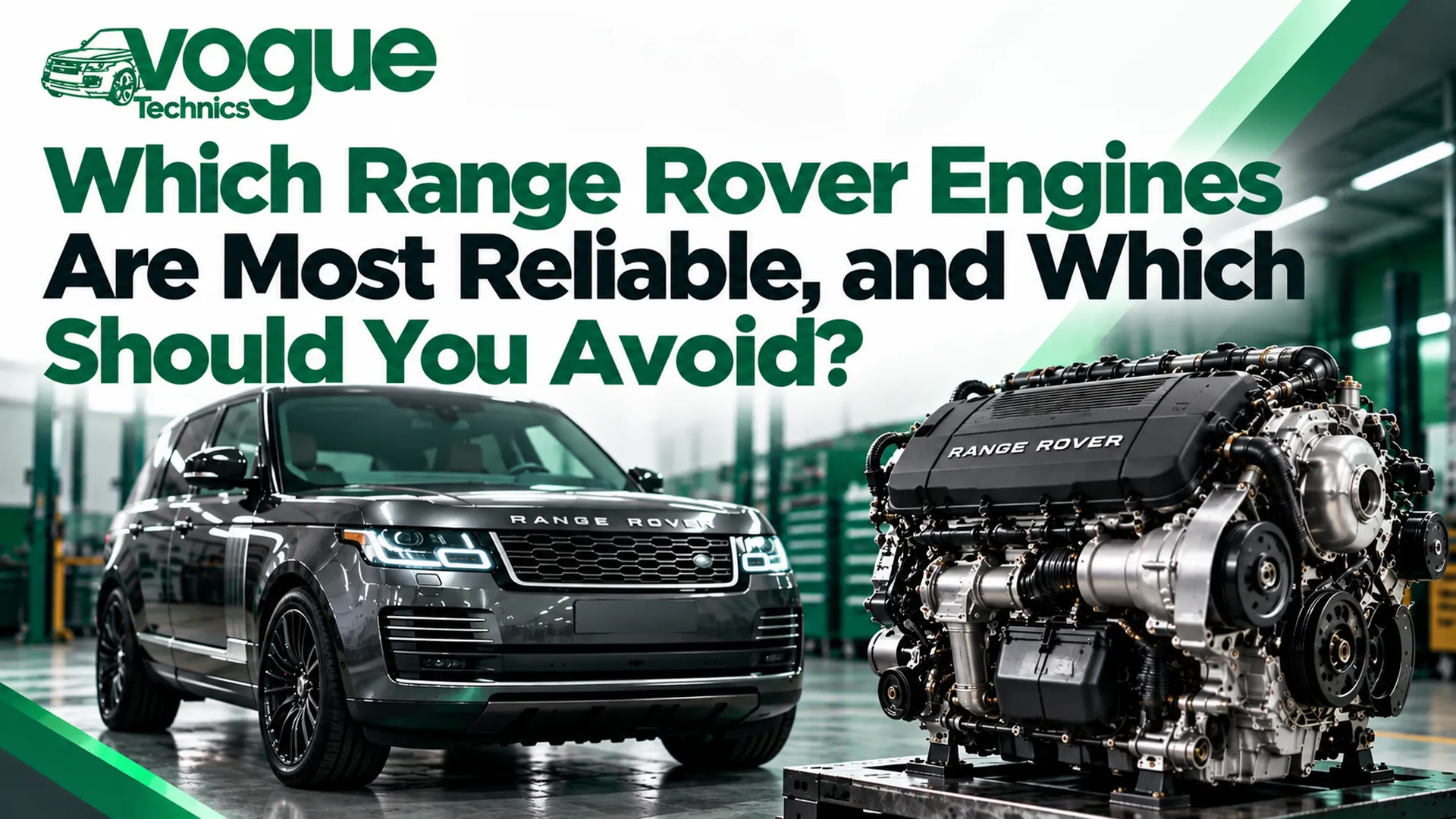
If you're buying a Range Rover, or deciding whether to invest in your current one, it helps to know where each engine stands. This guidance comes from what turns up on our workshop floor, not from brochures.
First, a quick answer to a common question: who makes Range Rover engines? The answer has changed over the years:
- BMW supplied the early L322's 3.0 Td6 diesel and 4.4 V8 petrol (2002–2005). BMW also supplies the twin-turbo 4.4 V8 used in the latest L460.
- Ford, together with PSA, developed the "Lion" diesels. These are the 2.7 and 3.0 V6 and the 3.6 and 4.4 V8 diesels used across the L320, L322, L405 and L494.
- Jaguar supplied the AJ-V8 petrol engines, including the 4.2 and 5.0 supercharged V8s.
- JLR now designs and builds its own Ingenium four- and six-cylinder engines at the Engine Manufacturing Centre in Wolverhampton.
What Is the Most Reliable Range Rover Engine?
No engine is bulletproof, but some stand out in practice.
- BMW M57 3.0 Td6 (early L322): a strong, simple straight-six diesel. Many are still going at very high mileage, which makes it a good candidate for reconditioning.
- 5.0 supercharged V8 (later builds): once the early timing chain tensioner issues were sorted, this engine has proved durable when serviced properly. Running costs are high, but it's mechanically sound.
- 3.0 Ingenium straight-six (2019+): it's still relatively young, but early signs are positive. It's a smoother, more modern design than the V6 diesel it replaced.
On Range Rover 4.4 V8 diesel engine reliability, the 448DT is a strong, torquey engine that handles high mileage when looked after. Its weak points tend to be turbos, oil leaks and cooling components rather than catastrophic internal failure, though bottom-end failures do occur.
The common thread: the most reliable Range Rover engine is usually the one that's had its oil changed on time. Stretched service intervals are behind a large share of the failures we rebuild.
Which Range Rover Engines Should You Avoid, and Why?
"Avoid" is a strong word. Every engine below can give good service if maintained well, and all of them respond well to proper reconditioning. Still, these are the Range Rover engines to avoid if you're buying used without history, or the ones to watch closely if you already own one.
- 3.0 TDV6/SDV6 (306DT) and 2.7 TDV6 (276DT): well known for crankshaft and bearing failure. The crank can snap or spin a bearing, often without much warning. These are the engines we rebuild most often.
- 4.6 Rover V8 (P38 Range Rover): prone to slipped or cracked cylinder liners, head gasket failure and overheating. If you're looking at a 4.6 Rover V8 engine for sale, insist on a compression and coolant test, or buy one that's been properly re-linered.
- Early 2.0 Ingenium diesel (2015–2018): known for timing chain stretch and oil dilution. These issues are covered in more detail below.
- Early 5.0 supercharged V8 (around 2010–2012): timing chain tensioner and guide wear. This was largely resolved on later engines.
A rough or rattling cold start, a drop in oil pressure, or a sudden limp mode on any of these engines needs prompt investigation. Catching a problem early can be the difference between a repair and a replacement.
What Are the Common Range Rover 4.4 V8 Diesel and Petrol Engine Problems?
Range Rover 4.4 V8 diesel engine problems (TDV8/SDV8, 448DT):
- Turbocharger failures, often linked to oil supply issues or carbon build-up.
- Oil leaks from the oil cooler, the turbo feed pipes and the rear of the engine.
- EGR and DPF problems, especially on cars used mainly for short journeys.
- Crank and bearing wear on neglected engines, which is less common than on the V6 but does happen.
Range Rover 4.4 V8 petrol engine problems:
- BMW 4.4 (early L322): worn timing chain guides, VANOS issues, valve stem seal oil burning and cooling system leaks.
- Later BMW twin-turbo 4.4 (L460): it's too early to judge long-term. Related BMW V8s have a history of oil consumption and timing chain wear, so regular servicing is essential.
Warning signs to watch for:
- Blue or black smoke
- Rising oil consumption
- A rattle on cold start
- Coolant loss with no visible leak
- A drop in power with turbo or boost fault codes
Do Range Rover Ingenium Engines Have Known Faults?
Yes, particularly the early 2.0 diesel (204DTD/AJ200D) fitted to the Evoque, Velar, Range Rover Sport and Discovery Sport. There are two main issues.
- Timing chain stretch. On the Ingenium, the timing chain sits at the back of the engine, against the gearbox. When it stretches, you'll often get a rattle and fault codes. Fixing it is a big job, because access is difficult. If the chain jumps a tooth, it can cause valve damage.
- Oil dilution. On cars that do short trips, repeated DPF regeneration can wash diesel into the sump. That thins the oil and speeds up wear on the bearings and the chain.
When we recondition a Range Rover Ingenium engine, we fit a new timing chain kit and check the bearing condition carefully. We also give owners practical advice:
- Change the oil more often than the long service interval suggests.
- Give the car a regular motorway run so the DPF can regenerate fully.
Frequently Asked Questions About Reconditioned Range Rover Engines
What is a reconditioned Range Rover engine?
It's an engine that has been fully stripped, cleaned, measured, machined where needed and rebuilt with new wear parts, such as bearings, seals, gaskets, piston rings and timing components. It's rebuilt to manufacturer specifications and tested before fitting.
What's the difference between reconditioned, rebuilt and remanufactured?
The terms overlap. In general:
- Reconditioned means an exchange engine rebuilt to factory tolerances.
- Rebuilt often means your own engine, repaired and renewed.
- Remanufactured usually describes high-volume factory or industrial rebuilding.
What matters most is the actual work done and the testing behind it, so always ask the supplier.
Are reconditioned Range Rover engines reliable?
Yes, when rebuilt by a specialist and fitted correctly. A properly reconditioned engine has its known weak points renewed. That can make it more dependable than the original engine was at the same mileage.
How long does a reconditioned engine last?
With correct servicing, a professionally reconditioned engine should last for many years and tens of thousands of miles. That's comparable to a healthy original engine. Regular oil changes and a careful running-in period make the biggest difference.
How long does a Range Rover engine replacement take?
Most supply-and-fit jobs take [X–X working days], depending on the engine code and on parts availability. Exchange engines from ready stock are the fastest option.
Is fitting included in the price?
On our supply-and-fit service, yes. The price includes removal, fitting, fluids, filters, coding and testing. Supply-only prices cover the engine itself.
Can you deliver a Range Rover engine anywhere in the UK?
Yes. We offer nationwide delivery for supply-only orders and can arrange vehicle collection for supply-and-fit jobs.
Is it worth replacing a Range Rover engine?
In most cases, yes. A Range Rover with a fresh reconditioned engine is often worth considerably more than the cost of the work. It's also far cheaper than replacing the vehicle.
Is a new Range Rover engine better than a reconditioned one?
A new engine is brand new, but it costs two to four times as much. For cars outside the manufacturer warranty, a reconditioned engine gives most owners better value with comparable reliability.
Get Your Range Rover Back on the Road with Vogue Technics
A failed engine doesn't have to mean the end of your Range Rover. With a reconditioned Range Rover engine from a genuine specialist, you get:
- A rebuilt and fully tested engine
- A warranty-backed fit
- A price that makes sense for an out-of-warranty vehicle
At Vogue Technics in Grays, Essex, Range Rover engines are our everyday work. That covers 306DT crank failures, Ingenium timing chains and V8s of every generation. You'll get honest advice, a fixed written quote and a clear warranty, from people who'll tell you when a repair will do instead of selling you a whole engine.