
Range Rover SVR Head Gasket Problems: Symptoms, Causes, Diagnosis & Repair Costs
If your Range Rover SVR is losing coolant with no obvious leak, running rough on start-up, or throwing a temperature warning you can't quite explain, you're probably staring down one of the most feared faults in the SVR world: head gasket failure. It's a problem that catches out even experienced owners, because the early signs rarely look like a "textbook" head gasket fault. There's no dramatic cloud of white smoke on day one. Instead, it starts quietly, a bit of coolant that seems to vanish, a slightly rough idle, a warning light that clears itself.
That quiet start is exactly why so many SVR owners end up with a far bigger repair bill than they needed to. Left undiagnosed, a head gasket issue on the 5.0-litre supercharged V8 doesn't stay small. It escalates into cylinder head damage, compression loss, and in the worst cases, a full engine rebuild.
This guide walks through everything you need to know: the real symptoms, what actually causes head gasket failure on the AJ133 engine, how a proper diagnosis is done, and what repair or replacement is likely to cost. If you're trying to work out whether your SVR has a genuine head gasket problem or something more straightforward like a coolant crossover pipe fault, you'll find the answer here.
What Are the Symptoms of a Range Rover SVR Head Gasket Problem?
Head gasket failure on the Range Rover Sport SVR rarely announces itself clearly. Most owners notice something feels slightly off before any dashboard warning appears. Understanding the early symptoms is the difference between a manageable repair and a catastrophic one.
How Do You Know If Your SVR Head Gasket Has Failed?
There isn't one single symptom that confirms a blown head gasket, it's usually a combination of small clues that build into a pattern. Here's what to watch for:
- Unexplained coolant loss with no visible leak, You keep topping up the coolant reservoir, but there's no puddle under the car and no obvious external leak. This is one of the strongest early indicators of internal gasket failure, because the coolant is escaping into the combustion chamber rather than onto your driveway.
- White smoke from the exhaust, This happens when coolant is burning inside the cylinder alongside fuel. It's often more visible on cold starts and tends to have a faintly sweet smell.
- Rough idle, misfires or poor performance, Coolant entering a cylinder disrupts combustion, which can cause a rough idle, hesitation under acceleration, or an intermittent misfire that doesn't correspond to a simple ignition fault.
- Milky or contaminated engine oil, If coolant is mixing with the oil, you'll often see a pale, milky discolouration on the dipstick or oil cap. This is a serious sign and shouldn't be ignored.
- Bubbling in the coolant expansion tank, Combustion gases escaping into the cooling system pressurise the reservoir and cause visible bubbling, even with the engine at idle.
If you're seeing two or more of these together, it's worth booking a proper diagnostic check rather than waiting to see if things settle down. They usually don't.
Can a Head Gasket Fail Without Overheating?
Yes, and this is one of the most misunderstood aspects of SVR head gasket problems. Many owners assume that if the temperature gauge hasn't spiked, the head gasket must be fine. In reality, a partial or early-stage gasket failure can exist for weeks or months before overheating becomes obvious, especially if the fault is a small combustion leak rather than a full breach.
Silent symptoms owners often miss include a slightly sweet smell from the cabin vents (a sign coolant vapour is circulating through the heater matrix), a coolant level that drops by a small amount every few weeks, or a very subtle loss of power that's easy to attribute to "just getting older." These subtler signs are often the earliest opportunity to catch the problem before it turns into cylinder head or block damage.
Head Gasket Failure vs a Simple Coolant Leak, What's the Difference?
Not every coolant problem on an SVR is a head gasket issue. In fact, a coolant crossover pipe fault, a failing water pump, or a worn thermostat housing can produce very similar symptoms, and it's a common (and costly) mistake to assume the worst without proper testing.
Symptom | Likely Cause |
| Low coolant with a visible external leak | Hose, water pump seal, or crossover pipe |
| Low coolant, no visible leak anywhere | Internal leak, possible head gasket |
| White smoke from exhaust | Coolant entering combustion chamber |
| Bubbles in the expansion tank | Combustion gases entering cooling system |
| Overheating that develops gradually | Cooling system component failure or early gasket fault |
| Misfire specifically on cold start | Coolant sitting in a cylinder overnight |
| Milky engine oil | Coolant contamination, head gasket or oil cooler |
| Hard, swollen coolant hoses | Excess combustion pressure in the cooling system |
This table is a useful starting point, but it's not a substitute for proper testing. A cooling system pressure test and a combustion leak test will tell you definitively which side of that table you're on, more on that further down.
What Causes Head Gasket Failure on the Range Rover SVR (AJ133 Engine)?
Understanding why SVR head gaskets fail is just as important as recognising the symptoms, because in most cases, the head gasket isn't actually the root cause. It's the final domino in a chain of events that usually starts somewhere else in the cooling system.
The Coolant Crossover Pipe Failure Chain
This is arguably the single most important thing to understand about SVR and Range Rover Sport SVR head gasket problems, and it's an area where a lot of generic advice falls short.
The AJ133 5.0-litre supercharged V8 relies on a coolant crossover pipe arrangement to circulate coolant efficiently around the block and heads, particularly given the additional thermal load created by the supercharger. When this pipe degrades or fails, often due to age, heat cycling, or corrosion at the pipe joints, coolant loss follows.
How crossover pipe failure leads to coolant loss: As the pipe or its seals deteriorate, coolant begins to seep out gradually. Because the pipe often runs in a location that's not immediately visible during a casual inspection, this leak can go unnoticed for some time, which is exactly why so many owners describe "coolant just disappearing."
How coolant loss leads to overheating and gasket damage: As coolant volume drops, the engine's ability to manage heat around the cylinder heads deteriorates. Under load, motorway driving, spirited use, hot weather, localised hot spots develop around the combustion chambers. This thermal stress is what ultimately causes the head gasket's sealing surfaces to fail, letting combustion gases into the cooling system and coolant into the cylinders.
In other words: what looks like a "head gasket problem" often started life as a coolant crossover pipe problem. This is a crucial distinction, because if the crossover pipe is replaced early, before sustained overheating occurs, the head gasket can often be saved entirely.
Water Pump and Thermostat Failures
The water pump and thermostat are two more common starting points for what eventually presents as a head gasket fault. A failing water pump reduces coolant circulation, while a stuck thermostat can prevent the cooling system from responding correctly to rising temperatures.
Why these are often mistaken for head gasket failure: Both faults produce overheating and coolant-related symptoms that look identical to early gasket failure from the driver's seat. The only way to tell them apart reliably is through proper diagnostic testing, visually, a failing thermostat and a genuinely blown head gasket can look very similar on a temperature gauge.
Overheating and Thermal Stress on the AJ133
Whatever the initial trigger, crossover pipe, water pump, thermostat, or simple coolant loss from an ageing hose, sustained overheating is the mechanism that actually damages the head gasket and, in severe cases, the surrounding components.
Cylinder head warping and cylinder liner movement: Aluminium cylinder heads are particularly sensitive to repeated heat cycling. Under sustained high temperatures, the head can warp slightly, which is enough to break the gasket's seal even if the gasket material itself was never faulty. In more severe or repeated overheating events, the AJ133's cylinder liners can shift position within the block, a much more serious form of damage that goes beyond a straightforward gasket replacement and moves into engine rebuild territory.
This is why SVR specialists take overheating seriously even when it seems to resolve itself. A single significant overheating event can cause damage that only becomes apparent weeks later.
How to Diagnose a Range Rover SVR Head Gasket Fault
Guesswork is the most expensive mistake you can make with a suspected head gasket problem. Replacing a head gasket unnecessarily wastes money; failing to catch a genuine one in time risks turning a moderate repair into a full engine rebuild. Proper diagnosis removes the guesswork.
Cooling System Pressure Test
A pressure test involves sealing the cooling system and applying controlled pressure to check for drops that indicate a leak, whether that's external (a hose, pipe, or seal) or internal (into a cylinder). This is usually the first test performed, because it quickly narrows down whether you're dealing with a straightforward external leak or something more serious.
Combustion Leak (Block) Test
If the pressure test suggests an internal issue, a combustion leak test, sometimes called a block test, checks specifically for combustion gases present in the coolant. A chemical indicator changes colour in the presence of exhaust gases, giving a fairly conclusive answer as to whether combustion gases are entering the cooling system through a failed head gasket.
Compression and Leak-Down Testing
Compression testing measures how well each cylinder holds pressure during the compression stroke, while a leak-down test goes a step further by pressurising each cylinder individually and measuring how quickly that pressure escapes, and, crucially, where it escapes to (the exhaust, the intake, or an adjacent cylinder).
What the results actually tell you: A leak-down test in particular can reveal whether a gasket has failed between two cylinders, between a cylinder and the water jacket, or whether the issue is unrelated to the gasket entirely, for example, worn piston rings or valve wear. This level of detail is what separates a proper diagnosis from an educated guess.
Why a Proper Diagnosis Matters Before You Approve Any Repair
Avoiding misdiagnosis on coolant-related faults: It's tempting, when an SVR is losing coolant, to jump straight to "it must be the head gasket", but as covered above, a crossover pipe, water pump, or thermostat fault can present almost identically. A specialist who runs the full diagnostic sequence, pressure test, combustion leak test, and compression/leak-down testing where needed, can tell you with confidence exactly what's failed, rather than replacing the most expensive component first and hoping the symptoms go away.
Range Rover SVR Head Gasket Repair: Cost, Process & Specialist Service in Essex
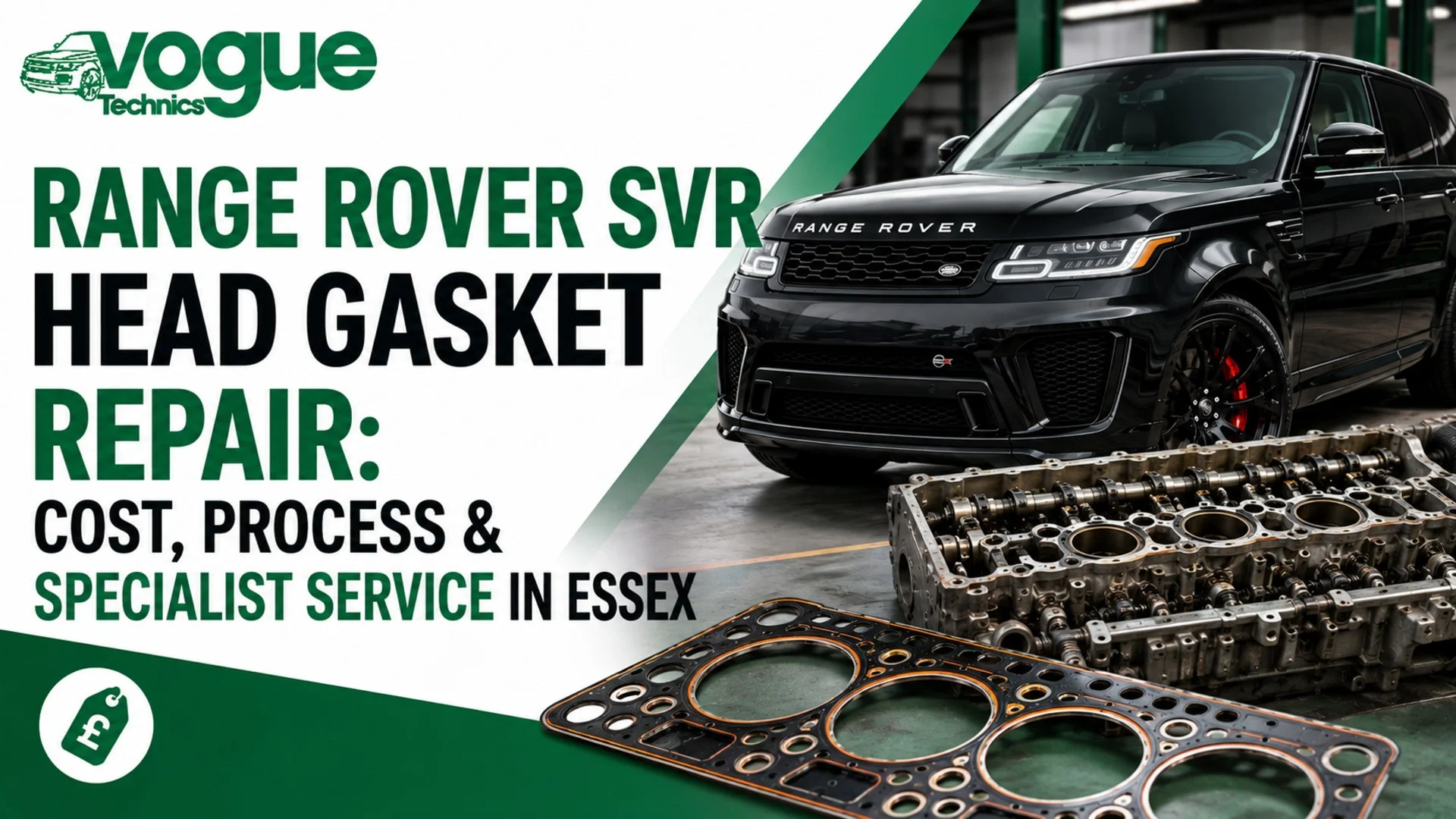
Once a head gasket fault is confirmed, the next question is straightforward: what does the repair actually involve, and what should you expect to pay?
What's Involved in a Head Gasket Replacement
A proper head gasket replacement on the AJ133 5.0-litre supercharged V8 is a substantial job, this isn't a quick bolt-on repair, and the process matters as much as the parts used.
Cylinder head removal, machining and inspection: Both cylinder heads are removed to access the gasket surfaces. Once off, the heads are checked for warping using precision measuring equipment. If any distortion is found, which is common after overheating, the heads need to be machined flat, or in more serious cases, replaced.
Checking for block and liner damage: This is a step that's easy to skip if you're not working with a specialist who understands the AJ133 specifically. Given that severe overheating can cause cylinder liner movement, a thorough repair should include an inspection of the block and liners, not just a straightforward gasket swap. Skipping this step risks a repair that fails again within a short period.
Head Gasket Replacement vs Engine Rebuild, Which Do You Need?
This is often the hardest decision for owners to make, largely because it hinges on factors that aren't visible from the driver's seat. Generally speaking:
- If the fault was caught early, coolant loss was moderate, and the cylinder heads show only minor warping, a head gasket replacement with head skimming is usually sufficient.
- If the vehicle has suffered sustained or repeated overheating, shows evidence of cylinder liner movement, or has significant coolant contamination in the oil that's been present for some time, an engine rebuild, or in some cases a replacement engine, becomes the more realistic option.
Mileage, overheating severity, compression test results, and the condition of the block all factor into this decision. A specialist should walk you through the findings from diagnostic testing before recommending one path over the other, rather than defaulting to the most expensive option.
Range Rover SVR Head Gasket Repair Cost Guide
Costs for SVR head gasket work vary considerably depending on the extent of the damage, whether the heads need machining or replacing, and whether any secondary components (water pump, thermostat, crossover pipe, timing chain inspection) are addressed at the same time. A straightforward gasket replacement with head skimming sits at one end of the scale; a full engine rebuild following liner damage sits at the other, considerably higher end.
Because the price range is genuinely wide, and because guessing at a figure without seeing the vehicle risks being misleading, the most reliable way to get an accurate cost is a proper diagnostic inspection. This also protects you from paying for work you don't actually need, which is a real risk given how often coolant symptoms are misdiagnosed.
Why Choose Voguetechnics for SVR Head Gasket Repairs in Grays, Essex
Specialist AJ133 diagnostics and genuine repair experience: Working on the AJ133 supercharged V8 properly means understanding the full failure chain, from crossover pipe and water pump faults through to cylinder liner movement, not just replacing a gasket and hoping for the best. At Voguetechnics, based in Grays, Essex, every suspected head gasket case starts with proper diagnostic testing: cooling system pressure testing, combustion leak testing, and compression checks where needed, so you get an accurate answer before any work begins.
Book a diagnostic inspection today: If your Range Rover SVR is losing coolant, showing white smoke, or running roughly and you're not sure whether you're looking at a head gasket problem or something more straightforward, get it checked properly before it gets worse. The earlier a genuine fault is caught, the more likely it is that a full engine rebuild can be avoided altogether.
Frequently Asked Questions About Range Rover SVR Head Gasket Problems
Can you drive a Range Rover SVR with a blown head gasket? It's not advisable. Continuing to drive with a failed head gasket allows combustion gases to keep entering the cooling system and coolant to keep entering the cylinders, which accelerates damage to the cylinder heads and increases the risk of more serious internal engine damage. Short-term driving to reach a garage is generally lower risk than continued daily use.
What happens if you keep driving an overheating SVR? Sustained overheating is what causes cylinder head warping and, in severe cases, cylinder liner movement within the block. What might have started as a moderate head gasket repair can turn into a full engine rebuild if the vehicle is driven repeatedly while overheating.
Does a coolant crossover pipe fault always lead to head gasket failure? Not always, if caught early, a crossover pipe fault can be repaired on its own before it causes enough coolant loss and overheating to damage the head gasket. This is exactly why early diagnosis matters so much on the AJ133 engine.
How long does an SVR head gasket replacement take? This depends on what's found during the job, a straightforward replacement with head machining takes considerably less time than a repair that uncovers block or liner damage requiring a wider rebuild. A specialist should be able to give you a realistic timeframe once the heads are off and inspected.
Is head gasket failure common on the Range Rover SVR? It's a known issue within the SVR and wider AJ133-engined Range Rover community, often linked back to cooling system components like the crossover pipe, water pump, and thermostat rather than the gasket material itself failing outright. Regular cooling system checks are one of the most effective ways to reduce the risk.
Can a head gasket problem be misdiagnosed? Yes, and it happens more often than owners realise. Symptoms like coolant loss and mild overheating can be caused by a crossover pipe, water pump, or thermostat fault rather than the head gasket itself. Proper testing, not just a visual inspection, is the only reliable way to confirm the actual cause.
Final Thoughts
A head gasket problem on a Range Rover SVR is rarely as simple as it first appears. In most cases, it's the end result of a chain that starts somewhere else, a coolant crossover pipe, a tired water pump, a thermostat that's stopped doing its job properly. Catching that chain early is what separates owners who face a moderate, manageable repair from those who end up looking at an engine rebuild.
If your SVR is showing any of the symptoms covered in this guide, coolant that keeps disappearing, a rough idle, white smoke, or an unexplained temperature warning, the smartest next step is a proper diagnostic check, not a guess. Get in touch with the team at Voguetechnics in Grays, Essex, and let's find out exactly what's going on before it turns into something bigger.