Range Rover SVR Engine Diagnostics | Specialist Fault Diagnosis in Grays, Essex
Your Range Rover Sport SVR just flashed up a warning light, and your stomach dropped a little. That's a fair reaction, this isn't a car you want to guess with. The AJ133 5.0-litre supercharged V8 under the bonnet is a genuinely serious piece of engineering, and when something goes wrong, throwing parts at it based on a generic OBD reading rarely ends well.
Here's the thing most drivers don't realise until they've been through it: a fault code tells you where to look, not what's broken. Get that distinction wrong, and you can end up paying for a new ignition coil when the real issue is a stretched timing chain, or worse, driving around in limp mode for weeks while the underlying fault quietly gets more expensive.
This guide walks through exactly what proper Range Rover SVR engine diagnostics involves, the warning signs worth taking seriously, how a specialist actually gets to the root cause, and what it typically costs to put things right.
What Does a Range Rover SVR Engine Diagnostic Check Include?
A proper diagnostic isn't just plugging in a scanner and reading whatever pops up. On a performance vehicle like the SVR, built by Jaguar Land Rover's Special Vehicle Operations division around a 5.0-litre supercharged V8 producing up to 575 PS and 700 Nm, the diagnostic process needs to match the complexity of the engineering.
A thorough check typically covers electronic diagnostics, live engine data, and physical inspection, cross-referenced against each other rather than treated as separate steps.
How We Read Stored, Pending & Freeze-Frame Fault Codes
When the ECU (engine control module) logs a fault, it doesn't just save a code, it saves context. This is where a lot of basic diagnostic checks fall short.
- Stored codes, confirmed faults the ECU has flagged as active
- Pending codes, faults detected once but not yet confirmed, often the first sign of an intermittent fault
- Freeze-frame data, a snapshot of what the engine was doing the moment the fault occurred: RPM, coolant temperature, engine load, fuel trims, throttle position, and vehicle speed
Freeze-frame data is genuinely underused in general diagnostics, but it's often the difference between a correct diagnosis and an educated guess. If a misfire code stores itself only under heavy load at high RPM, that points somewhere very different than a misfire that shows up at cold idle.
Live Data Analysis for the AJ133 5.0L Supercharged V8
Beyond stored codes, live data lets a technician watch the engine behave in real time, while it's actually running, under load, and reproducing the symptom.
Key parameters worth watching on the AJ133 include:
- Short-term and long-term fuel trims (STFT/LTFT)
- Oxygen (lambda) sensor readings
- MAF and MAP sensor values
- Camshaft and crankshaft position correlation
- Ignition timing and misfire counters
- Coolant temperature trends under load
This is particularly important on a supercharged engine, where boost pressure changes the entire fuelling and timing picture compared to a naturally aspirated unit.
Why a Fault Code Doesn't Always Mean the Component Has Failed
This is worth repeating because it's the single most common source of misdiagnosis: a fault code identifies a circuit or a symptom, not necessarily a broken part.
A P0016 crank/cam correlation code, for example, doesn't automatically mean a new timing chain is needed. It could point to a stretched chain, a failing tensioner, a faulty camshaft position sensor, or even wiring. The code narrows the search, it doesn't finish the job. A specialist's role is confirming which of those it actually is before any parts get replaced.
Common Range Rover SVR Engine Faults & Warning Signs
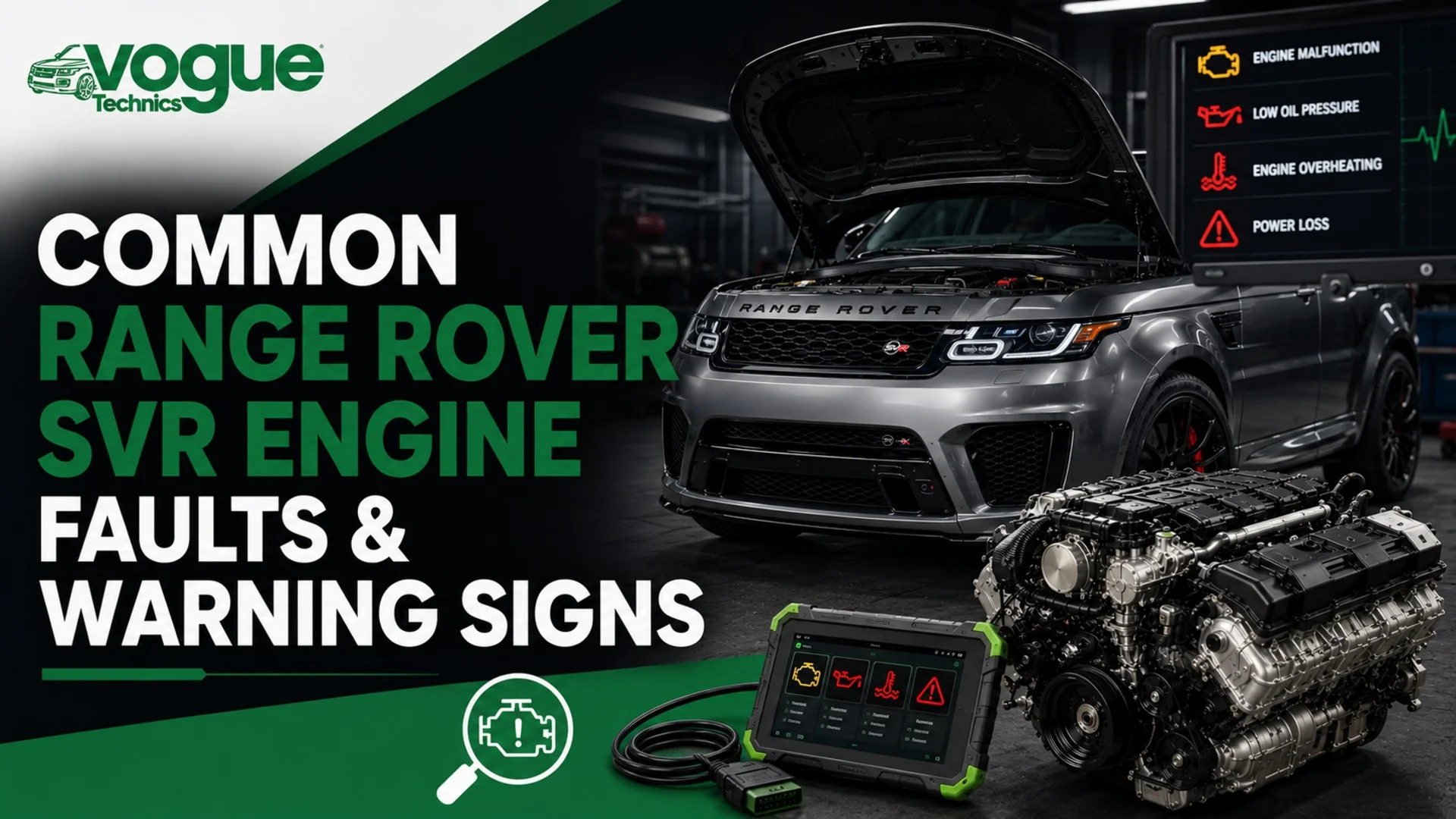
Certain symptoms come up repeatedly on the SVR platform, and most of them share a common thread, they're mechanical warnings, not electrical glitches, even when a warning light is involved.
Misfire, Rough Idle & Loss of Power
A misfire on the AJ133 can feel like a slight hesitation or a full-blown stumble under acceleration, and the cause list is genuinely broad:
- Worn or fouled spark plugs
- Failing ignition coils
- Injector faults or fuel delivery issues
- Low compression on one or more cylinders
- Timing-related faults affecting valve events
Rough idle and a noticeable loss of power often accompany a misfire, especially if the fault is intermittent and hasn't fully triggered limp mode yet.
Overheating, Coolant Loss & Oil Consumption
These three often get treated as separate issues, but on a high-output V8 they're frequently connected.
- Coolant loss without a visible puddle usually points to a water pump, thermostat housing, or a crossover pipe seal
- Overheating under load but not at idle often suggests a cooling system that can't keep pace with sustained high demand, common on cars used for spirited driving or towing
- Oil consumption beyond what's normal can indicate valve stem seal wear or piston ring wear, and if left unchecked, it raises the risk of long-term damage to the cylinder head
None of these should be ignored on the assumption they'll "sort themselves out." Persistent overheating in particular carries real head gasket risk on this engine.
Timing Chain Rattle on Cold Start
A rattle for a second or two on a cold start, particularly in colder weather, is one of the most commonly reported concerns on the 5.0-litre supercharged V8. It's usually linked to the hydraulic tensioner taking a moment to build oil pressure, but it's also one of the earliest audible signs of timing chain stretch developing.
This is exactly the kind of symptom where a proper inspection, rather than an assumption either way, matters. Some rattle is considered within normal characteristics for this engine family; excessive or worsening rattle is not.
Range Rover SVR Fault Codes Explained
Fault Code | Meaning | Likely Cause | Severity |
| P0016 | Crankshaft/camshaft correlation | Timing chain stretch, tensioner, VVT | High |
| P0017 | Crankshaft/camshaft correlation (bank 2) | Timing system fault | High |
| P0300 | Random/multiple cylinder misfire | Ignition, fuel, or compression issue | High |
| P0301–P0308 | Cylinder-specific misfire | Coil, plug, injector, or compression fault on that cylinder | High |
| P0316 | Misfire detected on startup | Cold-start ignition or fuel delivery fault | High |
| P0011/P0012 | Camshaft position, timing over/under-advanced | VVT actuator or oil pressure fault | Medium-High |
| P0420/P0430 | Catalyst efficiency below threshold | Catalytic converter, misfire, or oil contamination | Medium |
This table reflects the most frequently reported codes on the AJ133 platform. As with any diagnostic trouble code, the code itself is a starting point for investigation, not a parts order.
How We Diagnose a Range Rover SVR Engine Fault
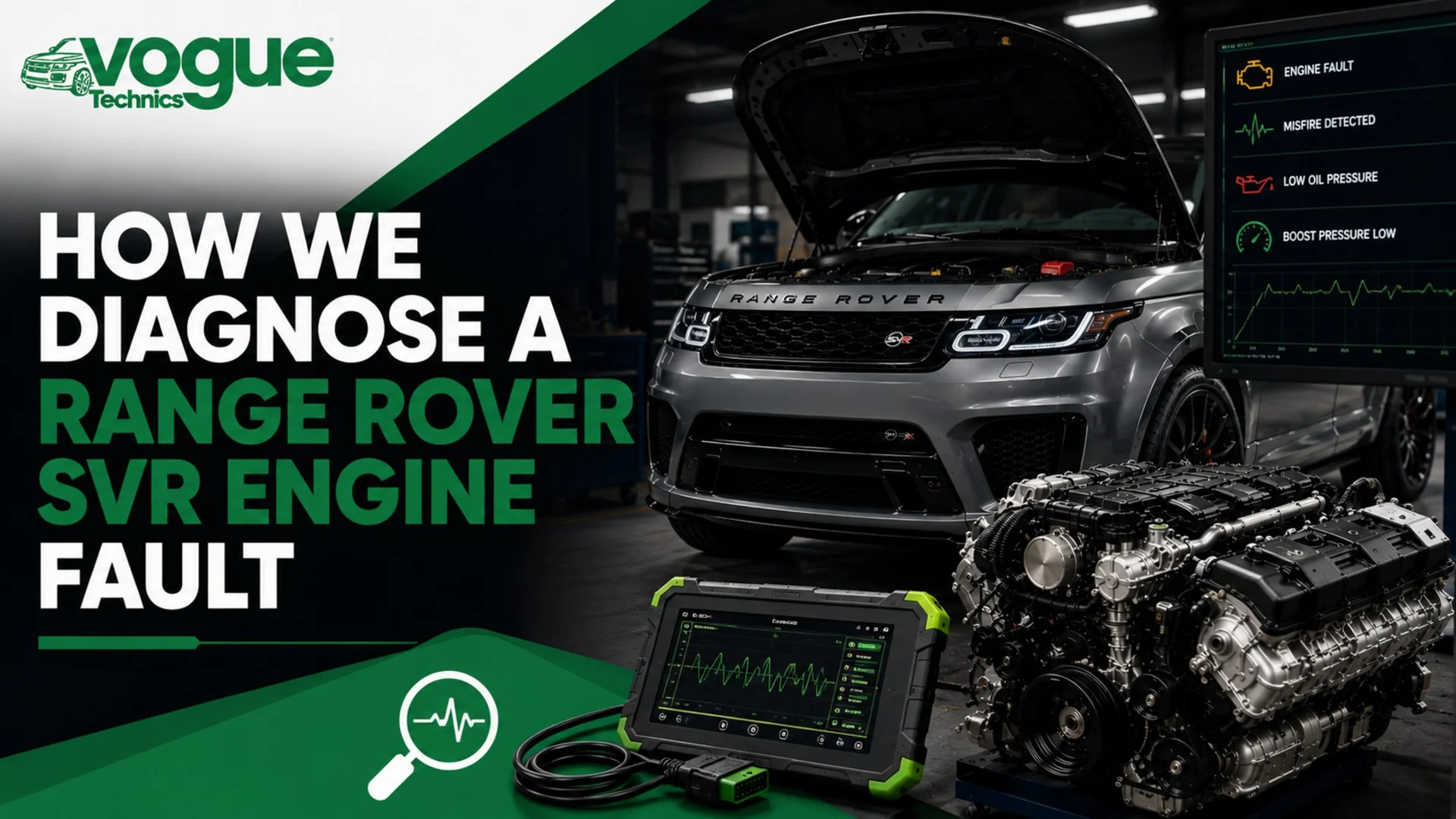
A dependable diagnosis follows a sequence, not a shortcut. Skipping steps is how misdiagnosis happens, and on an engine this expensive to get wrong, that sequence matters.
Diagnostic Scan & Fault Code Retrieval
The process starts with manufacturer-level diagnostic equipment capable of communicating properly with JLR systems, not a generic budget OBD-II reader that only pulls generic codes. This retrieves stored codes, pending codes, and freeze-frame data, and gives an initial picture of where to focus.
Compression & Leak-Down Testing
Where mechanical failure is suspected, particularly with misfires or unexplained power loss, compression testing and leak-down testing tell a more complete story than any electronic scan alone.
- Compression testing measures the pressure each cylinder builds, highlighting weak cylinders
- Leak-down testing goes a step further, pressurising each cylinder to identify where pressure is escaping, past the piston rings, the valves, or the head gasket
Used together, these tests can distinguish a genuinely failing engine from one that simply has an ignition or fuelling problem, a distinction that has a very large impact on repair cost.
Physical Inspection & Borescope Checks
Some faults simply don't show up cleanly in the data. A borescope inspection allows a direct visual look inside the cylinder without removing the head, checking piston crown condition, valve sealing, and any signs of carbon buildup or physical damage.
Combined with a visual inspection of the timing chain area, coolant system, and supercharger coupler, this physical check often confirms or rules out what the electronic data has suggested.
Road Testing & Fault Reproduction
Intermittent faults, the ones that don't show up sitting on a ramp, often only reveal themselves under real driving conditions: specific RPM ranges, sustained load, or engine temperature. A road test under controlled conditions, monitoring live data throughout, is frequently what confirms a diagnosis that static testing alone couldn't pin down.
Book Range Rover SVR Engine Diagnostics in Grays, Essex
If your Range Rover SVR is showing any of the symptoms above, a warning light, a rattle, a loss of power, or rising coolant or oil use, the earlier it's properly diagnosed, the cheaper and less disruptive the fix tends to be.
Why Choose Voguetechnics for SVR Diagnostics
Voguetechnics, based in Grays, Essex, works specifically with Range Rover and Range Rover Sport SVR models, using diagnostic equipment and a testing process built around this engine's actual failure points, not a one-size-fits-all approach borrowed from general servicing.
The focus throughout is root-cause confirmation before any repair is recommended, so you're not paying to replace parts on a guess.
Range Rover SVR Diagnostic Cost
Diagnostic pricing on a performance vehicle like the SVR reflects the level of equipment and testing time genuinely required, proper diagnostics on this engine takes longer than a routine warning-light check on a standard model, because getting to a confirmed root cause usually means combining electronic data with physical and mechanical testing.
For an accurate, current price for your specific vehicle and symptoms, get in touch directly, costs vary depending on whether the issue needs a scan-only check or a full mechanical investigation.
Repair, Rebuild or Replacement, What Happens Next
Once the root cause is confirmed, the next decision depends entirely on what's actually found:
- Minor component faults (a coil, a sensor, a plug) are usually a straightforward, low-cost repair
- Timing chain or VVT-related faults caught early are often repairable without full engine work
- Significant internal wear or damage, confirmed through compression, leak-down, and borescope findings, may point toward a partial rebuild
- Extensive or multiple-cylinder damage is where a full rebuild or replacement engine becomes the more sensible long-term option
The diagnostic stage exists precisely so this decision is based on evidence, not assumption.
Frequently Asked Questions
How do I know if my Range Rover SVR needs a diagnostic check?
Any warning light, unusual noise (especially a rattle on cold start), rough running, loss of power, or unexplained coolant or oil loss is worth having checked. Catching a fault early is almost always cheaper than waiting.
Can a basic OBD scanner diagnose a Range Rover SVR properly?
A basic reader can pull a generic code, but it won't give the manufacturer-level live data, freeze-frame detail, or timing correlation analysis needed to properly diagnose faults on this engine. It's a starting point, not a full diagnosis.
Is it safe to drive a Range Rover SVR with an engine fault light on?
It depends on the fault. Some issues are safe for short-term driving; others, particularly timing-related or overheating faults, risk serious damage if ignored. If the car has entered limp mode, that's the engine protecting itself, and it shouldn't be driven hard until diagnosed.
What does a timing chain rattle on cold start actually mean?
Brief rattle on a cold start can be within normal range for this engine, caused by the tensioner building oil pressure. Persistent or worsening rattle is different and should be inspected, as it can indicate chain stretch developing.
How much does a Range Rover SVR engine diagnostic cost?
Pricing depends on whether the issue needs a scan-only diagnostic or a full investigation involving compression, leak-down, and physical inspection. Contact Voguetechnics directly for an accurate quote based on your symptoms.
Does a fault code always mean a part needs replacing?
No. A fault code identifies where the ECU detected a problem, not necessarily which component failed. That's why proper diagnosis involves confirming the code against live data and physical testing before any repair goes ahead.
Ignoring an engine warning sign on a Range Rover SVR rarely makes the problem smaller, it usually just makes it more expensive by the time it's addressed. If your SVR is showing any of the symptoms covered here, getting a proper, root-cause diagnostic now is the most cost-effective decision you can make.
Get in touch with Voguetechnics in Grays, Essex, to book your Range Rover SVR engine diagnostic and find out exactly what's going on, before a small fault turns into a much bigger repair bill.