Range Rover Supercharged V8 Engine Rebuild UK: Cost, Process & Warranty Explained
Your Range Rover's engine light just came on, and now there's a knock you can't ignore. Maybe it's overheating on the motorway, or the garage that just inspected it used the words "timing chain" and "expensive" in the same sentence. Whatever brought you here, you're likely facing one big question: is this engine worth rebuilding, and what's it actually going to cost?
You're not alone. The AJ133 supercharged V8 that powers so many Range Rover and Range Rover Sport models is a genuinely impressive engine, smooth, powerful, and refined. But it also has known weak points that catch owners off guard, often right after the manufacturer warranty runs out.
This guide breaks down exactly what goes wrong, how a proper rebuild is done, what it costs, and why a rebuild is often the smarter financial decision compared to buying used or replacing the whole engine outright. No vague promises, just the detail you need to make an informed call.
What Causes Range Rover Supercharged V8 Engine Failure? (AJ133 Explained)
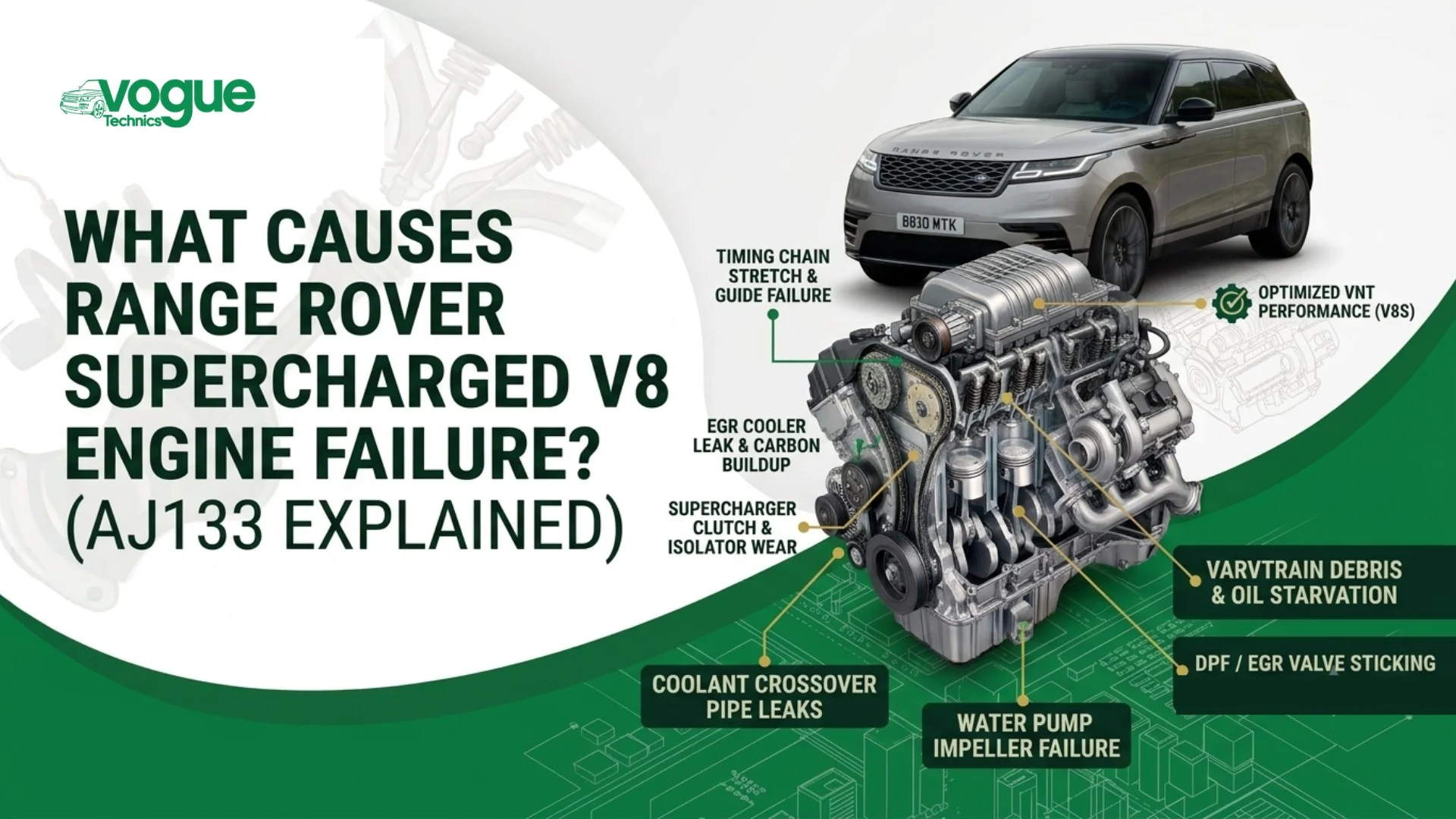
The AJ133 is Jaguar Land Rover's 5.0-litre supercharged V8, found across the Range Rover L405, Range Rover Sport L494, and performance variants like the SVR. It uses an Eaton TVS supercharger to deliver strong low-end torque and a genuinely quick 0-60 time, which is exactly why so many owners fell in love with it in the first place.
The problem is that this engine was never particularly forgiving of deferred maintenance. Once certain components start to wear, they tend to fail in ways that cascade into much bigger problems if left unchecked.
Common AJ133 Engine Problems: Timing Chains, Oil Starvation & Coolant Crossover Failure
A handful of failure points come up again and again in AJ133 engines, and recognising them early can be the difference between a manageable repair and a full engine replacement.
- Timing chain and tensioner wear: The AJ133 uses a timing chain rather than a belt, and worn tensioners allow the chain to slap or jump timing. Left unaddressed, this leads to valve-to-piston contact, which is catastrophic.
- Oil starvation: Oil pump wear or blocked pickup pipes can starve the crankshaft and big-end bearings of lubrication, causing bearing failure and, eventually, a seized engine.
- Coolant crossover pipe failure: This is a well-documented AJ133 weak point. The plastic crossover pipe sits inside the engine "V" and can fail internally, allowing coolant to mix with oil, a problem that's often invisible until the damage is already extensive.
- Supercharger seal and coupling wear: The Eaton TVS unit can develop bearing whine or coupling failure over time, particularly on higher-mileage vehicles that haven't had regular supercharger service.
None of these problems are unique to one specific Range Rover model. Whether you're driving an L405, an L494 Range Rover Sport, or an SVR, the AJ133's core architecture means the same weak points apply across the range.
Signs Your Range Rover V8 Needs a Rebuild, Not Just a Repair
Not every issue means you need a full rebuild. But certain symptoms are strong indicators that internal damage has already occurred, and a rebuild — rather than a patch repair — is the only real fix.
- Persistent metallic knocking, especially on cold start
- Oil pressure warnings that come and go, or a permanently lit oil light
- Milky residue on the oil cap or dipstick (a classic coolant-in-oil sign)
- Visible blue or white smoke from the exhaust under load
- Engine management light paired with misfire codes on multiple cylinders
- Loss of power or rough idle that's worsened over weeks rather than appearing suddenly
Engine Knocking, Overheating & Warning Light Symptoms Explained
If your Range Rover is overheating and you've also noticed a drop in oil level with no visible external leak, that combination points strongly toward internal coolant loss, often the coolant crossover pipe. A diagnostic compression test and an oil analysis will usually confirm it before you spend a penny on parts.
The key takeaway here: don't wait for a warning light to become a warning noise. Catching AJ133 problems early, before bearings or the crankshaft are damaged, often keeps rebuild costs significantly lower.
How We Rebuild a Range Rover Supercharged V8 Engine (Step-by-Step)
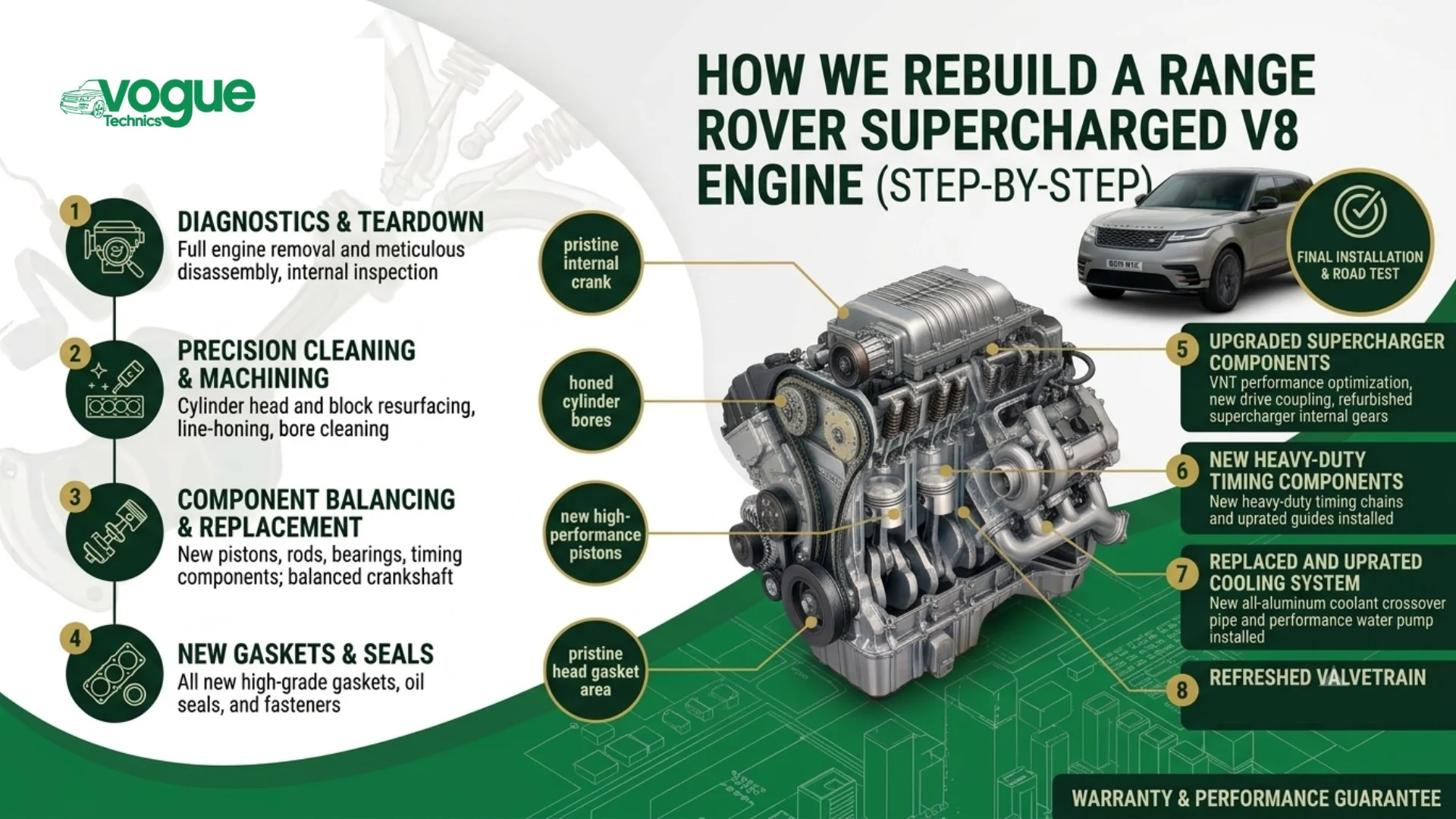
A genuine engine rebuild isn't a quick swap of a few gaskets. It's a full mechanical restoration, and the quality of that process is what determines whether your "rebuilt" engine lasts another 100,000 miles or fails again within a year. Here's what a properly executed AJ133 rebuild actually involves.
Full Strip Down, Machining & Top Hat Liner Installation
The engine is completely stripped to the bare block, and every component is inspected individually rather than reused on assumption.
- The aluminium block is cleaned and inspected for cracks, warping, or bore damage
- Cylinder bores are measured against factory tolerances, and where wear exceeds spec, top hat liners are fitted, a proven solution that restores bore integrity and gives the rebuilt engine genuine longevity rather than a temporary fix
- The crankshaft is inspected and measured for wear on the main and big-end journals, with main bearings and big-end bearings replaced as standard
- Connecting rods are checked for straightness and bearing surface condition
- The cylinder head is machined flat, valve seats are refaced, and valve guides and valve stem seals are replaced
This is where the real difference between a "cheap rebuild" and a proper one shows up. Top hat liners in particular are a step many budget rebuilders skip because they add time and cost, but skipping them on a worn bore is exactly how you end up paying for the same repair twice.
Supercharger Reconditioning, Compression & Leak-Down Testing
The Eaton TVS supercharger is stripped, inspected, and reconditioned alongside the engine rather than treated as a separate job. This includes replacing worn bearings, seals, and couplings, and checking the intercooler and coolant crossover pipes for the same failure points that likely contributed to the original problem.
Once reassembly is complete, the engine doesn't just get bolted back in and started. It goes through proper verification testing:
- Compression testing across all eight cylinders, confirming even pressure with no more than a small acceptable variance between cylinders
- Leak-down testing, which identifies exactly where pressure is escaping (rings, valves, or head gasket) if compression numbers aren't perfect
- Oil pressure checks at idle and under load, using a calibrated gauge rather than relying on the factory sensor alone
These tests matter because they're the only real proof that the rebuild has actually restored the engine to proper working tolerances, not just that it starts and runs.
Running-In Procedure After Your Engine Rebuild
A rebuilt engine needs a proper running-in period, just like a brand-new one. This typically means avoiding sustained high RPM or heavy towing for the first several hundred miles, using a break-in-appropriate oil, and having the oil and filter changed earlier than the standard service interval to clear any machining debris from the first heat cycles. Skipping this step is one of the most common (and avoidable) reasons a freshly rebuilt engine develops early problems.
Range Rover Engine Rebuild Cost UK: What You'll Actually Pay
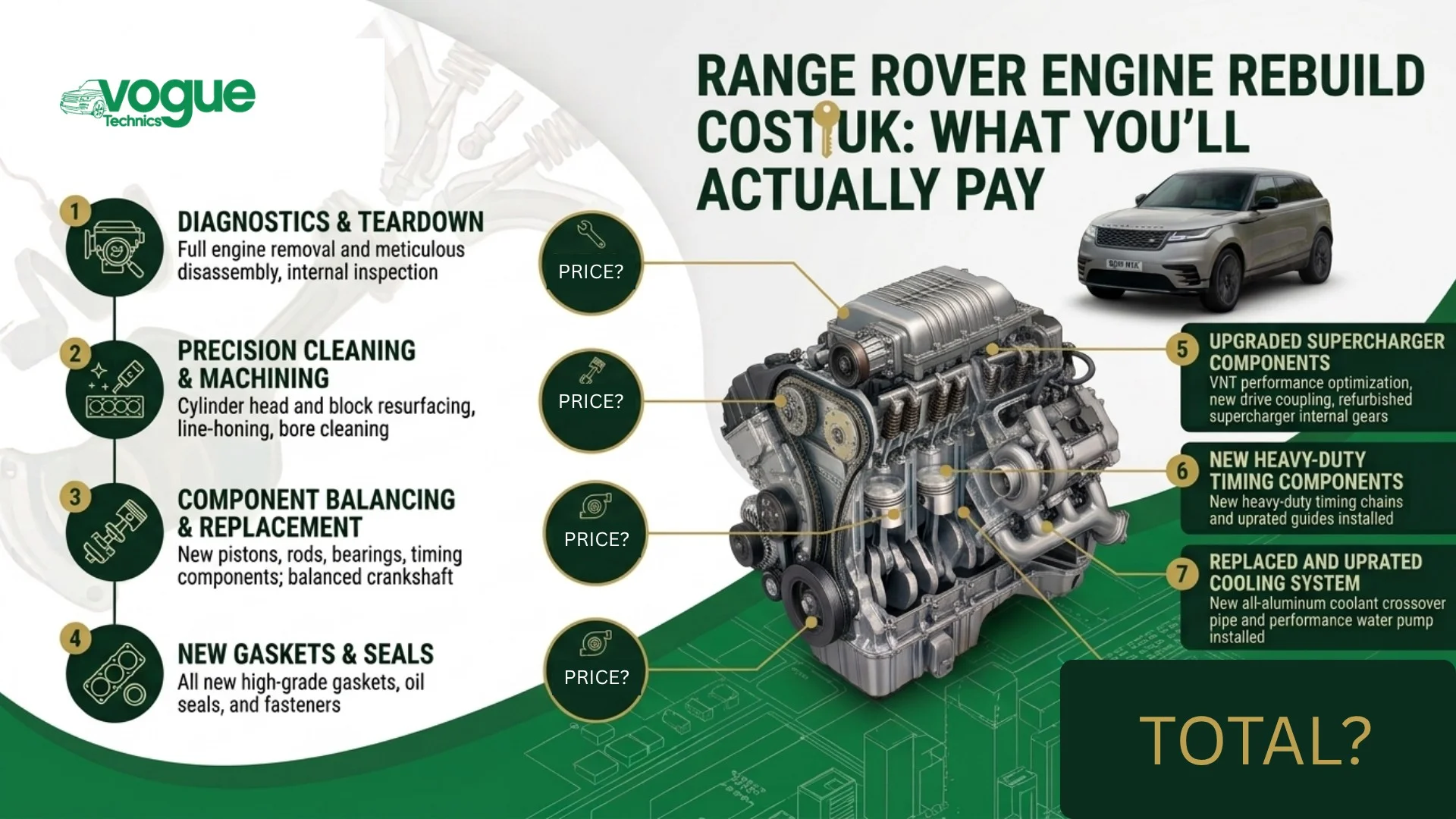
This is usually the question that brought you here, so let's address it directly. Costs vary depending on the extent of the damage, whether the supercharger needs reconditioning, and whether top hat liners are required, but here's a realistic breakdown of what you're choosing between.
Option | Typical Cost Range (UK) | Lifespan Expectation | Warranty Usually Offered |
| Used engine (unknown history) | Lowest upfront cost | Unpredictable, no verified condition | Little to none |
| Reconditioned engine (exchange unit) | Mid-range | Good, if properly reconditioned | Typically 12 months |
| Full engine rebuild (your own engine) | Mid-to-upper range | Excellent, with verified testing | Typically 12 months |
| New engine from manufacturer | Highest cost | Excellent | Manufacturer warranty |
Rebuild vs Reconditioned vs Replacement Engine: Which Should You Choose?
There's no single right answer here, it depends on your engine's specific damage and your priorities.
- Choose a rebuild if your original engine's block and crankshaft are fundamentally sound (common with timing chain or coolant crossover failures caught early). You keep your engine's known history and get it restored to full spec.
- Choose a reconditioned exchange engine if your original block has catastrophic damage, a seized crank or a cracked block, where rebuilding isn't cost-effective, but you still want a proven, tested unit rather than an unknown used engine.
- Avoid a used engine with no verified history unless the price difference is substantial and you fully understand the risk. A used AJ133 with unknown mileage and maintenance history could fail within months, and you'd have no way of knowing why.
What's Included in the Price: Parts, Labour & Warranty
A transparent supply-and-fit quote should clearly break down what you're paying for, rather than presenting one lump figure. That typically includes:
- The engine unit itself (rebuilt, reconditioned, or new)
- Labour for removal, fitting, and setup
- Ancillary parts, gaskets, seals, coolant, oil, and any worn components identified during fitting (timing chain guides, tensioners, etc.)
- ECU calibration and adaptation resets, ensuring the engine management system recognises the "new" engine correctly
- Post-fit road testing and diagnostics
Genuine OEM vs Aftermarket Parts: What We Use and Why
This is a question worth asking any specialist before you commit. OEM (or OEM-equivalent) parts are manufactured to the same tolerances as the originals fitted at the factory, which matters enormously for components like bearings, gaskets, and timing chain guides where clearances are tight. Aftermarket parts can be perfectly acceptable for some components, but on core internals, particularly bearings and top hat liners, sticking with parts built to genuine Land Rover specification reduces the risk of premature wear. A trustworthy specialist should be upfront about exactly which parts fall into which category on your invoice.
Why Choose Voguetechnics for Your Range Rover Engine Rebuild
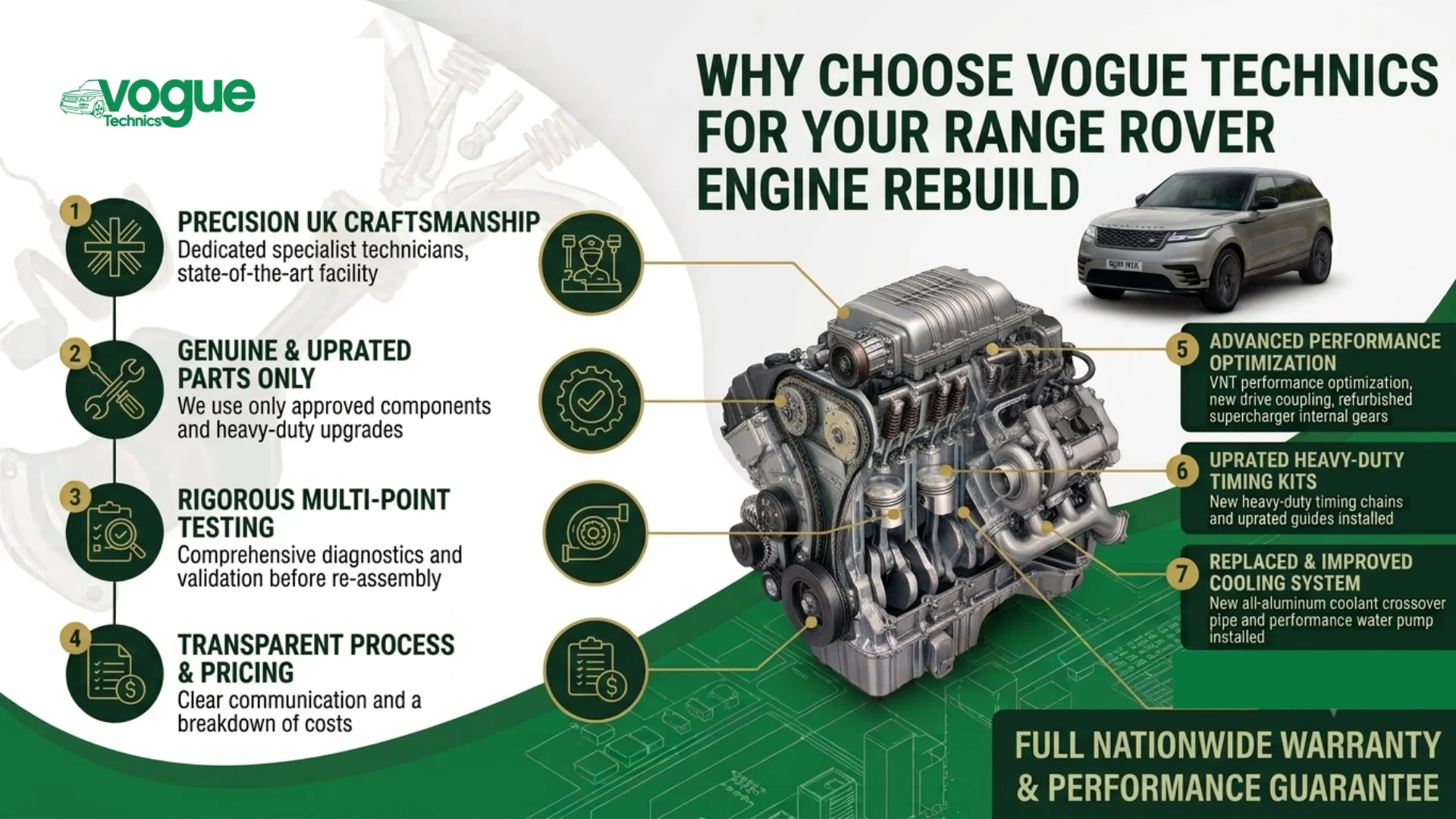
At Voguetechnics, we specialise specifically in Range Rover and Land Rover V8 engines, this isn't a general garage that occasionally sees an AJ133 come through the door. That focus matters when you're trusting someone with a five-figure vehicle.
Nationwide Collection & Delivery from Grays, Essex
We're based in Grays, Essex, and we arrange nationwide collection and delivery across the UK. Whether you're in London, Manchester, or further afield, you don't need to be local to us to use our rebuild service, we handle the logistics so your vehicle gets to us and back safely, with minimal disruption to you.
Warranty Cover: What's Protected After Your Rebuild
Every rebuild we carry out is backed by a warranty covering the core components we've worked on, the block, crankshaft, bearings, cylinder head, and supercharger reconditioning. We'll walk you through exactly what's covered before any work begins, so there's no ambiguity if you ever need to make a claim.
Frequently Asked Questions
How much does a Range Rover supercharged V8 rebuild cost in the UK? Costs depend on the extent of damage and whether components like the supercharger or cylinder liners need attention, but a full rebuild typically sits in the mid-to-upper cost range compared to buying a new engine outright, while offering comparable reliability when done properly.
Can the AJ133 engine be rebuilt after timing chain failure? In many cases, yes. If the chain failure is caught before it causes valve-to-piston contact, the block and crankshaft are often salvageable, making a rebuild a realistic and cost-effective option. If contact has occurred, the cylinder head and possibly the block will need closer inspection to confirm what's recoverable.
Do you collect vehicles from anywhere in the UK? Yes. We arrange nationwide collection and delivery from our base in Grays, Essex, so location isn't a barrier to using our service.
Is rebuilding better than replacing the whole engine? For many AJ133 failures, rebuilding your existing engine is more cost-effective than a full replacement, provided the core components (block and crankshaft) are undamaged. It also means your engine's known service history stays intact.
What's included in the warranty after a rebuild? Our warranty covers the core rebuilt components, including the block, crankshaft, bearings, and reconditioned supercharger. Full details are confirmed in writing before work begins so you know exactly what's protected.
Don't Let Engine Trouble Take Your Range Rover Off the Road
An AJ133 engine problem can feel overwhelming, especially with conflicting advice about whether to repair, rebuild, or replace. But with the right diagnosis and a specialist who actually understands this engine's specific weak points, most Range Rover owners can get back on the road with an engine that's genuinely more reliable than the one they started with.
If you're dealing with warning lights, unusual noises, or you've already had a diagnosis and want a second opinion on cost, get in touch with our team at Voguetechnics. We'll give you a clear, no-obligation assessment of what your engine actually needs, not just an upsell.
Get your free, no-obligation engine rebuild quote today, and find out exactly what it'll take to get your Range Rover running the way it should.