Range Rover Sport Oil Leak: Causes, Symptoms, Repair Costs and Expert Help in Grays, Essex
You spot a dark patch on the driveway, or a faint burning smell after a long run, or an oil warning that wasn't there last month. Any of these can point to a Range Rover Sport oil leak, and it's not a problem to leave for later.
A small seep from a worn seal costs relatively little to fix. The same leak, left alone, can starve the turbo, contaminate the drivetrain or damage the engine, and the bill grows quickly. This guide covers what causes these leaks, how to recognise them, what repairs typically cost and how to get them fixed properly in Essex.
Why Is My Range Rover Sport Leaking Oil? Symptoms and Common Leak Sources
The short answer: most Range Rover Sport oil leaks come from ageing seals, gaskets and oil lines. The usual culprits are the oil cooler and its housing, the turbo oil feed and return pipes, the rear differential, and the gearbox or transfer box seals. Heat cycles, mileage and hard use wear these parts down over time.
What Are the Symptoms of a Range Rover Sport Oil Leak?
Some leaks announce themselves. Others hide on top of an undertray for months. These are the signs we see most often:
- Oil spots under the car. Fresh oil usually looks dark brown or black. Gearbox and differential oil can be reddish or amber and smells sharper.
- A burning smell. Oil dripping onto a hot exhaust or turbo gives off an acrid smell, especially after a motorway run or when you stop.
- Low oil warnings. If the dashboard keeps asking for a top-up, oil is going somewhere. On models with a dipstick, check the level regularly. On models with an electronic oil level readout, take the warning seriously.
- Smoke from the engine bay. Light smoke on a hot engine often means oil is landing on a hot surface.
- Whining, clunking or rough shifting. These can mean low gearbox or differential oil, so a transmission-side leak is worth checking.
- A greasy, wet underside. A film of oil around the sump, gearbox or axles often shows exactly where the leak starts.
Each of these deserves attention, but the worst move is topping up the oil and ignoring the cause. You are masking the symptom while the fault keeps developing.
Which Parts Leak Most Often on the 3.0 TDV6 and L320 Models?
The L320 generation (2005 to 2013) and the later L494 share some weak points, and the 3.0 TDV6 diesel has a few of its own. The table below shows where leaks tend to start.
Leak source | Typical signs | Why it matters |
| Oil cooler and housing seals | Oil on the front of the engine, low oil, possible oil and coolant mixing | Can affect lubrication and cooling together |
| Turbo oil feed and return lines | Oil around the turbo, smoke, burning smell | Low oil pressure can damage the turbo |
| Rear differential seals | Oil on the rear axle, whining on the move | Low diff oil causes accelerated wear |
| Gearbox and transfer box seals | Reddish oil near the transmission, shifting problems | Low fluid can lead to costly transmission damage |
| Rocker cover and sump gaskets | Oil along the top or bottom of the engine | Usually simpler repairs if caught early |
If your vehicle is a 2010, 2011, 2012 or 2013 model, age and mileage make seal wear more likely. The 3.0 TDV6 is a capable engine, but the oil cooler area is a known place to look first when oil goes missing.
Is a Range Rover Sport Oil Cooler Leak, Turbo Leak or Differential Leak Behind Your Problem?
Where the oil appears tells you a lot. Use this as a starting point, not a final diagnosis.
Where you see oil | Likely source | What it usually looks like |
| Front or centre of the engine | Oil cooler leak | Dark oil, possibly with coolant loss |
| Around the turbo or on the exhaust side | Range Rover Sport turbo oil leak | Burning smell, light smoke |
| Rear of the vehicle, on the axle | Range Rover Sport differential oil leak | Thicker, darker gear oil |
| Mid-vehicle, near the transmission | Range Rover Sport gearbox oil leak | Reddish or amber fluid |
An oil cooler leak is one of the most common reasons owners search for an oil cooler Range Rover Sport repair. On a 2012 Range Rover Sport, oil cooler replacement means working through a tightly packed engine bay, so labour is a large part of the job. The L494 oil cooler area has its own access challenges, which is why a proper diagnosis before any parts are ordered saves money.
Owners of other models face similar issues. Land Rover Discovery oil leak problems often trace back to the same engine family, and Discovery 5 oil leak problems can come from the power transfer unit as well as the engine. Those are worth checking if you run both vehicles.
Don't guess. Confirm. A pressure test and a UV dye inspection can locate a leak that a visual check misses. Oil often travels along the underside before it drips, so the wettest spot is rarely the source.
How Much Does a Range Rover Sport Oil Leak Repair Cost?
Repair cost depends on three things: which part is leaking, how long it takes to reach it, and whether the job involves a seal or a whole component. Quoting a number without inspecting the vehicle would mislead you, so here is what actually drives the price.
What Affects Repair Costs on a 2010, 2011, 2012, 2013 or 2016 Range Rover Sport?
Cost factor | Effect on the bill |
| Type of leak | A rocker cover gasket is usually cheaper than an oil cooler or turbo line |
| Access and labour time | Components buried deep in the engine bay add labour hours |
| Seal vs. full component | Replacing a seal costs less than replacing a cooler or pipe set |
| Parts quality | Genuine or quality-matched parts cost more upfront but last longer |
| Related wear | Worn hoses, contaminated fluid or damaged parts can add to the job |
Model year matters too. A 2010 or 2011 vehicle with high mileage is likely to have several ageing seals, so a good technician will check neighbouring components while the area is open. A 2012 or 2013 model may need an oil cooler seal or full cooler replacement. A 2016 model is a newer L494, where leaks are often more localised, but the layout can still make access time-consuming.
Mileage, service history and previous repairs all shift the picture. A vehicle that has had regular oil changes and inspections is often easier to diagnose and repair.
Why fixing it early saves money: picture an owner who notices a few drips and puts off the repair for several months. The seal keeps weeping, the turbo runs low on oil, and a modest gasket job becomes a turbo and oil cooler repair. Acting early tends to keep a repair in the smaller category.
If you would like an accurate figure for your vehicle, request a free quote from our Essex workshop and we'll tell you what the job involves before any work begins.
Where Can I Get a Range Rover Sport Oil Leak Fixed in Grays, Essex?
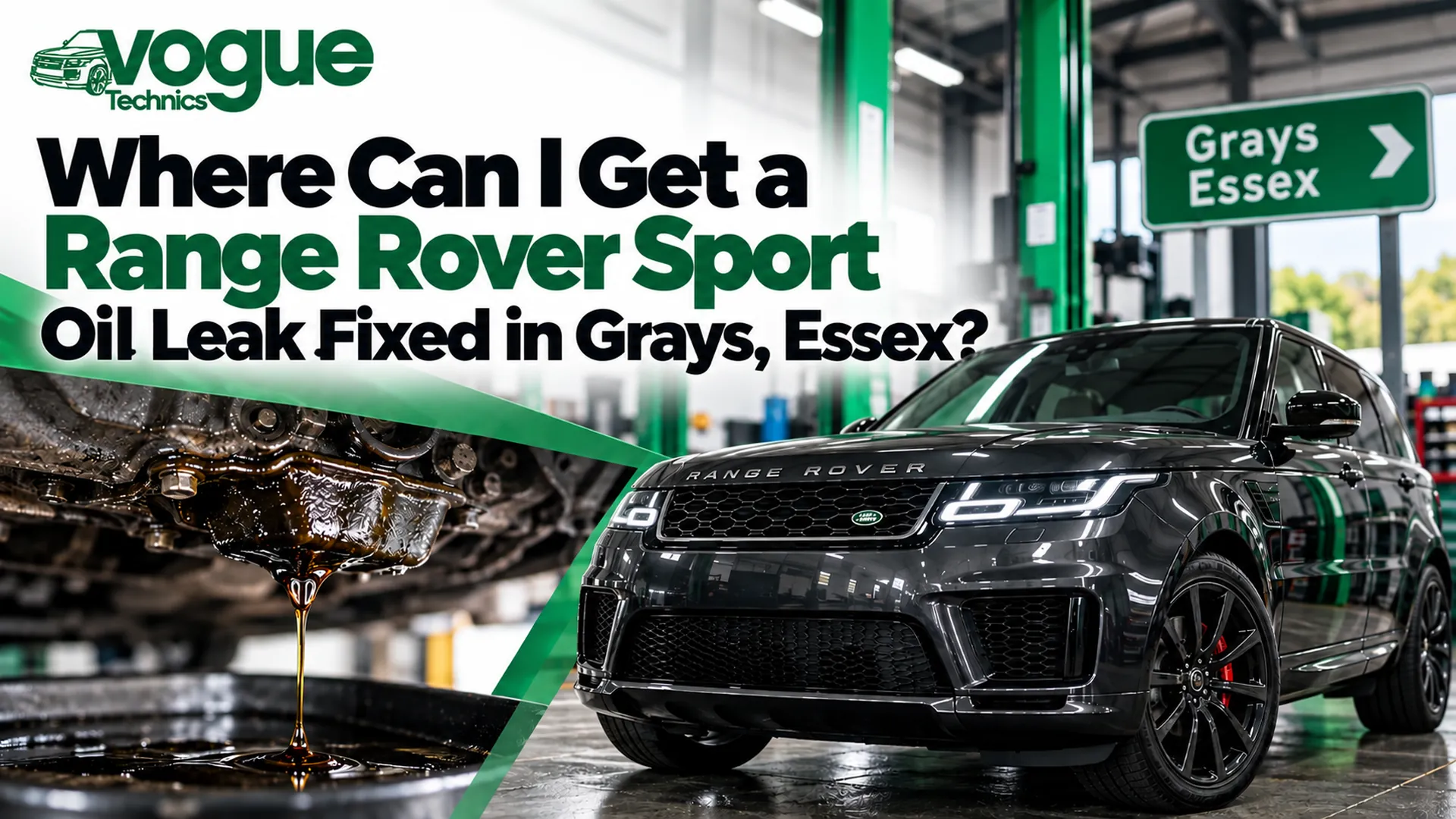
If you're searching for a specialist near you, look for a workshop that diagnoses first and repairs second. Replacing parts without finding the true source wastes money and leaves the leak in place.
Why Choose voguetechnics.co.uk for Land Rover Oil Leak Diagnosis and Repair?
At voguetechnics.co.uk, our Grays, Essex workshop treats an oil leak as a puzzle to solve properly. Our process follows four steps:
- Listen first. You tell us when you notice the leak, how often you top up and what the car does on the road. These details narrow the search.
- Trace the source. We clean the area, inspect it and use pressure testing and dye where needed to find the exact origin.
- Repair with precision. We replace the faulty seal, line or component and check surrounding parts that may have worn at the same time.
- Test and validate. After the repair, we road test the vehicle and recheck for leaks so you're not left wondering.
What you can expect from us:
- A clear explanation of what failed and why, without jargon.
- A quote before work starts, so there are no surprises.
- Parts matched to your model, whether you drive an L320 or an L494.
- Honest advice on what needs doing now and what can wait.
Consider a typical case: an owner brings in a Range Rover Sport with oil on the driveway and assumes the engine is failing. After a proper inspection, the leak turns out to be a worn rear differential seal. The repair is far smaller than the owner feared, and the vehicle returns to the road with confidence restored.
Frequently Asked Questions
Is it safe to drive a Range Rover Sport with an oil leak?
A very slight seep may be manageable for a short time, but it isn't safe to ignore. If the oil level drops or a warning appears, stop driving and have the vehicle checked.
What is the most common cause of a Range Rover Sport oil leak?
Worn seals and gaskets are the most common cause, with the oil cooler, turbo lines and rear differential being frequent trouble spots.
How do I know if my oil leak is from the oil cooler?
Signs include oil near the front of the engine, falling oil levels and sometimes coolant loss. Only an inspection can confirm it.
Can a Range Rover Sport differential or gearbox leak cause damage?
Yes. Low oil in the differential or gearbox speeds up wear and can lead to expensive failures if left unchecked.
How long does an oil leak repair take?
Simple gasket work can be quick, while oil cooler or turbo-related jobs take longer because of access. We'll give you a realistic time estimate when we quote.
Do all 3.0 TDV6 engines leak oil?
No. But the 3.0 TDV6 does have recognised weak points, particularly around the oil cooler, so it pays to monitor it as the vehicle ages.
Don't let a small drip become a big repair. A Range Rover Sport oil leak is far easier and cheaper to fix when it's found early, and a proper diagnosis protects your engine, turbo and drivetrain. If you're in Grays, Essex or nearby, contact voguetechnics.co.uk today to book an inspection and get a clear quote on the work your vehicle needs.