
Range Rover Vogue Timing Chain Problems: Symptoms, Causes, Diagnosis & Replacement Cost

You turn the key on a cold morning, and there it is, that metallic rattle from under the bonnet that wasn't there last winter. It fades after a few seconds, so you tell yourself it's nothing. Then it comes back the next morning. And the one after that.
If you're reading this, chances are your Range Rover Vogue is doing exactly that, or you're about to buy a used one and want to know what you're getting into. Either way, you're in the right place. Timing chain problems are one of the most common, and most misunderstood, issues affecting the Range Rover Vogue across the L322, L405 and now L460 generations, and they touch nearly every engine variant Land Rover has fitted, from the 5.0 V8 to the 2.0 Ingenium diesel.
This guide walks through exactly what's happening inside the engine when that rattle starts, which engines are most at risk, how a proper diagnosis is carried out, and what you can realistically expect to pay to put it right. We've based this on the patterns we see week in, week out at our workshop in Grays, Essex, working on Range Rovers that come in with precisely this complaint.
What Are the Symptoms of Range Rover Vogue Timing Chain Problems?
Timing chain wear rarely announces itself with a single dramatic symptom. It builds gradually, and the early signs are easy to dismiss, which is exactly why so many owners end up facing a much bigger bill than they needed to.
Why Does a Range Rover Vogue Rattle on Cold Start?
The cold-start rattle is the single most reported symptom, and there's a straightforward mechanical reason for it. Overnight, engine oil drains down from the top of the engine into the sump. The hydraulic timing chain tensioner relies on oil pressure to keep the chain taut against its guides. For those first few seconds after startup, before oil pressure builds back up, the tensioner can't do its job properly, so the chain is allowed to slap against its guides, producing that unmistakable metallic rattle.
On a healthy timing chain system, this gap is barely noticeable. On a worn one, the chain has already stretched slightly, the guides have worn down, or the tensioner itself is losing its ability to take up slack even once oil pressure is restored. That's when the rattle becomes louder, lasts longer, or starts showing up even after the engine has warmed through.
It's worth being honest here: not every cold-start noise is a timing chain. We cover how to tell the difference a little further down, because guessing wrong can mean paying for the wrong repair entirely.
Other Warning Signs, Misfires, Limp Mode & Loss of Power
As chain wear progresses beyond the "annoying noise" stage, it starts to actually affect how the engine runs. That's because the timing chain's entire job is to keep the camshaft and crankshaft precisely synchronised, and once that synchronisation drifts, the engine's computer notices immediately.
Common symptoms at this stage include:
- Rough idle, the engine feels less smooth at a standstill, sometimes with a slight vibration through the cabin
- Misfires, one or more cylinders firing incorrectly, often felt as a hesitation or stumble under acceleration
- Reduced power or sluggish acceleration, the engine management system pulling back performance to protect itself
- Limp mode, the vehicle restricting engine output and speed as a protective measure once timing deviation crosses a threshold
- Illuminated check engine light, almost always accompanies the above, and is the trigger for the fault codes below
- Difficulty starting, particularly noticeable in colder weather, as timing deviation makes ignition less reliable
If your Vogue has moved from "occasional rattle" into any of these territories, it's a strong signal that wear has progressed past the cosmetic-noise stage and into something affecting actual engine timing.
Range Rover Vogue Timing Chain Fault Codes (P0016, P0017, P0345)
When the engine control module detects that the camshaft and crankshaft are no longer correlating the way they should, it logs specific fault codes. On a Range Rover Vogue, the codes most commonly associated with timing chain wear include:
- P0016, Crankshaft/Camshaft Position Correlation (Bank 1, Sensor A)
- P0017, Crankshaft/Camshaft Position Correlation (Bank 1, Sensor B)
- P0018 / P0019, the equivalent codes for Bank 2 on V6 and V8 engines
- P0345, Camshaft Position Sensor Circuit (Bank 2), which frequently appears alongside correlation faults
These codes are pulled during a diagnostic scan and give a technician the first solid clue that something in the timing system has drifted out of spec.
Do These Codes Always Mean the Timing Chain Has Failed?
Not necessarily, and this is a distinction worth understanding before you commit to any repair. These fault codes indicate a timing correlation problem, not automatically a snapped or catastrophically failed chain. In some cases, the root cause is a faulty camshaft or crankshaft position sensor rather than actual chain wear. That's precisely why a proper diagnostic workflow (covered in the next section) matters so much, it separates a genuine chain/tensioner problem from a sensor fault that's considerably cheaper to fix.
What Causes Timing Chain Failure, and Which Engines Are Affected?
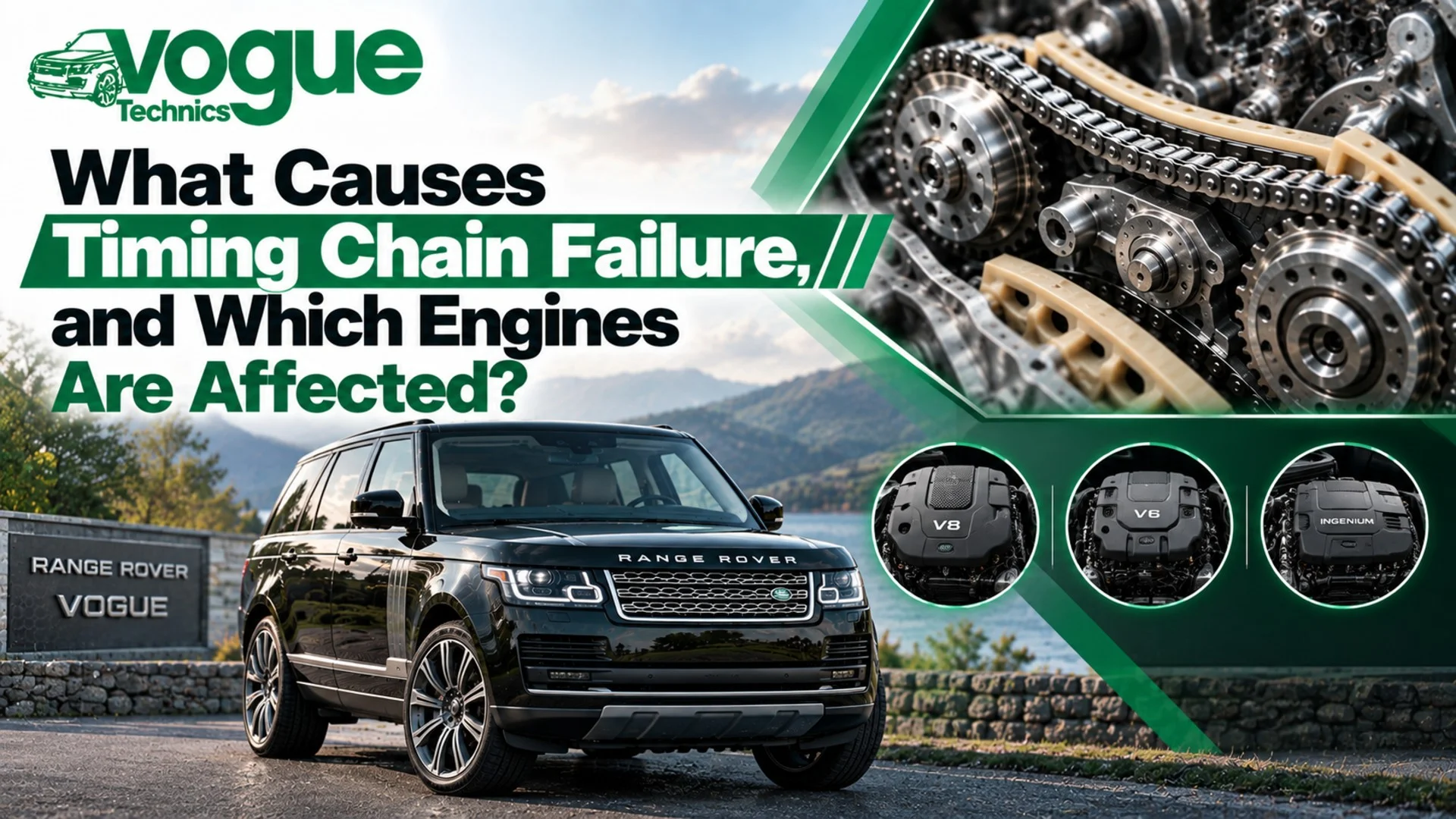
Timing chain failure on a Range Rover Vogue isn't a single fault, it's usually the end result of several components wearing down together: the chain itself stretching over time, the tensioner losing hydraulic effectiveness, and the plastic guide blades wearing thin from years of friction. Land Rover has even acknowledged repeat timing-chain-system noise complaints through technical service bulletins such as SSM71893, which identifies incorrect chain tension and outlines revised tensioner and guide-blade components as part of the fix, useful confirmation that this isn't an isolated or anecdotal issue.
Which Range Rover Vogue Engines Have Timing Chain Problems?
Not every engine in the Vogue line-up suffers in the same way, and the location and design of the timing chain varies significantly between petrol and diesel variants.
5.0 V8 Supercharged (AJ133), Tensioner & Guide Wear
The 5.0-litre supercharged V8 (AJ133), found in higher-spec L322 and L405 Vogues, is well documented for timing chain tensioner and guide wear. The chain itself tends to hold up reasonably well, but the plastic guide blades and hydraulic tensioners wear over time, particularly on vehicles that have covered high mileage on extended service intervals. This is the engine most associated with the classic cold-start rattle described above.
4.4 TDV8/SDV8 & 3.0 TDV6/SDV6, Rear Chain Wear
The diesel variants present a different, and often more expensive, challenge. On the 4.4 TDV8 and SDV8 engines, the timing chain sits at the rear of the engine, against the bulkhead, rather than at the front. That positioning means access for inspection or replacement is significantly more involved, often requiring the engine to be pulled forward or the transmission dropped, which pushes labour time and cost up considerably compared with a front-mounted chain. The 3.0 TDV6 and SDV6 units share a broadly similar architecture and face comparable wear patterns, particularly around chain guides and tensioner wear at higher mileages.
The 2.0-litre Ingenium diesel, fitted to later Vogue models, has its own well-documented timing chain fault pattern relating to chain and tensioner wear, and is worth treating as a separate diagnostic case given how different its layout is from the older V6/V8 units.
Engine | Chain Location | Typical Failure Point | Relative Repair Complexity |
| 5.0 V8 Supercharged (AJ133) | Front | Tensioner & guide wear | Moderate |
| 4.4 TDV8 / SDV8 | Rear | Chain & guide wear | High (engine access needed) |
| 3.0 TDV6 / SDV6 | Rear | Chain & tensioner wear | High |
| 2.0 Ingenium Diesel | Front | Chain, tensioner & guide wear | Moderate |
How Poor Maintenance and Extended Oil Intervals Accelerate Failure
Timing chain tensioners are hydraulic, they rely entirely on clean oil at the correct pressure to function. When service intervals get stretched, or the wrong grade of oil is used, several things happen at once: oil degrades and loses viscosity, sludge can build around the tensioner, and oil pressure delivery to the timing system becomes less consistent. Every one of those factors accelerates wear on the chain, guides and tensioner simultaneously.
We regularly see this pattern in workshop: two Vogues of the same age and mileage, one with a spotless service history and no timing chain complaint, the other with gaps in its oil-change record and a rattle that's been "monitored" for a year. The mechanical difference between the two often comes down almost entirely to maintenance discipline.
How Is a Timing Chain Problem Diagnosed, and What Does Replacement Cost?
This is usually the section owners care about most, and understandably so. But diagnosis has to come before cost, because guessing at a repair on a Range Rover Vogue can mean paying for parts and labour you didn't actually need.
How We Diagnose a Range Rover Vogue Timing Chain Fault
A proper diagnostic workflow goes well beyond "it's rattling, so it must be the chain." At our Grays workshop, a full timing chain assessment typically involves:
- Cold-start listening test, identifying exactly when, where and how the noise presents itself
- Full diagnostic scan, pulling stored and pending fault codes, including any camshaft/crankshaft correlation faults
- Cam/crank correlation analysis, using live data to check how far the timing has actually deviated, not just whether a code is present
- Oil pressure assessment, ruling out low oil pressure as a contributing or root cause
- Physical tensioner and guide inspection, where access allows, checking chain slack and guide wear directly
- Noise differentiation, ruling out other likely culprits (see below) before committing to a timing chain diagnosis
That last point matters more than most guides give it credit for. A cold-start rattle can come from several sources besides the timing chain, supercharger bearing wear, an accessory pulley, a belt tensioner, injector ticking, or even a bottom-end knock unrelated to timing at all. Correctly separating these before quoting for work protects you from paying for a timing chain replacement that was never going to fix the actual noise.
Timing Chain Repair vs Full Engine Rebuild, Which Do You Need?
The right level of repair depends entirely on how far the wear has progressed by the time it's caught.
Situation | Recommended Action | Why |
| Chain problem caught early, correlation fault minor | Timing chain, tensioner & guide replacement | Restores correct timing before internal damage occurs |
| Chain + guides + tensioner heavily worn | Full timing system repair | Addresses all wear points together to prevent repeat failure |
| Timing chain has jumped or snapped, valves affected | Engine rebuild | Internal components (valves, pistons) likely damaged and need repair or replacement |
| Existing engine uneconomical to repair | Engine replacement | Cost of rebuild exceeds the value of restoring the original engine |
The earlier a timing chain issue is caught, the more likely it is to fall into that first, least expensive category. This is really the central message of this whole article: a rattle you ignore for eighteen months can turn a straightforward chain-and-tensioner job into a full engine rebuild.
Range Rover Vogue Timing Chain Replacement Cost in Essex/UK
Costs vary considerably depending on engine type, how far wear has progressed, and whether it's a straightforward tensioner/guide replacement or a full timing system overhaul. As a general guide for UK independent specialist pricing (main dealer pricing typically runs higher):
- Tensioner and guide replacement only (caught early, front-mounted chain engines): generally the least expensive option
- Full timing chain kit replacement (chain, guides, tensioners, sprockets): a more involved job, particularly on rear-chain diesel engines requiring significant engine access
- Engine rebuild following chain jump or breakage: the most expensive outcome, and the one we're always trying to help owners avoid
Because pricing depends so heavily on your specific engine and the extent of wear, the most reliable way to get an accurate figure is a proper diagnostic inspection rather than a phone-quote guess. If you're local to Essex, we're happy to book your Vogue in for exactly that.
Can You Keep Driving, and How Do You Prevent Future Failure?

Is It Safe to Drive a Range Rover Vogue With a Noisy Timing Chain?
Short-term, a light cold-start rattle that disappears quickly generally won't strand you on the motorway tomorrow. But "safe for now" and "fine to ignore" are two very different things. Every mile driven on a worn chain adds further stretch and wear to the guides, and the progression tends to follow a predictable pattern:
Early wear → cold-start rattle → chain slack increases → timing deviation grows → chain jumps a tooth → piston-to-valve contact → engine rebuild or replacement
The earlier you're able to step off that path, the cheaper and less disruptive the fix.
What Happens If the Timing Chain Snaps?
This is the scenario every Vogue owner with a rattle is quietly worried about, and it's a fair concern. On an interference engine, which describes every Range Rover Vogue petrol and diesel unit, pistons and valves occupy the same space at different points in the rotation, kept apart only by precise timing. If the chain snaps or jumps significantly out of time, valves and pistons can physically collide. The result is typically bent valves at minimum, and potentially piston, cylinder head or camshaft damage in more severe cases, the difference between a chain-and-tensioner job and a full engine rebuild.
Buying a Used Range Rover Vogue? What to Check Before You Buy
If you're shopping for a used Vogue rather than currently owning one with a noise complaint, timing chain history deserves a place near the top of your checklist:
- Ask for full service history, specifically oil change records and intervals, gaps or stretched intervals are a red flag
- Request proof of any previous timing chain, tensioner or guide replacement, including invoices
- Do a cold-start test yourself, arrive when the car has been sitting for several hours, ideally overnight, and listen carefully at startup
- Get a pre-purchase diagnostic scan carried out by an independent specialist, checking specifically for stored or pending correlation fault codes
- Factor engine variant into your decision, a 4.4 TDV8/SDV8 with an untouched chain history carries a different risk profile than a 5.0 V8 given the rear-chain access issue
A seller who's upfront about chain history and welcomes a pre-purchase inspection is generally a good sign. Reluctance to allow one is worth paying attention to.
Frequently Asked Questions
How long does a Range Rover Vogue timing chain last?
There's no fixed mileage figure Land Rover publishes, and it varies significantly by engine and maintenance history. Well-maintained examples with consistent oil changes on the correct grade can go well past 100,000 miles without issue, while poorly maintained engines have shown problems considerably earlier. Service history is a far better predictor than mileage alone.
Can I just replace the tensioner instead of the whole chain?
Sometimes, yes, if the problem is caught early and the chain itself hasn't stretched significantly, tensioner (and often guide) replacement alone can resolve the noise and correlation issue. This is exactly why a proper diagnostic inspection matters before committing to a full chain kit replacement.
Will my warranty cover timing chain failure?
It depends entirely on your specific warranty terms and how the failure occurred. Extended or manufacturer warranties may cover it if maintenance records are complete and up to date; aftermarket warranties vary widely in what they classify as wear-and-tear versus a covered mechanical failure. Check your policy documentation, and don't assume either way without confirming.
Should I book a diagnostic check or go straight to replacement?
Always start with a diagnostic check. Timing chain symptoms can overlap with several other engine noises, and correlation fault codes don't automatically confirm chain failure versus a sensor issue. A proper inspection avoids paying for parts and labour that may not actually be needed.
Does a diesel Vogue's timing chain fail differently to the petrol V8?
Not in mechanism, but in access. The core wear process, chain elongation, guide wear, tensioner wear, is similar across engines. What differs is location: the 4.4 TDV8/SDV8 and 3.0 TDV6/SDV6 diesel chains sit at the rear of the engine, making inspection and replacement considerably more labour-intensive than the front-mounted chain on the 5.0 V8.
Getting Your Range Rover Vogue's Timing Chain Checked
A cold-start rattle is easy to explain away, but timing chain wear only moves in one direction. The gap between "a bit of noise on a cold morning" and "engine rebuild" is often smaller than owners expect, and it's almost always cheaper to close that gap early with the right diagnosis than to wait for a warning light or, worse, a jumped chain to force the issue.
If your Range Rover Vogue is rattling on start-up, throwing correlation fault codes, or you're weighing up a used purchase with an uncertain chain history, we'd rather you get a proper answer than keep guessing. At Voguetechnics, based in Grays, Essex, we work on Range Rover Vogues across the 5.0 V8, 4.4 TDV8/SDV8, 3.0 TDV6/SDV6 and Ingenium engine range every week, and a full diagnostic inspection is the fastest way to find out exactly what you're dealing with, and what it'll actually cost to fix.
Get in touch to book your Range Rover Vogue in for a timing chain diagnostic inspection.