
Range Rover Velar Timing Chain Issues: Symptoms, Causes, Costs & Repairs

That metallic rattle you hear when you start your Velar on a cold morning isn't your imagination, and it isn't "normal Land Rover character" either. If you've been searching for answers about Range Rover Velar timing chain issues, chances are you've already heard it yourself, or a mechanic has mentioned it during a service. Either way, you're right to take it seriously.
Timing chain problems on the Velar, particularly on the 2.0 Ingenium engines, are one of the most common reasons these vehicles end up in specialist workshops. Left unchecked, a worn chain can go from a mild annoyance to a five-figure engine rebuild. Caught early, it's usually a straightforward, contained repair.
This guide walks through exactly what's going on inside your engine, how to recognise the warning signs, what a proper diagnosis looks like, and what you should realistically expect to pay to have it fixed in the UK. We've written this based on years of hands-on experience with Ingenium engines at our workshop in Grays, Essex, so you're getting the same information we'd give a customer standing in front of us.
Does the Range Rover Velar Have Timing Chain Problems?
Yes. The Range Rover Velar, built on Jaguar Land Rover's L560 platform, is fitted with the Ingenium engine family, and certain variants within that family have a well-documented history of timing chain wear. This isn't a rare fault picked up by a handful of unlucky owners; it's a recurring pattern seen consistently by independent specialists and JLR dealers alike.
The issue centres on the timing chain, its guides, and the hydraulic tensioner that keeps everything under correct tension. Over time, and often well before you'd expect on a modern engine, these components can wear, stretch, or fail outright.
It's worth being clear about something from the start: not every Velar will develop this problem, and plenty run for years without any drama. But the failure rate is high enough that it's now a well-known consideration for anyone buying, owning, or maintaining one.
Which Range Rover Velar Engines Are Affected?
Timing chain problems aren't spread evenly across the Velar range. Some engines are affected far more than others, so it's worth knowing exactly what's under your bonnet.
2.0 Ingenium Diesel (D180, D200, D240)
The 2.0-litre Ingenium diesel is the engine most commonly associated with timing chain failure. Across the D180, D200, and D240 variants, owners and specialists report similar symptoms: a rattling noise on cold start, chain stretch showing up on inspection, and tensioner wear appearing earlier than it should on an engine of this age and mileage.
A large part of this comes down to how these diesel engines manage emissions. Diesel particulate filter regeneration cycles can lead to fuel entering the engine oil, a problem known as oil dilution, which we'll explain properly further down. That diluted oil doesn't lubricate as effectively, and the timing chain system feels the effects first.
2.0 Ingenium Petrol (P250, P300)
The petrol side of the Ingenium family, covering the P250 and P300 engines, isn't immune either. JLR technical documentation has recorded a timing-chain-area rattle concern on 2018-onwards Velar models fitted with the 2.0 Ingenium petrol engine.
The underlying mechanism differs slightly from the diesel dilution issue, but the outcome for the driver is much the same: a rattling noise, potential fault codes, and a chain system that needs proper inspection rather than being ignored.
How Common Is Timing Chain Failure on the Velar?
It's genuinely one of the most frequent mechanical issues we see come through the workshop on this model. Independent Land Rover specialists across the UK report similar patterns, and online owner communities are full of the same complaint, usually starting with "is this rattle normal?"
That said, "common" doesn't mean "guaranteed." Service history, driving style, and how quickly a problem is caught all influence whether a Velar develops full timing chain failure or just needs a routine tensioner or guide replacement somewhere down the line.
Range Rover Velar Timing Chain Symptoms & Warning Signs
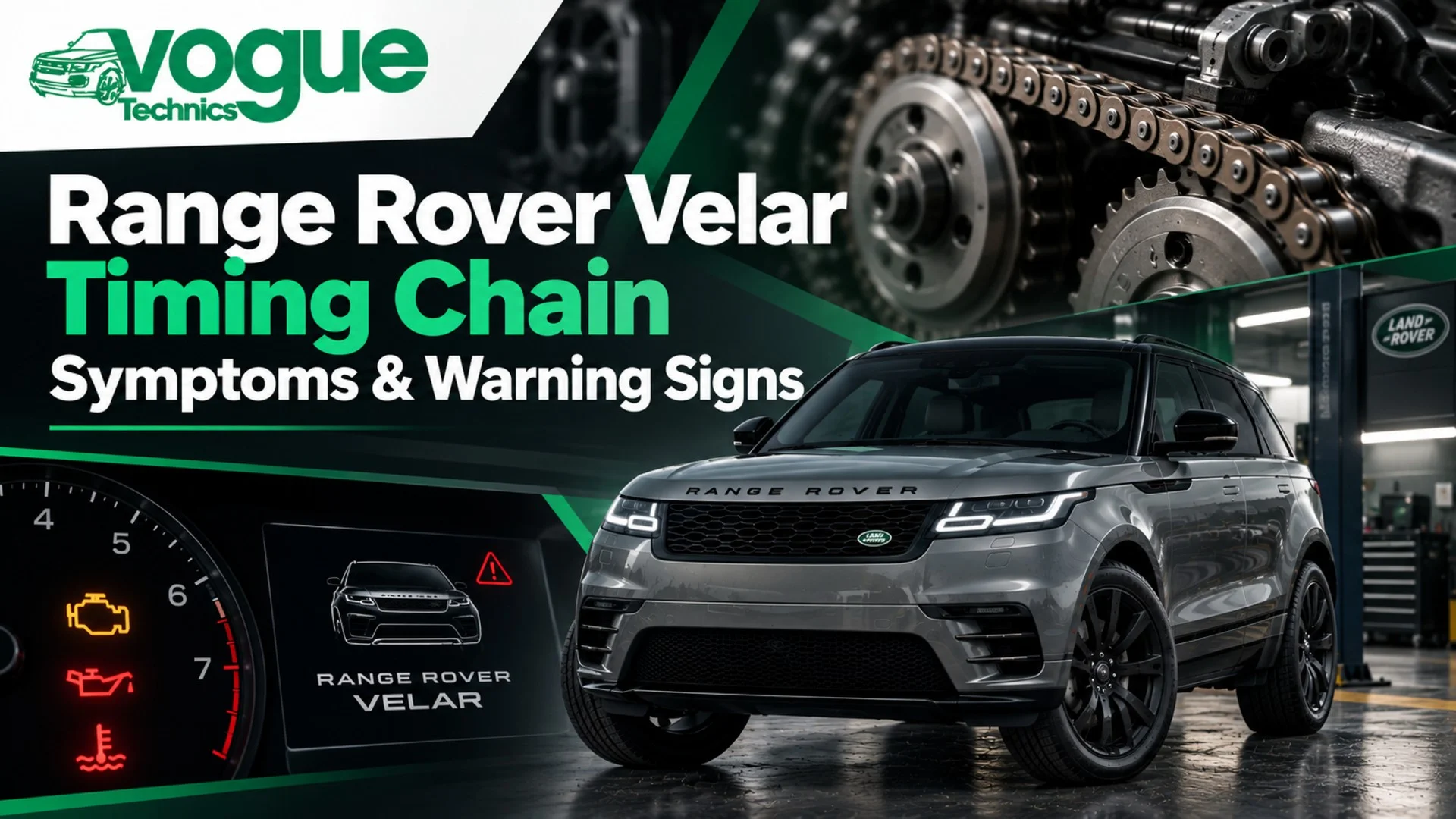
Catching a timing chain problem early is the single biggest factor in keeping repair costs down. The symptoms are usually audible before they become anything more serious, which gives you a genuine window to act.
What Does a Velar Timing Chain Rattle Sound Like?
Owners describe it in fairly consistent terms: a metallic rattling or chattering noise, sometimes compared to a bag of loose bolts or a diesel engine that's suddenly gone "tappety." It's not subtle once you know what you're listening for.
Cold-Start Metallic Rattle
The most telling symptom is a rattle that appears the moment you turn the key, particularly on a cold engine first thing in the morning. This happens because oil pressure takes a moment to build after a cold start, and if the tensioner or chain is already worn, that brief drop in lubrication is enough to let the chain slap against its guides.
Rattle That Disappears When the Engine Warms Up
Here's the part that catches a lot of owners out: the noise often fades or disappears entirely once the engine warms up and oil pressure stabilises. This leads people to assume the problem has "gone away." It hasn't. The underlying wear is still there, and the rattle will typically return, and usually worsen, over time.
Timing Chain vs VVT: How to Tell the Difference
Not every cold-start rattle is a timing chain problem, and this is where a lot of competitor advice falls short. A worn Variable Valve Timing (VVT) solenoid or VCT actuator can produce a surprisingly similar noise and can trigger overlapping fault codes.
The honest answer is that you can't reliably tell the difference by sound alone. A proper diagnosis needs to check:
- The timing chain and tensioner for physical slack or stretch
- The VVT/VCT solenoids for correct operation and oil flow
- Camshaft position sensors for accurate correlation with crankshaft data
- Oil pressure at idle and under load, since low pressure can mimic both faults
This is exactly why we always recommend a diagnostic inspection rather than guessing based on the noise alone. Replacing a timing chain kit when the real fault is a VVT solenoid wastes money and leaves the actual problem unresolved.
Range Rover Velar Timing Chain Fault Codes
When a timing chain or related component starts to fail, the engine management system usually picks it up before you do, storing diagnostic trouble codes that a scan tool can read. Here's a breakdown of the most relevant ones.
Fault Code | What It Relates To |
| P0016 | Crankshaft/camshaft correlation (Bank 1, Sensor A) |
| P0017 | Crankshaft/camshaft correlation (Bank 1, Sensor B) |
| P0011 | Camshaft/VVT performance, timing over-advanced |
| P0341 | Camshaft position sensor performance |
| P0366 | Camshaft position performance (Bank 1, Sensor B) |
| P052A | Cold-start camshaft timing performance |
P0016 / P0017 – Crankshaft/Camshaft Correlation
These codes indicate that the crankshaft and camshaft aren't rotating in the relationship the ECU expects. This is a classic sign of a stretched timing chain, since a stretched chain physically allows the camshaft to lag behind where it should be.
P0341 / P0366 – Camshaft Position Faults
These point to the camshaft sensor reporting performance issues, which can stem from a worn chain, a failing sensor, or a VVT fault. Again, this is where proper diagnosis earns its keep rather than assuming the worst-case scenario straight away.
Is It Safe to Drive a Velar With a Timing Chain Rattle?
We get asked this constantly, and the honest answer is: not indefinitely, and not without getting it checked. The progression typically looks like this:
Minor chain or tensioner wear leads to increased slack, which leads to timing deviation, which can eventually cause the chain to jump a tooth or, in worse cases, snap altogether. Once timing jumps on an interference engine like the Ingenium, pistons and valves can make contact, and that turns a contained repair into a full engine rebuild.
Continuing to drive on a rattling timing chain is a gamble. Some owners get months of warning before anything serious happens. Others have the chain fail within days of the noise first appearing. There's no reliable way to predict which category you're in without an inspection, which is why we'd always recommend booking a diagnostic the moment you notice the noise, rather than waiting to see if it gets worse.
What Causes Range Rover Velar Timing Chain Problems?
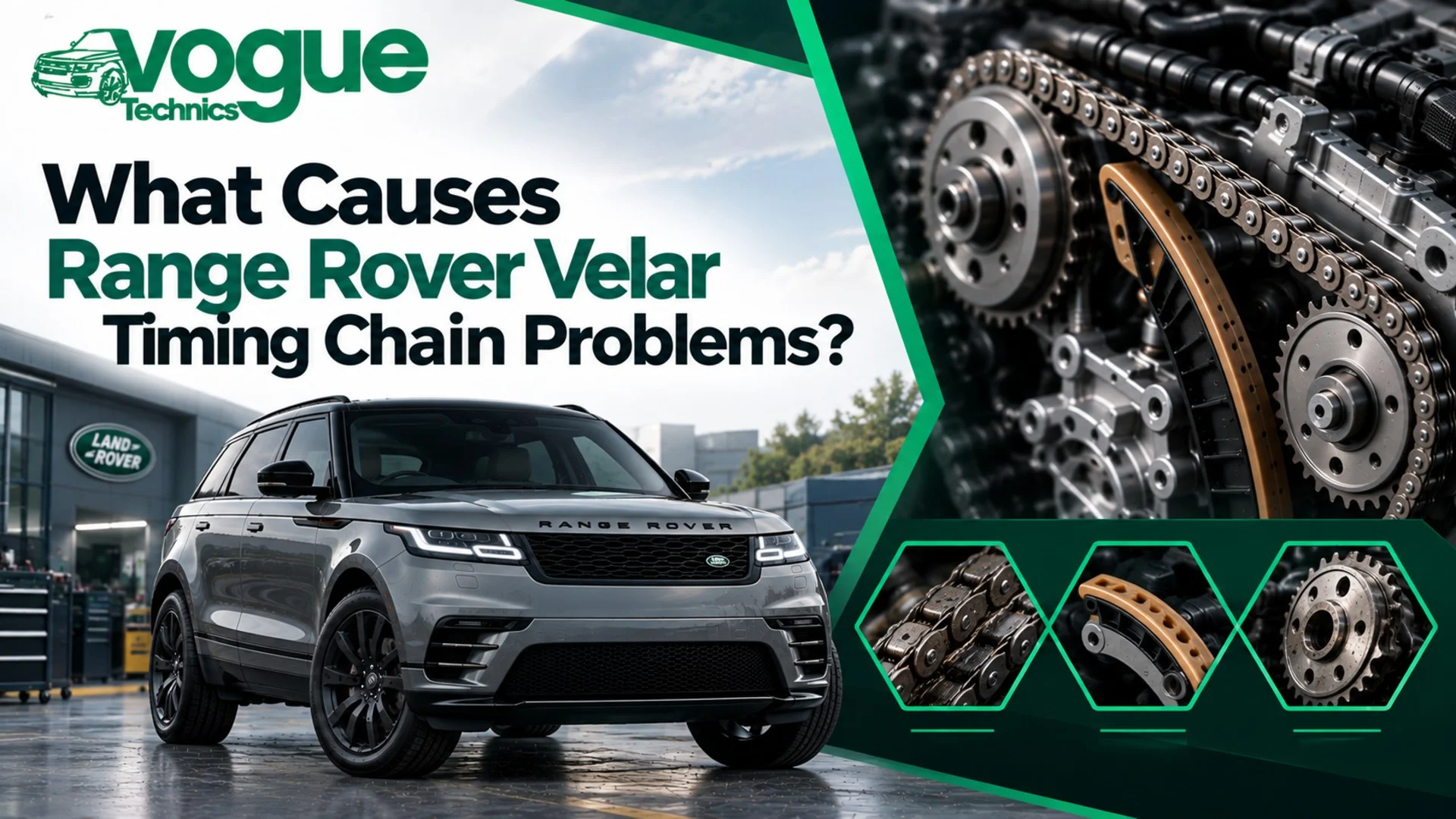
Understanding why this happens helps make sense of the repair recommendations and, more importantly, how to avoid a repeat failure down the line.
Timing Chain Stretch, Worn Guides & Tensioner Failure
Despite the name, a timing chain doesn't physically stretch like elastic. What actually happens is that the pins and rollers within the chain wear down slightly, and that cumulative wear across hundreds of links effectively lengthens the chain's working path. This is what mechanics mean when they refer to "chain stretch."
As the chain lengthens, it puts more strain on the plastic guides that keep it aligned, and on the hydraulic tensioner responsible for keeping it taut. Once the guides wear or the tensioner starts to lose its holding pressure, slack develops, and that's when you start hearing the rattle.
How Oil Dilution Affects the Ingenium Timing Chain
This is one of the most important, and most overlooked, factors behind Ingenium timing chain failure, particularly on the diesel models.
DPF Regeneration and Fuel-in-Oil Explained
To burn off trapped soot, the diesel particulate filter periodically goes through a regeneration cycle, during which extra fuel is injected into the cylinders. Some of that unburned fuel inevitably makes its way past the piston rings and into the engine oil.
Over time, and especially on cars used mostly for short journeys that don't let regeneration complete properly, this fuel-in-oil contamination builds up. Diluted oil is thinner, lubricates less effectively, and struggles to maintain correct pressure. The timing chain tensioner relies on stable oil pressure to function correctly, so diluted oil directly undermines its ability to keep the chain properly tensioned.
This is why we always check oil condition and service history as part of any timing chain investigation, not just the mechanical components themselves.
What Happens If the Timing Chain Jumps or Snaps?
This is the scenario every Velar owner wants to avoid. If chain slack becomes severe enough, the chain can skip a tooth on the sprocket, instantly throwing engine timing out of sync. On some Ingenium configurations, this is enough to let pistons strike open valves.
The consequences scale quickly:
- Jumped timing – engine runs roughly, throws multiple fault codes, may not start
- Bent valves – requires cylinder head removal and valve replacement
- Piston damage – often requires a full engine rebuild
- Snapped chain – almost always results in catastrophic internal damage
None of this is meant to alarm you unnecessarily. It's meant to explain clearly why we take every reported rattle seriously, and why "it's probably fine" isn't advice we're willing to give without actually looking at the car.
Range Rover Velar Timing Chain Repair & Replacement Cost
Once you've established there's a genuine timing chain issue, the next questions are always the same: how is it fixed, how long does it take, and what will it cost?
How Is a Velar Timing Chain Problem Diagnosed?
A proper diagnosis goes well beyond plugging in a code reader and reading whatever comes up. Here's what a thorough inspection should actually involve:
- Cold-start listening test to hear the rattle in the conditions it actually occurs
- Oil level and quality inspection, checking for dilution or contamination
- Fault code scan across the full engine management system
- Cam/crank correlation check using live data, not just stored codes
- VVT and VCT system testing to rule out solenoid or actuator faults
- Physical timing chain stretch assessment, where access allows
- Tensioner and guide inspection for visible wear or damage
- Engine timing verification to confirm whether components are still correctly aligned
Skipping steps here is how misdiagnosis happens, and misdiagnosis is how owners end up paying for parts that were never the actual problem.
Timing Chain Replacement Cost UK
Costs vary depending on the engine variant, how much labour access is needed, whether the tensioner and guides are replaced alongside the chain, and whether any secondary damage has already occurred. As a general guide, UK specialists typically quote anywhere from around £1,200 for a contained tensioner and chain kit replacement, up to £4,000 or more where the fault has progressed further or additional components need attention.
If the engine has sustained internal damage from jumped or snapped timing, costs climb sharply, since you're now looking at cylinder head work, valve replacement, or a full rebuild rather than a chain kit.
We'd always recommend getting a written diagnostic report and itemised quote before agreeing to any work, so you know exactly what you're paying for and why.
Does the Engine Need to Be Removed?
On several Ingenium configurations, the timing chain sits at the rear of the engine, closer to the bulkhead than the front grille. Depending on the specific variant and workshop setup, this can mean partial engine removal or a significant amount of dismantling just to gain access, which is a large part of why labour costs on this job run higher than you might expect for "just a chain."
Timing Chain Repair vs Engine Rebuild
Not every timing chain issue ends in the same outcome. The right course of action depends entirely on how far the problem has progressed.
Situation | Likely Repair Path |
| Early chain wear, rattle only | Timing chain kit replacement |
| Worn tensioner, chain still within tolerance | Tensioner and guide replacement |
| Damaged guides | Full chain kit including guides |
| Chain has jumped timing | Internal engine inspection required |
| Bent valves found | Cylinder head repair |
| Piston or valve damage confirmed | Full engine rebuild |
| Severe bottom-end damage | Engine replacement or reconditioned unit |
This is exactly why diagnosis has to come before any repair decision. Replacing a chain kit on an engine that's already sustained internal damage won't fix the underlying problem, and skipping straight to a rebuild when the fault is still contained wastes money unnecessarily.
How to Prevent Ingenium Timing Chain Problems
While you can't fully eliminate the risk on an engine design with known weaknesses, there's a lot you can do to reduce it and catch problems early:
- Stick to the correct oil specification for your engine variant, not just "any" suitable oil
- Shorten your oil change intervals if your Velar is mostly used for short journeys, since this reduces the impact of dilution
- Let DPF regeneration complete fully rather than cutting journeys short repeatedly
- Act on any rattle immediately, rather than waiting to see if it "sorts itself out"
- Keep a full service history, which also protects the car's resale value
- Have the timing chain checked as part of major services, even without symptoms, once the car passes 60,000–70,000 miles
None of these guarantee you'll never have a problem, but they meaningfully reduce the odds and, just as importantly, mean any issue that does develop is caught while it's still cheap to fix.
Book a Timing Chain Diagnostic With Voguetechnics (Grays, Essex)
If you've recognised any of the symptoms above in your own Velar, the worst thing you can do is wait and hope. At Voguetechnics, based in Grays, Essex, we carry out proper diagnostic inspections on Ingenium-engined Range Rover Velars, checking the timing chain, tensioner, guides, and related VVT components before recommending any repair work.
We'll give you a clear, honest assessment of exactly where your car stands and what it'll take to put right, with no pressure to agree to work you don't actually need. Whether you're dealing with an early-stage rattle or you're worried the problem has already gone further, getting it looked at properly now is always cheaper than waiting.
Frequently Asked Questions
How long does a Range Rover Velar timing chain last?
There's no fixed replacement interval from the manufacturer, since it's designed to last the life of the engine. In practice, problems commonly start appearing anywhere from 40,000 to 90,000 miles, particularly on diesel models affected by oil dilution.
How much does Velar timing chain replacement cost?
Costs typically range from around £1,200 for a contained tensioner and chain kit job, up to £4,000 or more depending on labour access and whether additional components need replacing. Costs rise significantly if internal engine damage has occurred.
Can a stretched timing chain damage the engine?
Yes. If left unaddressed, a stretched chain can eventually jump timing or snap, which on an interference engine can cause pistons to contact valves, resulting in serious internal damage.
Does the Velar have a timing chain or a timing belt?
The Range Rover Velar uses a timing chain across its Ingenium engine range, not a timing belt. Chains are generally more durable than belts but aren't maintenance-free, and they're not designed to be routinely replaced like a belt would be.
Is it normal for a Velar to rattle on cold start?
No. While it's a commonly reported issue, a cold-start rattle is not something to dismiss as normal engine character. It's almost always worth having checked by a specialist familiar with Ingenium engines.
A rattling Velar isn't a car to ignore or hope improves on its own. The earlier a timing chain issue is caught, the simpler and cheaper the fix tends to be, and the more likely you are to avoid the kind of internal engine damage that turns a routine repair into a major rebuild. If you're hearing anything unusual from your Velar's engine, get it looked at properly, and get the full picture before deciding what to do next.