Range Rover TDV8 Timing Chain Issues: Symptoms, Causes, Diagnosis & Replacement Cost (UK Guide)

That metallic rattle from under the bonnet on a cold morning isn't your imagination. If you drive a Range Rover with the TDV8 diesel V8, and you've heard a knocking, clattering noise that seems to fade once the engine warms up, you're probably dealing with one of the most talked-about faults in the model's history: timing chain wear.
Here's the good news first. Not every rattle means catastrophic failure, and not every TDV8 needs an engine rebuild. But ignoring the noise, or misdiagnosing it, can turn a manageable repair into a five-figure one. This guide walks through exactly what's happening inside your engine, how to tell a genuine timing chain fault from something else entirely, what it costs to fix in the UK, and what to check before you buy a used TDV8.
We've built this around the real questions owners type into Google at 11pm after hearing a strange noise on the driveway — not generic engine theory.
What Are the Common Range Rover TDV8 Timing Chain Issues?

Before diagnosing anything, it helps to know exactly which engine you're dealing with. "TDV8" isn't one single engine — it's a family, and mixing them up leads to wrong parts, wrong advice, and wasted money.
Which Range Rover TDV8 Engines Use a Timing Chain?
Every version of the TDV8 diesel V8 fitted to Range Rover models uses a timing chain rather than a belt. That's a deliberate design choice from Land Rover, intended to reduce the need for scheduled belt changes. In practice, though, the chain, its tensioner, and its guides are still wear items — they just don't have a fixed replacement interval the way a cam belt does.
The TDV8 badge covers three distinct engines, each with its own displacement, engine code, and typical application:
Engine | Displacement | Engine Code | Common Applications |
| 3.6 TDV8 | 3.6L | 368DT | Range Rover L322, Range Rover Sport L320 |
| 4.4 TDV8 | 4.4L | 448DT | Range Rover L322 |
| 4.4 SDV8 | 4.4L (4,367cc) | 448DT | Range Rover L405, Range Rover Sport L494 |
The 4.4 TDV8 and 4.4 SDV8 share the same 448DT engine block and the same AJD-V8 (Lion engine) lineage, just fitted to later platforms with updated software and turbo hardware. The 3.6 TDV8, by contrast, is a genuinely different engine — the 368DT — and shouldn't be assumed to share identical failure patterns, part numbers, or repair costs with the 4.4-litre versions.
If you're trying to work out which one you have, your V5C logbook and VIN plate will confirm the exact engine code, and any competent specialist can cross-reference it against Land Rover's TIS (Technical Information System) parts data before quoting.
3.6 TDV8 vs 4.4 TDV8 vs 4.4 SDV8 — What's the Difference?
- 3.6 TDV8 (368DT): The earlier, smaller-capacity unit. Known for its own set of chain and injector-related issues, generally regarded as slightly less powerful and, in owner circles, a step behind the 4.4 in outright reliability reputation.
- 4.4 TDV8 (448DT): Found in the L322-generation Range Rover. A stronger, more refined unit than the 3.6, but timing chain wear at the rear of the engine remains a well-documented weak point, particularly on higher-mileage examples with patchy service history.
- 4.4 SDV8 (448DT): Essentially the same core engine as the 4.4 TDV8, carried forward into the L405 Range Rover and L494 Range Rover Sport, with turbo, EGR, and emissions updates. Timing chain wear symptoms are broadly similar, though later software and hardware revisions have narrowed some of the earlier failure points.
What Causes TDV8 Timing Chain Problems?
Timing chain failure on a TDV8 rarely happens overnight. It's almost always the end point of a gradual wear process, and understanding that process is genuinely useful if you own or are about to buy one.
The main contributing factors include:
- Chain stretch over time. Every timing chain elongates slightly as it wears. On a TDV8, this stretch changes the relationship between crankshaft and camshaft timing, which is exactly what triggers the fault codes and rattle you'll read about below.
- Tensioner wear. The hydraulic tensioner is designed to take up slack automatically as the chain stretches. When it starts to wear or lose oil pressure efficiently, it can't keep the chain taut, and slack develops — this is usually where the rattle originates.
- Guide wear. Plastic or composite guides keep the chain running true. As they wear down, the chain can move slightly off its intended path, adding to noise and accelerating further wear.
- Extended oil change intervals. The TDV8's timing chain sits at the rear of the engine and relies on clean, correctly pressured oil for lubrication. Stretched service intervals or infrequent oil changes are consistently linked to earlier chain and tensioner wear.
- High mileage without preventative attention. Chains don't fail at a fixed mileage, but the risk curve rises steadily past the 100,000–150,000-mile mark, especially on vehicles with incomplete service history.
None of these factors act in isolation — a vehicle with a thin service history and high mileage and inconsistent oil changes is a genuinely different risk profile to a well-maintained example with full history, even if both show the same mileage on the clock.
Range Rover TDV8 Timing Chain Failure Symptoms & Diagnosis
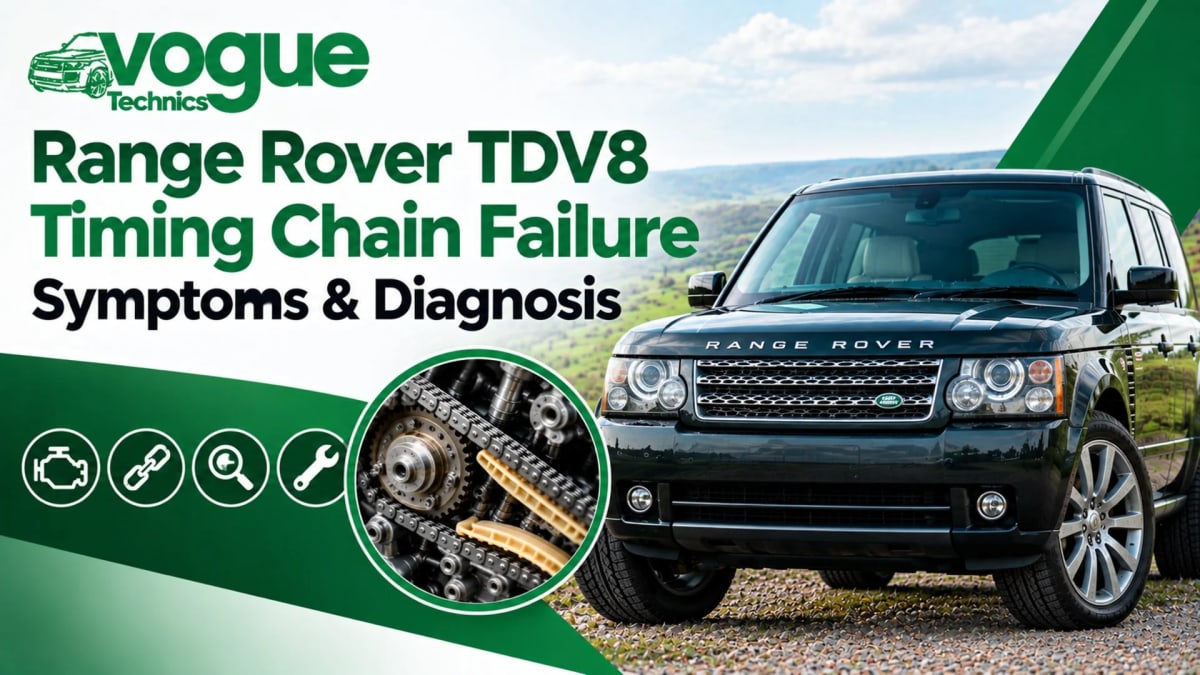
This is the section most people land on with a specific noise in mind. It's also where a lot of guides oversimplify things — treating every rattle as confirmed chain failure. That's not accurate, and it's not helpful. Let's be more precise.
What Does a TDV8 Timing Chain Rattle Sound Like?
Owners consistently describe genuine TDV8 timing chain rattle in similar terms:
- A metallic, clattering rattle on cold start-up, most noticeable in the first few seconds
- A noise that often fades or disappears once the engine reaches operating temperature
- A sound that seems to come from deep in the engine, toward the rear rather than from an accessory belt or the front of the block
- In more advanced cases, a persistent tapping or ticking that doesn't fully go away even when warm
If your engine does this every single cold start, it's worth taking seriously — not necessarily as an emergency, but as something that needs a proper diagnostic check rather than a guess.
TDV8 Timing Chain Rattle vs Other Engine Noises (Fuel Pump, Injectors & More)
This is one of the most overlooked parts of TDV8 diagnosis, and it matters. Owner discussions and independent forums have repeatedly noted that not every rattle traces back to the timing chain. Some owners running TDV8-powered Range Rovers for years report never experiencing genuine chain failure, despite occasional startup noise — because the actual source turned out to be something else.
Other components that can produce similar noise include:
- The high-pressure fuel pump (HPFP), which can generate a mechanical clatter that's easily mistaken for chain rattle by an untrained ear
- Injector tick, a lighter, faster ticking noise distinct from a chain's heavier rattle
- Auxiliary belt tensioners or idlers, particularly if worn, though these tend to be more audible from the front of the engine
- Turbo actuator components, which can produce noise under specific load conditions rather than purely on cold start
The honest takeaway: a cold-start rattle is a strong indicator, not a diagnosis. Treating every noise as confirmed chain failure can lead to unnecessary spending on the wrong repair — while dismissing a genuine rattle as "just the fuel pump" can lead to a much more expensive failure later. Neither guess is good enough on its own.
How Is a TDV8 Timing Chain Problem Diagnosed?
A proper diagnosis combines listening, testing, and reading live data — not just one of these on its own.
A thorough diagnostic process typically includes:
- Cold-start listening test — assessing the noise's character, location, and how it changes as the engine warms
- Diagnostic scan for stored and pending fault codes
- Cam/crank correlation check using live data, to see whether the actual timing relationship has drifted
- Oil pressure assessment, since low pressure can both cause and accompany chain-related wear
- Physical inspection of tensioner and guide condition where access allows
- Process of elimination for HPFP, injector, and auxiliary component noise
Diagnostic Scan & Fault Codes (P0016 / P0017 / P0008)
If a diagnostic scan is run, certain fault codes are strong indicators of a genuine timing-related issue:
- P0016 – Crankshaft/camshaft correlation fault (Bank 1)
- P0017 – Crankshaft/camshaft correlation fault (Bank 2)
- P0008 – Engine position system performance fault
These codes suggest the actual timing relationship between the crankshaft and camshaft has shifted beyond expected tolerance — which is a meaningful step up from "there's a noise." That said, codes alone aren't a complete diagnosis. They point a technician in the right direction, but should be confirmed against live data and, ideally, physical inspection before any repair is booked.
Cam/Crank Correlation & Live Data Test
This is where diagnosis becomes genuinely reliable rather than guesswork. By reading live crankshaft and camshaft position data while the engine runs, a technician can see whether the timing relationship is within Land Rover's specified tolerance or has drifted — which is the clearest confirmation of chain stretch or tensioner failure available without opening the engine.
Can You Drive a Range Rover TDV8 With Timing Chain Rattle?
This is one of the most common questions we get asked, and the honest answer depends on the noise pattern.
Generally lower risk (but still worth booking a check):
- A brief rattle only on the very first cold start, gone within a second or two, with no warning light
Higher risk — get it looked at promptly:
- A rattle that's getting louder or lasting longer over successive weeks
- Any accompanying engine warning light or timing-fault code
- Rough idle or a noticeable misfire alongside the noise
- Any loss of power or hesitation under acceleration
- Difficulty starting, or the engine cranking longer than usual before firing
If the rattle is worsening, or if it's paired with any of the symptoms above, the safest approach is to limit driving to what's necessary and get a diagnostic check booked. A timing chain that's slipped even slightly can, in the worst case, lead to valve-to-piston contact — and that turns a chain replacement into a full cylinder head and potentially engine rebuild job. Catching it early is genuinely the difference between a moderate repair bill and a very large one.
TDV8 Timing Chain Replacement Cost & Repair Options

Once a genuine timing chain issue is confirmed, the next question is almost always about cost — and reasonably so, given how much the price range can vary depending on how far the problem has progressed.
How Much Does TDV8 Timing Chain Replacement Cost in the UK?
Costs vary based on the specific TDV8 variant, labour rates in your area, whether genuine or quality aftermarket parts are used, and — critically — how much of the engine needs to come apart to reach the chain.
Repair Scope | What's Involved | Typical UK Price Range* |
| Tensioner replacement only | Isolated tensioner fault caught early | Lower end of repair costs |
| Full timing chain kit (chain, tensioner, guides) | Standard chain replacement with engine access | Mid-range |
| Chain replacement + head inspection | Where timing has drifted and valve clearance needs checking | Higher mid-range |
| Full engine rebuild | Confirmed valve or piston damage from a jumped/broken chain | Highest — often approaching or exceeding a replacement engine |
| Replacement/reconditioned engine | Where rebuild costs approach or exceed a used engine's value | Varies by supplier and warranty |
*Exact pricing depends on your specific vehicle, engine variant, and the specialist carrying out the work. Always request a written quote based on an actual diagnostic assessment rather than a phone estimate.
The reason costs escalate so sharply between tiers is straightforward: catch a tensioner or early chain stretch issue quickly, and it's a contained repair. Let it progress to a jumped timing chain, and you're now looking at valve damage, cylinder head work, and potentially internal engine damage — a completely different scale of job.
Does TDV8 Timing Chain Replacement Require Engine Removal?
On most TDV8 variants, yes — at least partially. The timing chain on this engine family sits at the rear, which is a significantly less accessible position than a front-mounted chain or belt. In many cases, the engine needs to be removed from the vehicle, or at minimum substantially disassembled in situ, to gain proper access to the tensioner, guides, and chain itself.
This rear-mounted position is the single biggest reason TDV8 timing chain work costs more than a comparable job on many other engines — it's a labour-intensive repair by design, not because a specialist is overcharging.
Timing Chain Replacement vs Engine Rebuild — Which Do You Need?
This is a genuinely important decision point, and it's worth understanding before you commit to either.
A straightforward timing chain kit replacement is usually appropriate when:
- The fault has been caught early, with no confirmed valve or piston contact
- Diagnostic data shows timing has drifted but not catastrophically
- There's no history of the engine running with a jumped or slipped chain
Cylinder head inspection becomes necessary when:
- Timing correlation faults suggest significant drift
- There's any suspicion the chain has skipped a tooth
- The vehicle has been driven for any length of time with an active rattle or warning light
A full engine rebuild — or a replacement engine — becomes the realistic option when:
- Valve-to-piston contact is confirmed
- Internal engine damage has occurred from a broken or badly jumped chain
- The cost of parts and labour to rebuild in place approaches or exceeds the cost of a quality reconditioned or replacement engine
There's no universally "correct" answer here — it depends entirely on what the diagnosis actually finds, the vehicle's overall condition, and its value relative to repair cost. A specialist who inspects the vehicle properly, rather than quoting over the phone, is the only reliable way to make this call.
Why Choose Voguetechnics for TDV8 Timing Chain Repair in Essex?
We're based in Grays, Essex, and TDV8 diagnostics and engine work are a regular part of what we do — not a sideline. That matters on an engine family where the difference between a proper diagnosis and a guess can be a few hundred pounds versus several thousand.
When you bring a TDV8-powered Range Rover to us, you get:
- A genuine diagnostic process — cold-start assessment, fault code reading, and cam/crank correlation checks, not just a visual glance and a quote
- Straight answers on whether you're looking at a tensioner fix, a full chain kit, or something more serious — including when a rebuild genuinely isn't the right call
- Access to quality parts sourced against correct TIS references for your exact engine variant (3.6 TDV8, 4.4 TDV8, or 4.4 SDV8)
- Transparent, written quotes before any work begins, so you're never guessing what the final bill will look like
If you're hearing a rattle, seeing a warning light, or you've just picked up a diagnostic report you don't fully understand, get in touch and we'll talk you through exactly what it means for your vehicle.
Preventing Problems & Buying a Used Range Rover TDV8

Whether you already own a TDV8 or you're weighing one up as a purchase, a little diligence here goes a long way toward avoiding an expensive surprise.
How to Prevent TDV8 Timing Chain Problems
You can't make a timing chain last forever, but you can meaningfully reduce the risk of premature failure:
- Stick to manufacturer-recommended oil change intervals — or tighten them if the vehicle sees a lot of short journeys or cold starts, both of which are harder on chain lubrication
- Use the correct oil specification every time, not just "something close enough"
- Don't ignore a cold-start rattle, even a brief one — get it checked rather than hoping it goes away
- Keep a full service history, including any timing chain or tensioner work, as this becomes valuable evidence of the engine's condition
- Book a periodic health check on higher-mileage vehicles, even with no symptoms, particularly once you're past 100,000 miles
None of these guarantee a chain will never wear out — that's simply not realistic on any high-mileage V8 — but consistent maintenance measurably shifts the odds in your favour.
Buying a Used Range Rover TDV8: Timing Chain Checks to Make
Buying a used TDV8 without checking for timing chain history is a genuine gamble. Here's what's worth doing before you commit:
- Listen to a cold start. Ask the seller not to start the engine before you arrive, so you hear it completely cold — this is the single most revealing test.
- Ask for full service history, specifically looking for evidence of regular oil changes and any documented timing chain, tensioner, or guide work.
- Request or arrange a diagnostic scan for stored and pending fault codes, including timing correlation codes.
- Factor mileage into your risk assessment — a vehicle well past 100,000–150,000 miles with patchy history carries meaningfully more risk than a lower-mileage example with full records.
- Get a pre-purchase inspection from an independent specialist rather than relying solely on the seller's word or a basic AA/RAC check — a specialist familiar with TDV8 engines will know exactly what to listen and look for.
- Negotiate on uncertainty, not just faults. If service history is incomplete and you can't get a proper diagnostic check done before purchase, that uncertainty has a cost — reflect it in your offer.
A vehicle with full history, recent chain-related work, and a clean diagnostic scan is a fundamentally different proposition to one with none of that — even if the asking price and mileage look identical on paper.
Frequently Asked Questions About TDV8 Timing Chain Issues
Does the Range Rover TDV8 have a timing chain?
Yes. All TDV8 variants — the 3.6 TDV8, 4.4 TDV8, and the related 4.4 SDV8 — use a timing chain rather than a timing belt, positioned at the rear of the engine.
How long does a TDV8 timing chain last?
There's no fixed replacement interval, unlike a cam belt. Chain life depends heavily on maintenance history, oil change frequency, and mileage. Many run well past 100,000 miles without issue when properly maintained; others show wear earlier if service intervals have been stretched.
Is TDV8 timing chain failure common?
It's a well-documented issue within the TDV8 range, but it's not universal. Plenty of well-maintained examples run trouble-free for very high mileages. Risk rises with age, mileage, and inconsistent servicing rather than being an inevitability on every vehicle.
What causes TDV8 timing chain rattle?
Most commonly, chain stretch combined with tensioner or guide wear, often linked to extended oil change intervals or reduced oil pressure over time.
How much does TDV8 timing chain replacement cost?
It varies significantly depending on whether it's an isolated tensioner fix, a full chain kit replacement, or a job that's escalated to cylinder head inspection or engine rebuild. Always get a written quote based on an actual diagnosis for your specific vehicle.
Can you drive with a TDV8 timing chain rattle?
A very brief cold-start rattle with no other symptoms is lower risk short-term, but still worth checking. A worsening rattle, any warning light, rough running, or loss of power means you should get it diagnosed promptly rather than continuing to drive on it.
Is the timing chain at the front or rear of the TDV8 engine?
At the rear — which is why access for repair typically requires substantial disassembly or full engine removal, and why the job costs more in labour than a front-mounted chain would.
Should I buy a Range Rover with timing chain noise?
Not without a proper diagnostic assessment first. A confirmed, worsening chain issue should be factored hard into your offer, or walked away from if the seller won't allow an inspection. Some noises turn out to be unrelated components, so don't assume the worst — but don't assume the best either.
Your Next Step on TDV8 Timing Chain Issues
A timing chain rattle on a Range Rover TDV8 isn't automatically a disaster — but it isn't something to shrug off either. The vehicles that avoid five-figure repair bills are almost always the ones where the owner acted early: got a proper diagnosis, understood exactly what the fault codes and live data were showing, and made an informed repair decision rather than a rushed one.
If you're hearing a rattle, staring at a P0016 or P0017 code, or you're about to buy a used TDV8 and want peace of mind before you hand over the money, Voguetechnics is based right here in Grays, Essex, and works on these engines regularly. Get in touch for a proper diagnostic assessment and a straight, written quote — no guesswork, no unnecessary upsell, just an honest read on what your engine actually needs.