Range Rover SVR Overheating Problems: Causes, Symptoms & Repair Costs

If your Range Rover Sport SVR's temperature gauge is climbing, or you've watched the coolant warning light flash on during a school run or a motorway drive, you're not imagining it, and you're definitely not alone. Overheating on the SVR's 5.0-litre supercharged AJ133 V8 is one of the most common reasons owners end up searching for a specialist rather than booking straight into a main dealer.
The tricky part is that overheating rarely has one single cause. It could be something as simple as a low coolant level, or something far more serious like a cracked coolant pipe hiding beneath the supercharger, out of sight until the damage is already done. Left unchecked, what starts as a warning light can turn into a warped cylinder head or a blown head gasket, and that's a very different repair bill.
This guide walks through exactly why Range Rover SVRs overheat, how to tell the difference between a minor coolant issue and a genuine emergency, what a proper diagnosis actually involves, and what you should expect to pay to get it fixed properly.
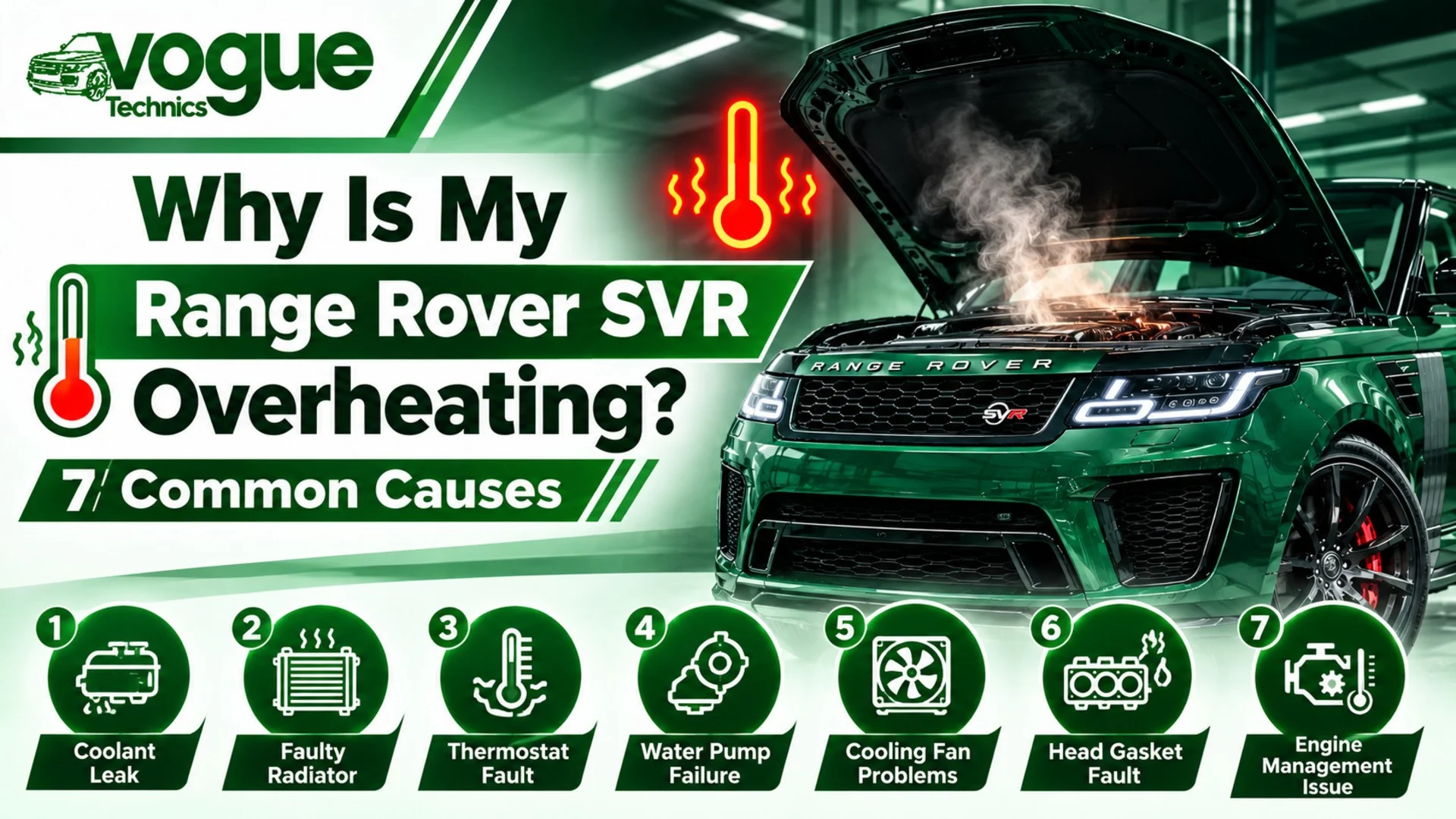
Why Is My Range Rover SVR Overheating? 7 Common Causes
The AJ133 5.0-litre supercharged V8 runs hot by design, it's a high-output engine producing serious power from a relatively compact block, which means the cooling system has very little margin for error. When any single component in that system underperforms, engine temperature can climb faster than on a naturally aspirated V8.
Here are the seven causes we see most often when diagnosing SVR overheating problems.
Coolant Leaks and Coolant Loss
This is the number one cause of Range Rover SVR overheating, and it's not always obvious. A leak can be external, a puddle under the car, a damp patch on the engine bay floor, or internal, where coolant is being lost into the combustion chamber or oil system without ever hitting the ground.
Common leak points on the SVR include the coolant reservoir, hose connections, and O-ring seals around pipe joints. If your coolant level keeps dropping and you can't find a puddle anywhere, don't assume the system is fine, an internal leak is often worse than an external one.
Cracked Plastic Coolant Pipes (AJ133 Weak Point)
This is arguably the most important entity relationship to understand on this engine. The AJ133 uses plastic coolant pipes and connectors routed around and beneath the supercharger. Over time, repeated heat cycles, the engine heating up and cooling down thousands of times, make this plastic brittle.
Eventually, a pipe or connector cracks, usually right where you can't see it without stripping the supercharger housing. This is a known design weak point on the 5.0 supercharged V8, and it's one of the most frequent causes of coolant loss with no visible external leak.
Water Pump Failure
The water pump keeps coolant circulating through the block, radiator, and supercharger circuit. When the impeller wears, the pulley bearing fails, or the seal starts weeping, circulation drops and hot spots develop in the engine even if the coolant level looks normal.
A failing water pump often shows early warning signs, a faint coolant smell, a slight pulley wobble, or coolant staining near the pump housing, before it fails completely.
Thermostat or Thermostat Housing Failure
The thermostat controls when coolant starts circulating through the radiator. If it sticks closed, the engine can't shed heat and temperature spikes quickly, even at idle. If it sticks open, the engine may run cooler than normal but struggle to reach and hold optimum operating temperature.
The thermostat housing itself, often made partly from plastic, is also a known leak point as it ages and the seals harden.
Radiator Restriction or Failure
A radiator that's internally blocked with scale or debris, or externally clogged with road debris and insects, can't dissipate heat efficiently. On the SVR, this becomes more noticeable during heavy load, towing, hard acceleration, or extended motorway driving in warm weather.
Cooling Fan Failure
The electric cooling fan is essential at low speed and idle, where there isn't enough airflow through the radiator naturally. If the fan motor fails, the relay sticks, or the fan doesn't ramp up correctly, you'll typically notice overheating specifically in traffic or at idle, with temperatures normalising once you're moving again.
Air Trapped in the Cooling System (Airlock)
This one catches a lot of owners out, especially after a recent coolant top-up, hose replacement, or DIY repair. Trapped air creates pockets that block proper coolant circulation, even though the reservoir looks full. Airlocks won't resolve themselves, the system needs to be properly bled using the correct procedure for the AJ133, or the overheating will keep coming back.
Range Rover SVR Overheating Symptoms, What to Look For
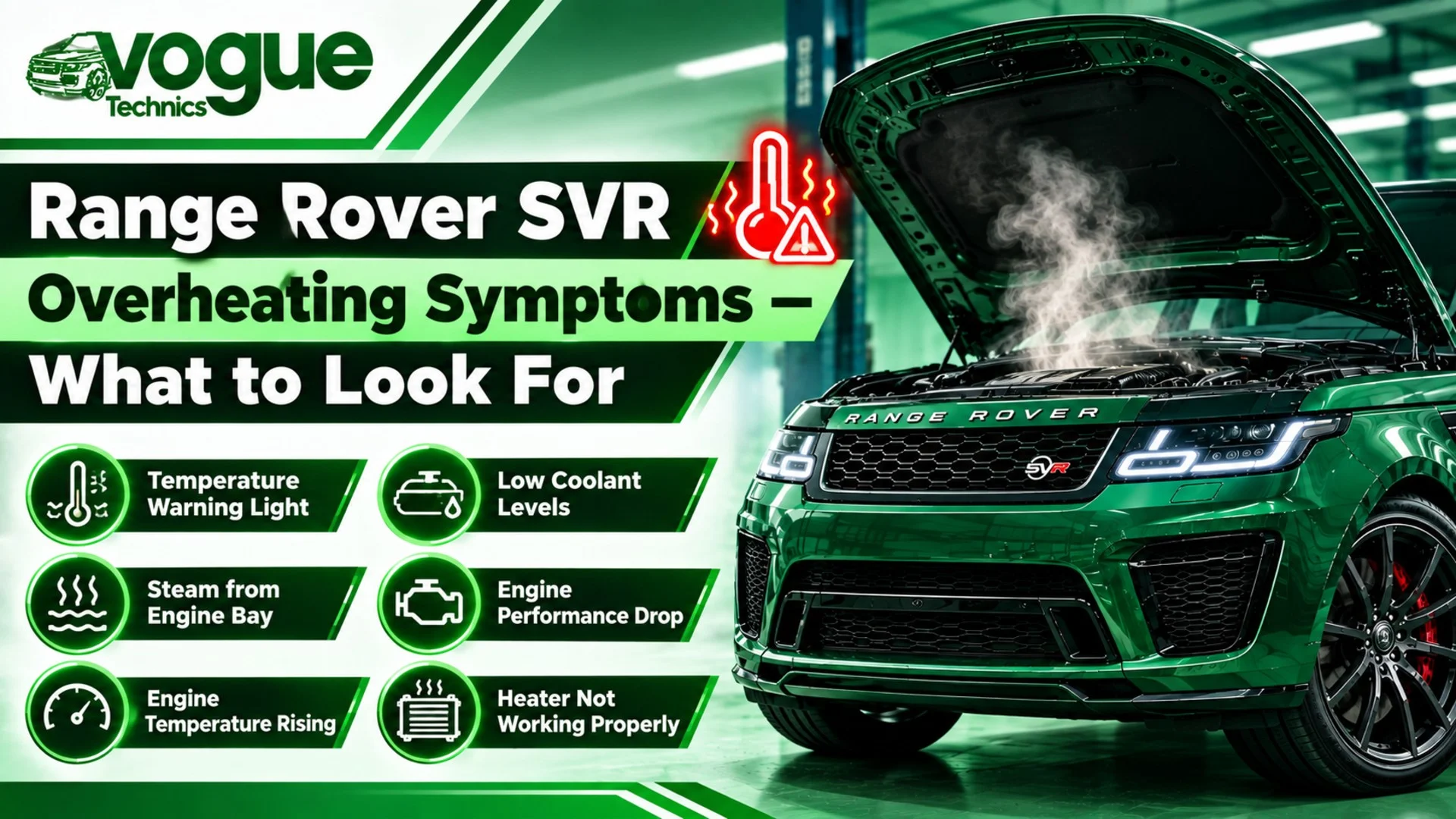
Recognising the early signs of a cooling problem can be the difference between a straightforward repair and a full engine rebuild. Here's what to watch for.
- Temperature gauge climbing above normal, especially during idle, traffic, or towing
- Coolant warning light on the dashboard
- Coolant smell inside or outside the cabin
- Steam or white smoke from under the bonnet
- Coolant reservoir running low repeatedly, even after topping up
- Fan running constantly, or continuing to run after the engine is switched off
- Reduced engine performance or the car entering limp mode
- Rough idle or misfire shortly after a period of overheating
If you notice more than one of these together, it's worth booking a proper inspection before you drive the car any further.
Coolant Warning Light vs Actual Overheating, What's the Difference?
These two things get confused constantly, and understanding the difference matters.
A low coolant warning simply means the reservoir has dropped below a set level. The engine itself may still be running at a completely normal temperature. This is worth investigating, but it's not necessarily an emergency.
Actual overheating means the engine's operating temperature has genuinely risen above its safe range, shown on the temperature gauge itself, not just a reservoir sensor. This is the situation where you need to stop driving and let the engine cool down before continuing.
The key takeaway: a coolant warning light with a normal temperature gauge reading is a "book it in soon" situation. A rising temperature gauge is a "pull over now" situation.
Why Is My SVR Overheating in Traffic or at Idle?
If overheating only happens at low speed or when stationary, but the temperature drops back to normal once you're moving, this points strongly toward a cooling fan problem. At speed, airflow through the radiator does the fan's job for it. At idle, the fan has to work alone, and if it's failing, that's when the problem shows up.
Why Is My SVR Losing Coolant With No Visible Leak?
This is one of the most common, and most misleading, SVR cooling complaints. If you're topping up coolant regularly but there's no puddle under the car and no obvious wet patch in the engine bay, there are two likely explanations: a cracked plastic coolant pipe leaking internally near the supercharower, or an internal leak into the combustion chamber via a failing head gasket.
The only reliable way to tell these apart is a proper pressure test and, if needed, a combustion-gas test on the coolant. Don't keep topping up and hoping it resolves itself, coolant doesn't disappear without a reason.
Head Gasket Failure vs External Coolant Leak
Because these two issues often present with similar symptoms, coolant loss and rising temperature, it helps to see them side by side.
Symptom | External/Pipe Leak | Head Gasket Failure |
| Coolant loss | Yes | Yes |
| Visible puddle or wet patch | Often | Usually not |
| White smoke from exhaust | Rarely | Possible |
| Combustion gases in coolant | No | Possible |
| Oil contaminated with coolant | No | Possible |
| Pressure test result | Drop in pressure, visible source | May hold pressure initially |
| Repair complexity | Low to moderate | High, often requires cylinder head removal |
If a pressure test doesn't reveal an obvious external source and the coolant keeps disappearing, a combustion-leak test should be the next step before assuming the worst. It's a far cheaper test than a wrong guess.
How Much Does It Cost to Fix an Overheating Range Rover SVR?
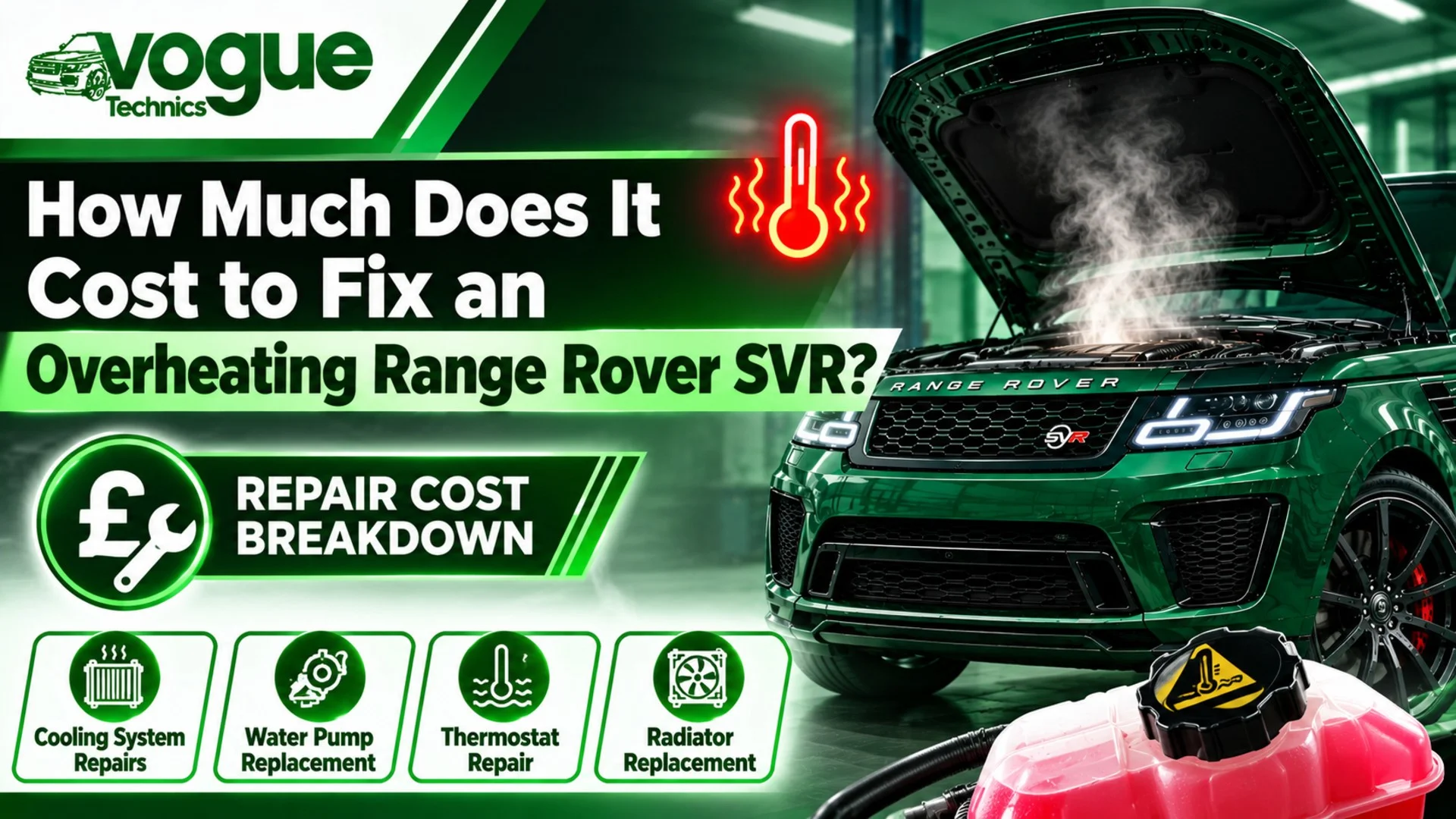
Repair costs vary significantly depending on what's actually wrong, so a single "average price" isn't very useful. Below is a realistic cost breakdown by fault type, based on typical UK independent specialist pricing. Always ask for a written quote after diagnosis, since parts and labour vary by garage and by exact vehicle year.
Diagnostic & Pressure Testing Cost
A proper diagnostic, including a cooling-system pressure test, visual inspection, and OBD scan, typically costs a modest fixed fee and should always be the starting point. Skipping this step and guessing at parts is the single most common way owners end up paying twice.
Coolant Leak & Pipe Repair Cost
Repairing a leaking hose connection or O-ring is relatively affordable. Replacing the plastic coolant pipes near the supercharower is more involved, since it usually requires partial removal of the supercharger housing to access them, this pushes labour time up significantly compared with a simple hose repair.
Water Pump & Thermostat Replacement Cost
Water pump replacement on the AJ133 involves more labour than on a simpler engine layout, due to its position relative to the supercharger and ancillary components. Thermostat and housing replacement is generally less labour-intensive but still requires careful bleeding of the system afterward to avoid airlocks.
Radiator Replacement Cost
A full radiator replacement is one of the pricier individual jobs, largely due to the parts cost on a performance-spec radiator plus the labour to access and refit it correctly.
Head Gasket Repair vs Engine Rebuild, Cost Comparison
This is where costs escalate sharply, and it's exactly why catching overheating early matters so much.
Repair Type | Typical Scope | Relative Cost |
| Coolant leak repair | Hose, O-ring, or reservoir fix | Low |
| Coolant pipe replacement | Supercharger-area pipes | Moderate |
| Water pump / thermostat | Component replacement | Moderate |
| Radiator replacement | Full radiator swap | Moderate–High |
| Head gasket repair | Cylinder head removed, gasket replaced, head skimmed if needed | High |
| Engine rebuild | Internal damage from prolonged overheating | Very High |
| Engine replacement | Reconditioned or replacement AJ133 unit | Highest |
The pattern is clear: catching a cooling fault at the "leak or component failure" stage is dramatically cheaper than letting it progress to head gasket or engine damage. If your SVR has overheated even once and you kept driving, it's worth having the head gasket and cylinder head checked as a precaution, not just the obvious leak.
Why Choose Voguetechnics for Range Rover SVR Overheating Repairs in Essex

Cooling system faults on the AJ133 aren't always straightforward, and a misdiagnosis can mean paying for parts that were never the problem in the first place. Working on Range Rover and Jaguar Land Rover engines specifically, rather than treating them like any other V8, means knowing exactly where the AJ133's known weak points are, including the plastic coolant pipes that so many owners never think to check.
Our AJ133 Diagnostic & Repair Process
A thorough diagnosis follows a clear sequence rather than guesswork:
- Visual inspection of hoses, pipes, and connection points for obvious leaks or damage
- Coolant level and condition check, looking for contamination that might indicate internal leaks
- Cooling-system pressure test to identify the exact source of any leak
- Thermostat and water pump function checks under real operating conditions
- OBD diagnostic scan to pull any stored temperature or sensor fault codes
- Combustion-gas or block test where head gasket failure is suspected
This step-by-step approach means you get an accurate diagnosis and a proper quote before any work begins, not a guess based on the most commonly replaced part.
Book a Range Rover SVR Cooling System Inspection in Grays, Essex
If your SVR is showing any of the warning signs covered above, the best time to get it checked is before it overheats badly enough to cause internal damage. Voguetechnics, based in Grays, Essex, works specifically with Range Rover and Jaguar Land Rover vehicles, including the 5.0-litre supercharged AJ133 engine used in the SVR.
Get in touch to book a cooling system inspection and receive a clear, itemised quote before any work starts.
Frequently Asked Questions
Why does my Range Rover SVR keep overheating even after I've topped up the coolant? Topping up treats the symptom, not the cause. If coolant keeps dropping, there's an active leak somewhere in the system, often a cracked plastic coolant pipe near the supercharger, which won't show as an external puddle. A pressure test is needed to find the actual source.
Can I keep driving my Range Rover SVR if it's overheating?
No. Continuing to drive with the temperature gauge in the red risks warping the cylinder head and blowing the head gasket, turning a moderate repair into an engine rebuild. If the gauge is rising, pull over safely, switch off the engine, and let it cool before arranging recovery or a inspection.
How do I know if it's a head gasket or just a coolant leak?
Look for white smoke from the exhaust, a rough idle after the car has overheated, or coolant that keeps disappearing with no visible puddle. A pressure test combined with a combustion-gas test on the coolant is the only reliable way to confirm which one it is.
What temperature should a Range Rover SVR run at normally?
Like most modern performance engines, the AJ133 is designed to run within a specific operating range shown by the gauge sitting in its normal mid-range position. Any sustained movement toward the high end, or the gauge climbing toward the red zone, indicates a fault that needs investigating.
Is overheating a common problem on the Range Rover SVR?
It's a well-documented issue linked to the AJ133's plastic coolant pipe design and the demands placed on the cooling system by a high-output supercharged engine. It isn't universal, but owners researching SVR reliability should be aware of it and prioritise regular cooling-system checks.
Does adding coolant fix overheating?
Only if low coolant was genuinely the entire cause, which is rare. In most cases, topping up coolant is a temporary fix that masks an underlying leak or component failure that will resurface.
How much does it cost to fix an overheating Range Rover SVR?
It depends entirely on the cause, a simple hose or O-ring repair costs far less than a coolant pipe replacement, and both are considerably cheaper than head gasket repair or an engine rebuild. Getting a proper diagnosis first avoids paying for the wrong repair.
Getting Your SVR's Cooling System Sorted Properly
Overheating on a Range Rover SVR is almost never something to ignore or wait out. The AJ133's supercharged V8 puts real demands on its cooling system, and the known weak points, particularly those plastic coolant pipes, mean that what looks like a minor coolant top-up issue can be an early warning of something more serious.
The single most useful thing you can do is get it properly diagnosed at the first sign of trouble: a warning light, a rising gauge, or coolant that keeps disappearing. Catching a cooling fault early is the difference between a moderate repair bill and a full engine rebuild.
If your Range Rover SVR is showing any of these signs, get in touch with Voguetechnics in Grays, Essex, to book a cooling system inspection and get a clear diagnosis before the problem gets worse.