Range Rover SVR Engine Oil Consumption Problem: Causes, Symptoms, Diagnosis & Fixes
If you're topping up your Range Rover SVR's engine oil more often than you'd like, you're not imagining things. The 5.0-litre supercharged V8 in the Range Rover Sport SVR is a genuinely thrilling piece of engineering, but it's also developed a reputation among owners and independent specialists for using oil faster than most petrol engines its size. Whether you've noticed the oil level creeping down between services, seen a whiff of smoke on a hard pull, or simply want to understand what's normal before it becomes a problem, this guide walks through exactly what's going on under the bonnet, and what to do about it.
We'll cover why the AJ133 engine consumes oil, how to tell a genuine leak from internal oil burning, the diagnostic steps a proper inspection should include, and what your repair options look like if the problem turns out to be more than just a top-up habit.
Why Is My Range Rover SVR Using So Much Engine Oil?
Every internal combustion engine uses a small amount of oil as part of normal operation. Oil lubricates moving parts, some of it inevitably reaches the combustion chamber in tiny amounts, and it burns off. That's expected. The question owners actually want answered is: where's the line between normal and excessive?
Is Oil Consumption Normal on a Range Rover SVR 5.0 V8?
For most modern petrol engines, oil consumption of around one litre per 6,000–10,000 miles is generally considered acceptable. The supercharged 5.0-litre V8 (badged AJ133 within Jaguar Land Rover's engine family) runs higher internal pressures and temperatures than a naturally aspirated engine because of the supercharger, and JLR's own guidance has historically allowed for a higher consumption tolerance than you'd expect from a standard family car.
That said, "the manufacturer allows for it" and "it's not a problem" aren't the same thing. If you're adding oil every 1,000–2,000 miles, or the low oil warning light is becoming a familiar sight, that's a pattern worth investigating rather than dismissing.
Common Causes of Excessive Oil Consumption on the AJ133 Engine
Oil doesn't just vanish. It either leaves the engine through an external leak, or it's being drawn into the combustion chamber and burned internally. Here's what typically drives each scenario on this engine.
Worn Piston Rings and Cylinder Bore Wear
Piston rings seal the combustion chamber and control how much oil reaches the cylinder walls. As they wear, particularly the oil control ring, oil starts working its way past them and burning alongside the fuel. This tends to show up as blue exhaust smoke, especially under load or acceleration, and it's more common as mileage climbs.
Failing PCV or Breather System
The Positive Crankcase Ventilation (PCV) system manages pressure inside the crankcase and routes vapour back through the intake. When the PCV valve or breather diaphragm fails, crankcase pressure can build up, oil vapour gets pulled into the intake in larger quantities than intended, and consumption rises. This is one of the more commonly overlooked causes because it doesn't always produce an obvious external symptom.
Worn Valve Stem Seals
Valve stem seals stop oil from seeping down the valve guides into the combustion chamber. When they harden or wear with age and heat cycles, oil creeps past them, often most noticeable as a puff of smoke on cold start or after the car has been idling, since oil pools around the valves when the engine is at rest.
External Oil Leaks (Rocker Cover, Oil Cooler, Sump)
Not every case of "oil consumption" is internal at all. Gaskets and seals around the rocker cover, oil cooler housing, sump, and timing cover are common points where oil simply leaks out, sometimes dripping visibly, sometimes burning off a hot exhaust manifold before you ever see a puddle on the driveway.
How Much Oil Loss Is Considered Excessive? (Litres per 1,000 Miles)
A rough way to think about it:
- Under 0.5 litres per 1,000 miles, generally within normal range for this engine
- 0.5–1 litre per 1,000 miles, worth monitoring closely and checking service history
- Over 1 litre per 1,000 miles, typically considered excessive and warrants a proper diagnostic inspection
These figures aren't exact science, driving style, short journeys versus motorway miles, and how hard the car is driven all affect the number. But they give you a useful benchmark rather than guessing.
Range Rover SVR Oil Consumption Symptoms & Warning Signs
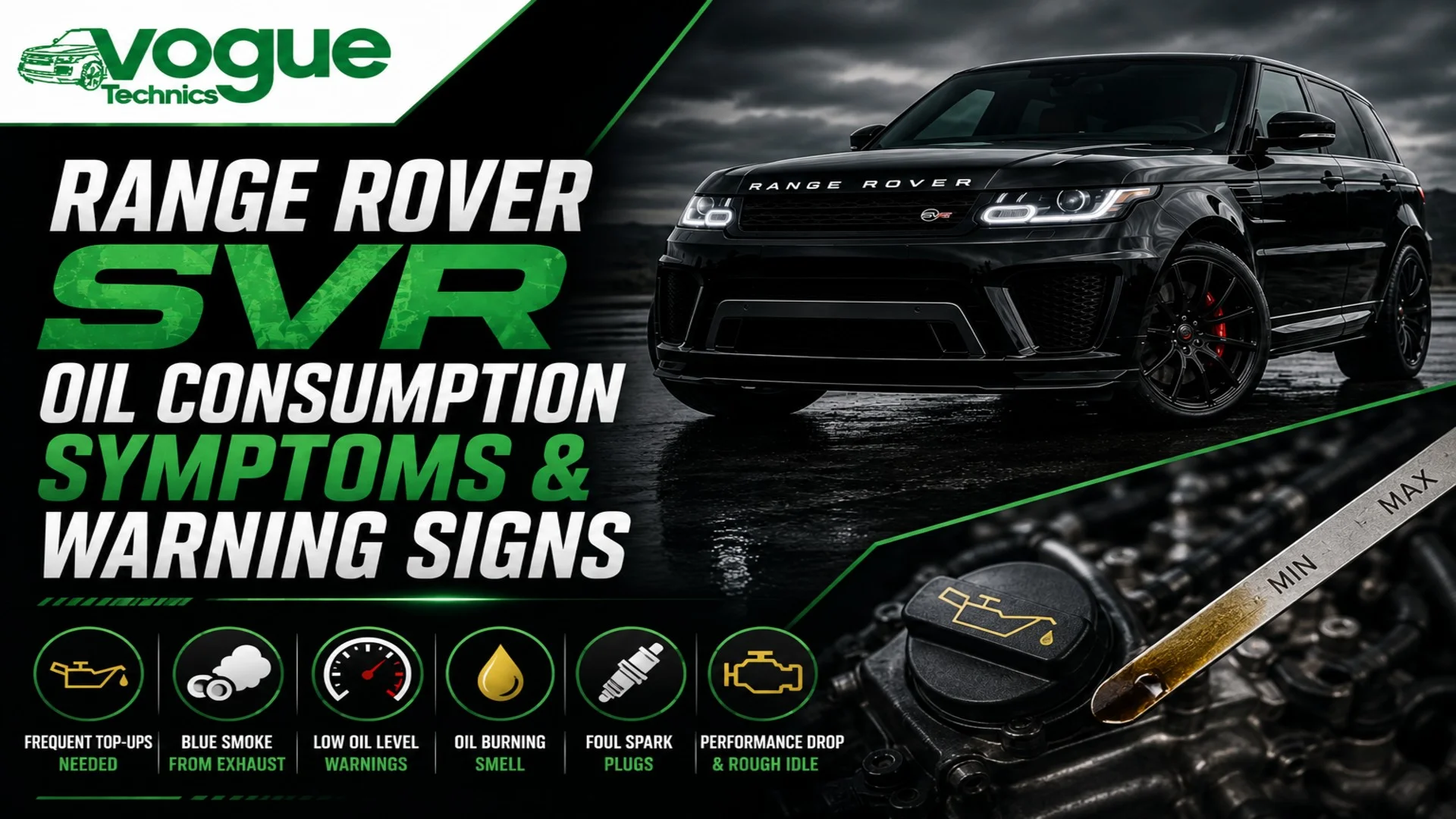
Catching oil consumption early usually means the fix is simpler and cheaper. Here's what tends to show up before things get serious.
Blue Smoke From the Exhaust Under Acceleration
Blue-tinted smoke, particularly under hard acceleration or after the engine has been idling, is one of the clearer signs oil is reaching the combustion chamber. It's different from white smoke (which usually points to coolant) or black smoke (typically a fuelling issue).
Frequent Oil Top-Ups Between Services
If you find yourself reaching for the top-up bottle more than once between scheduled services, that's your engine telling you something has changed. It's worth keeping a simple log, date, mileage, amount added, so a specialist can calculate an accurate consumption rate rather than working off guesswork.
Low Oil Warning Light and Dropping Oil Level
Modern SVRs monitor oil level electronically, and a warning light shouldn't be treated as a minor inconvenience. Repeated warnings, especially close together, are a strong signal that consumption has moved from "normal" into "needs investigating."
Oil Smell From the Engine Bay, Leak or Burning Oil?
A burning oil smell, particularly after a drive, often means oil is contacting a hot surface like the exhaust manifold, which usually points to an external leak rather than internal consumption. This distinction matters because it changes the entire diagnostic and repair path, which brings us to the next section.
How to Diagnose Oil Consumption, Is It a Leak or Internal Burning?
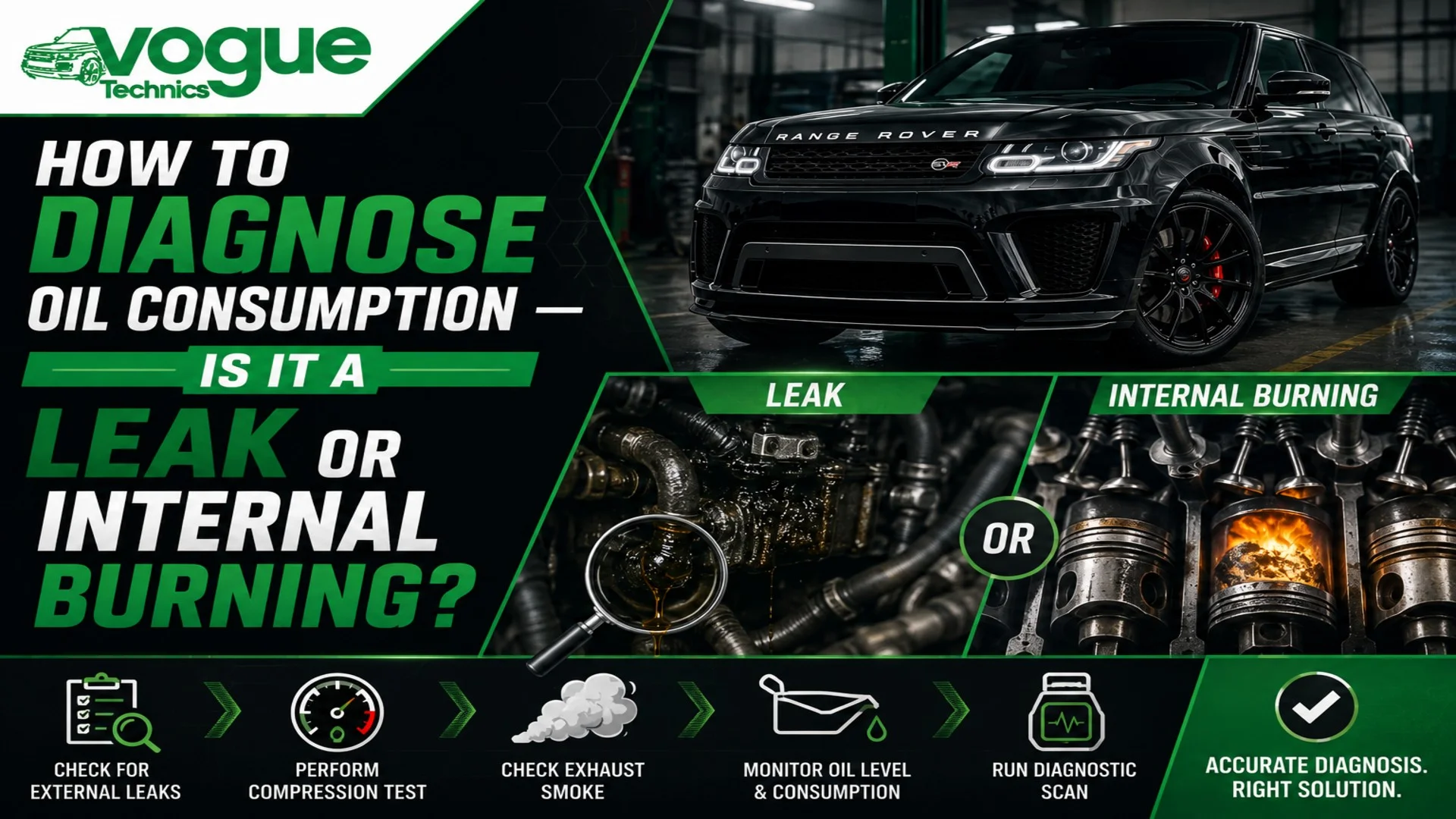
This is the step most guides skip past, and it's arguably the most important one. Treating an external leak like an internal consumption problem (or vice versa) wastes time and money.
Oil Leak vs Internal Oil Burning: What's the Difference?
Symptom | Likely Cause |
| Oil visible on driveway or under the car | External leak |
| Burning oil smell without visible smoke | External leak onto hot components |
| Blue smoke from exhaust | Internal oil burning |
| Oil residue around rocker cover | Gasket or seal failure |
| Oil found in intake system | PCV or breather fault |
| High crankcase pressure | PCV failure or blow-by |
| Reduced compression on testing | Piston ring or cylinder wear |
| Oil disappearing with no visible leak anywhere | Internal consumption |
Step-by-Step Oil Consumption Diagnostic Process
A proper diagnosis doesn't start with guesswork, it follows a sequence.
- Oil Consumption Test, Recording mileage against oil added over a defined period (often 1,000–2,000 miles) to establish an actual consumption rate rather than an impression.
- PCV and Breather System Inspection, Checking crankcase pressure and inspecting the PCV valve and breather hoses for cracking, blockage, or diaphragm failure.
- Compression and Leak-Down Testing, A compression test measures how well each cylinder holds pressure; a leak-down test goes further by identifying exactly where pressure is escaping, past the rings, through a valve, or via a head gasket.
Piston Rings vs Valve Stem Seals, How to Tell Which One Is Failing
Both cause blue smoke and both involve oil reaching the combustion chamber, but the pattern differs.
Indicator | Piston Rings | Valve Stem Seals |
| Smoke on cold start | Less typical | Very characteristic |
| Smoke under acceleration | Strong indicator | Possible but less specific |
| Effect on compression | Often reduced | Usually unaffected |
| Blow-by present | Common | Less common |
| Smoke after idling | Less pronounced | Pronounced |
A borescope inspection, a small camera fed into the cylinder, often provides the clearest confirmation when compression and leak-down results are ambiguous.
How to Fix Range Rover SVR Oil Consumption & Book a Specialist
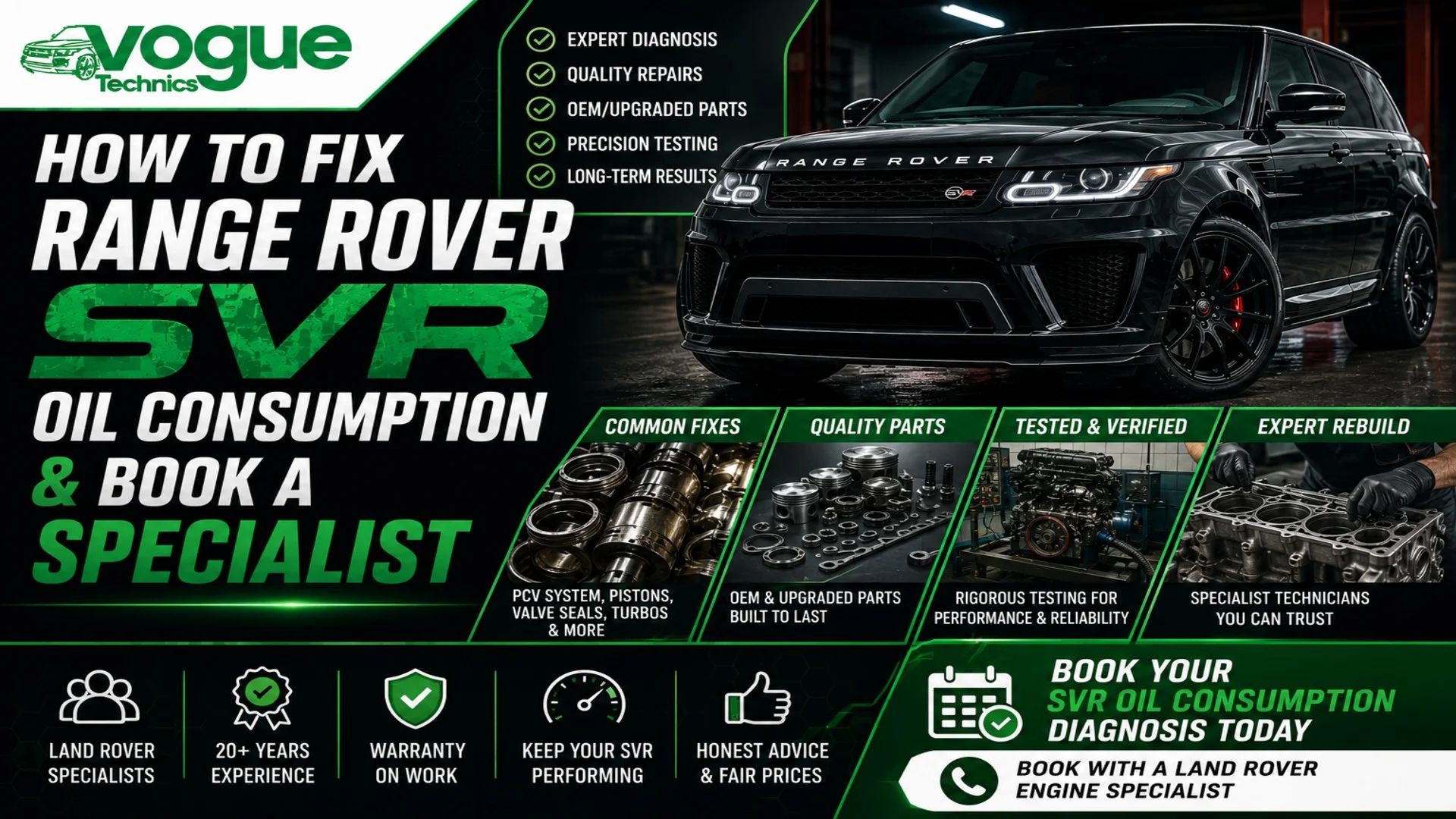
Once the cause is confirmed, the repair path depends entirely on what's actually failing, not on generic assumptions.
Repair Options: PCV Replacement, Valve Seals & Gaskets
For many cases, especially where the PCV system or an external gasket is the culprit, the fix is relatively contained:
- PCV valve or breather system replacement
- Rocker cover, oil cooler, or sump gasket replacement
- Valve stem seal replacement, which typically requires cylinder head work but stops short of a full rebuild
These repairs address the specific fault without disturbing the bottom end of the engine, which keeps both cost and downtime more manageable.
When Does an SVR Need a Full Engine Rebuild?
If diagnostics point to worn piston rings, significant bore wear, or compression loss across multiple cylinders, a partial repair often isn't enough to resolve the underlying issue long-term. At that point, a rebuild, replacing rings, inspecting bearings, and machining the bore where needed, becomes the more sensible route, particularly on a high-mileage or hard-driven example.
Engine Rebuild vs Engine Replacement, Which Is Right for You?
A rebuild restores your existing engine using new internal components and is usually the better option when the block itself is in good condition. A full replacement, using a reconditioned or remanufactured unit, tends to make more sense when damage is extensive, when you want a faster turnaround, or when a rebuild's labour cost starts approaching replacement cost. A specialist should be able to walk you through both options with real numbers rather than a one-size-fits-all recommendation.
Get a Free Oil Consumption Diagnostic Quote, Range Rover SVR Specialists, Essex
If your SVR is drinking oil faster than it should, the worst thing you can do is keep topping it up and hoping it resolves itself. Left unchecked, oil starvation from a genuine internal fault can lead to bearing damage, a far more expensive problem than the original issue.
At Voguetechnics, based in Grays, Essex, we work specifically with Range Rover and Range Rover Sport engines, including the 5.0-litre supercharged V8 fitted to the SVR. We run a proper diagnostic sequence, leak inspection, consumption testing, PCV assessment, and compression/leak-down testing where needed, so you get an accurate answer, not a guess. Get in touch for a no-obligation quote and we'll tell you exactly what's going on and what your options are.
Frequently Asked Questions About SVR Oil Consumption
Why is my Range Rover SVR using so much oil?
The most common causes are worn piston rings, a failing PCV or breather system, worn valve stem seals, or an external leak from a gasket around the rocker cover, oil cooler, or sump. A proper diagnostic test is the only reliable way to confirm which is responsible.
How much oil consumption is normal for a Range Rover SVR?
Under roughly 0.5 litres per 1,000 miles is generally considered within normal range for this engine, given its supercharged design and higher operating pressures. Consumption above 1 litre per 1,000 miles is usually considered excessive.
Can a PCV fault cause oil consumption on an SVR?
Yes. A failed PCV valve or breather diaphragm can allow oil vapour to be drawn into the intake in larger quantities than normal, increasing consumption without necessarily producing an obvious leak.
Does blue smoke always mean piston ring failure?
Not always. Blue smoke can point to either worn piston rings or worn valve stem seals. The timing of the smoke, on cold start versus under acceleration, along with a compression test, usually helps narrow down which component is at fault.
Is it cheaper to rebuild or replace an SVR engine?
It depends on the extent of the damage. A rebuild is often more cost-effective when the engine block is fundamentally sound, while a full replacement may work out better value when damage is extensive or a faster turnaround is needed. A specialist quote comparing both is the best way to decide.
How often should I check the oil level on a Range Rover SVR?
Given this engine's known consumption tendencies, checking the oil level every couple of weeks, or before any long journey, is a sensible habit, rather than relying solely on the dashboard warning light.
Oil consumption on the Range Rover SVR isn't something to ignore, but it's also not automatically a disaster. The key is understanding whether what you're seeing falls within the engine's normal range or signals a genuine fault, and getting that answer from a proper diagnostic process rather than forum guesswork. If you're based in or around Essex and want a clear, honest assessment of what your SVR actually needs, Voguetechnics is here to help. Get in touch for a free, no-obligation quote and find out exactly where you stand.