
Range Rover Sport Timing Chain Problems: Symptoms, Causes & Replacement Cost (UK Guide)

That faint metallic rattle you hear for two or three seconds every time you start your Range Rover Sport on a cold morning isn't your imagination, and it isn't something you should wait out either.
Timing chain problems are one of the most searched, most misunderstood, and potentially most expensive issues a Range Rover Sport owner can face. Some engines in this lineup are genuinely prone to chain wear. Others don't even use a timing chain at all. Getting that distinction wrong is exactly how owners end up paying for the wrong repair, or ignoring a warning sign until it turns into a full engine rebuild.
This guide breaks down exactly which Range Rover Sport engines are affected, what the early symptoms actually sound and feel like, what's really happening inside the engine when a chain starts to fail, and what replacement genuinely costs in the UK. We'll also clear up one of the biggest sources of confusion in this space: whether your specific engine uses a timing chain or a timing belt, because a lot of the advice floating around online gets this wrong.
What Are the Symptoms of Range Rover Sport Timing Chain Problems?
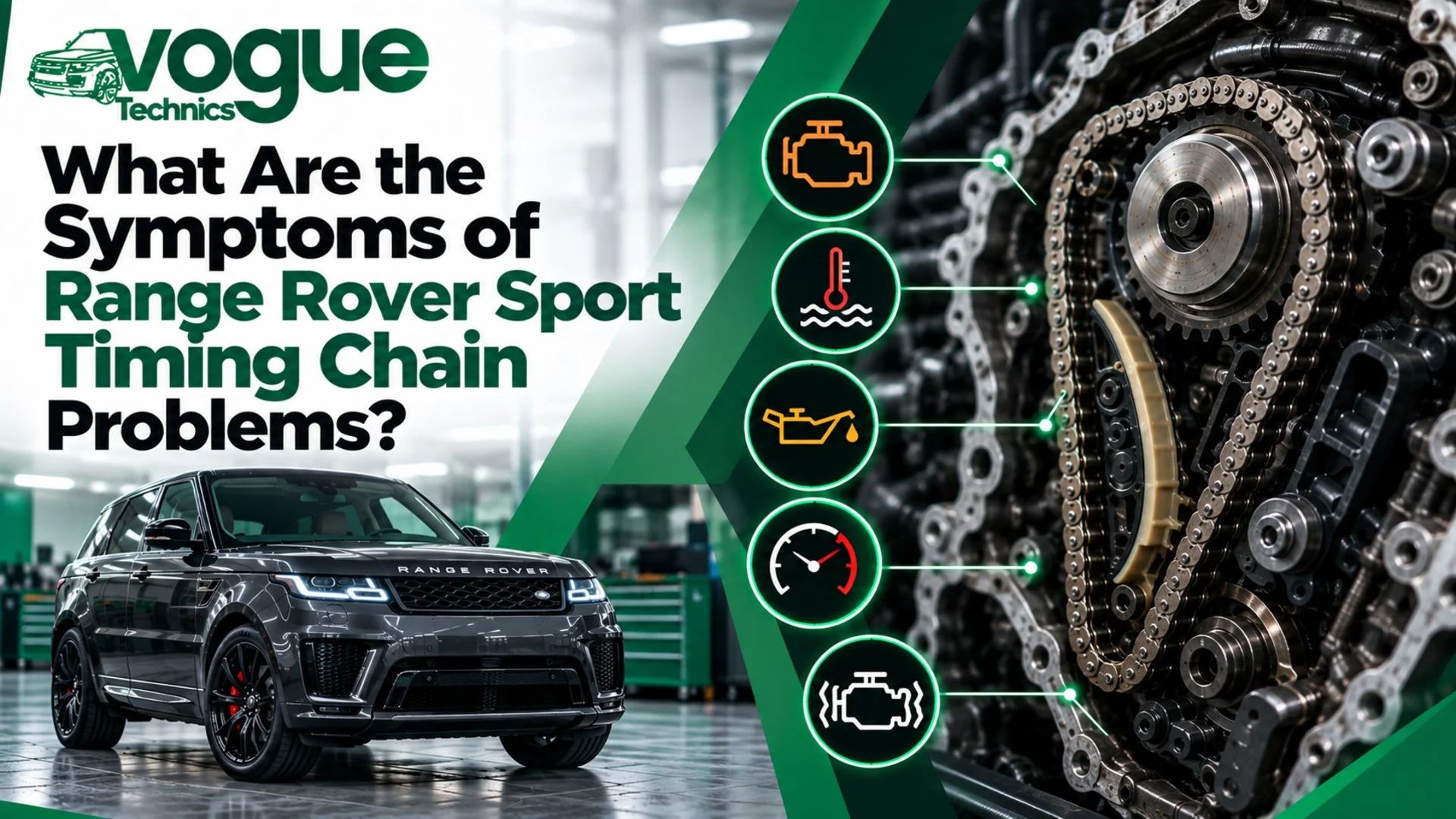
Timing chain wear doesn't happen overnight. It's a gradual process, and the engine usually gives you several warnings before anything catastrophic happens. The trouble is that these early signs are easy to dismiss, especially in colder months when a bit of engine noise on start-up feels almost normal.
It isn't. Here's what to actually listen and watch for.
Why Does My Range Rover Sport Rattle on Cold Start?
A cold-start rattle is the single most reported symptom of timing chain wear, and there's a clear mechanical reason for it.
When the engine has been sitting overnight, oil drains back down into the sump. On start-up, it takes a moment for oil pressure to build back up and reach the hydraulic timing chain tensioner. Until that happens, the tensioner can't apply proper pressure to the chain, so the chain has slack, and that slack shows up as a rattling or clattering noise for a few seconds until oil pressure normalises.
In a healthy engine, this settles almost instantly. In an engine with a worn chain, stretched links, or a tired tensioner, that rattle can:
- Last longer than a few seconds
- Get progressively worse over weeks or months
- Start occurring on warm starts too, not just cold ones
- Deepen from a light rattle into a heavier, more metallic clatter
If you're only hearing a brief rattle on the coldest mornings, it's worth monitoring. If it's lasting five, ten, or more seconds, or happening every time you start the car regardless of temperature, that's a strong indicator the tensioner or chain itself needs inspection.
What Does a Failing Timing Chain Sound Like?
Owners describe this noise in fairly consistent terms, and it's worth knowing the difference between normal engine sounds and genuine chain-related noise:
- Light rattle or chatter, usually the earliest sign, most noticeable on cold start
- Metallic ticking, often points to a chain riding against its guides rather than sitting properly in its track
- Deeper rattling or clattering under load, usually means the problem has progressed and the chain has developed real slack
- A knocking noise from the front of the engine, one of the more serious signs, often associated with chain, guide, or tensioner failure
It's genuinely easy to confuse timing chain noise with other engine sounds. A worn accessory belt, a failing supercharger coupler, an injector tick, or even a developing exhaust leak can all produce noises that sound similar to an untrained ear. This is one of the biggest reasons DIY diagnosis leads owners astray, and it's exactly why proper diagnostic equipment, not guesswork, should confirm what's actually happening before any repair work starts.
Can Timing Chain Wear Cause Rough Idle, Misfires or Loss of Power?
Yes, and this is where timing chain problems stop being a noise issue and start becoming a performance issue.
As a chain stretches or a tensioner weakens, the chain's position relative to the crankshaft and camshaft drifts slightly out of its intended alignment. This is called timing deviation, and even a small amount of it throws off the precise relationship between when valves open and close and where the pistons are in their stroke.
The knock-on effects typically include:
- Rough idle, the engine struggles to run smoothly at low RPM
- Misfires, cylinders fire at the wrong moment, or not efficiently
- Reduced power and hesitation, the engine feels flat or sluggish under acceleration
- Poor fuel economy, the engine compensates inefficiently for incorrect timing
- Difficulty starting, particularly once timing deviation becomes more pronounced
At this stage, the engine management system usually picks up on the discrepancy too, which brings us to warning lights.
Warning Signs You Shouldn't Ignore
Treat any of the following as a signal to book a diagnostic check rather than wait and see:
- Cold-start rattle lasting longer than a few seconds, or worsening over time
- Rattling on warm starts, not just cold ones
- Check engine light or reduced performance warning appearing
- Any combination of rough idle, misfire, or hesitation alongside unusual noise
- A noticeable drop in power that wasn't there before
Catching these signs early is the difference between a timing chain repair costing you a controlled, planned expense, or an engine rebuild costing you several times more.
Which Range Rover Sport Engines Are Affected, Timing Chain or Timing Belt?
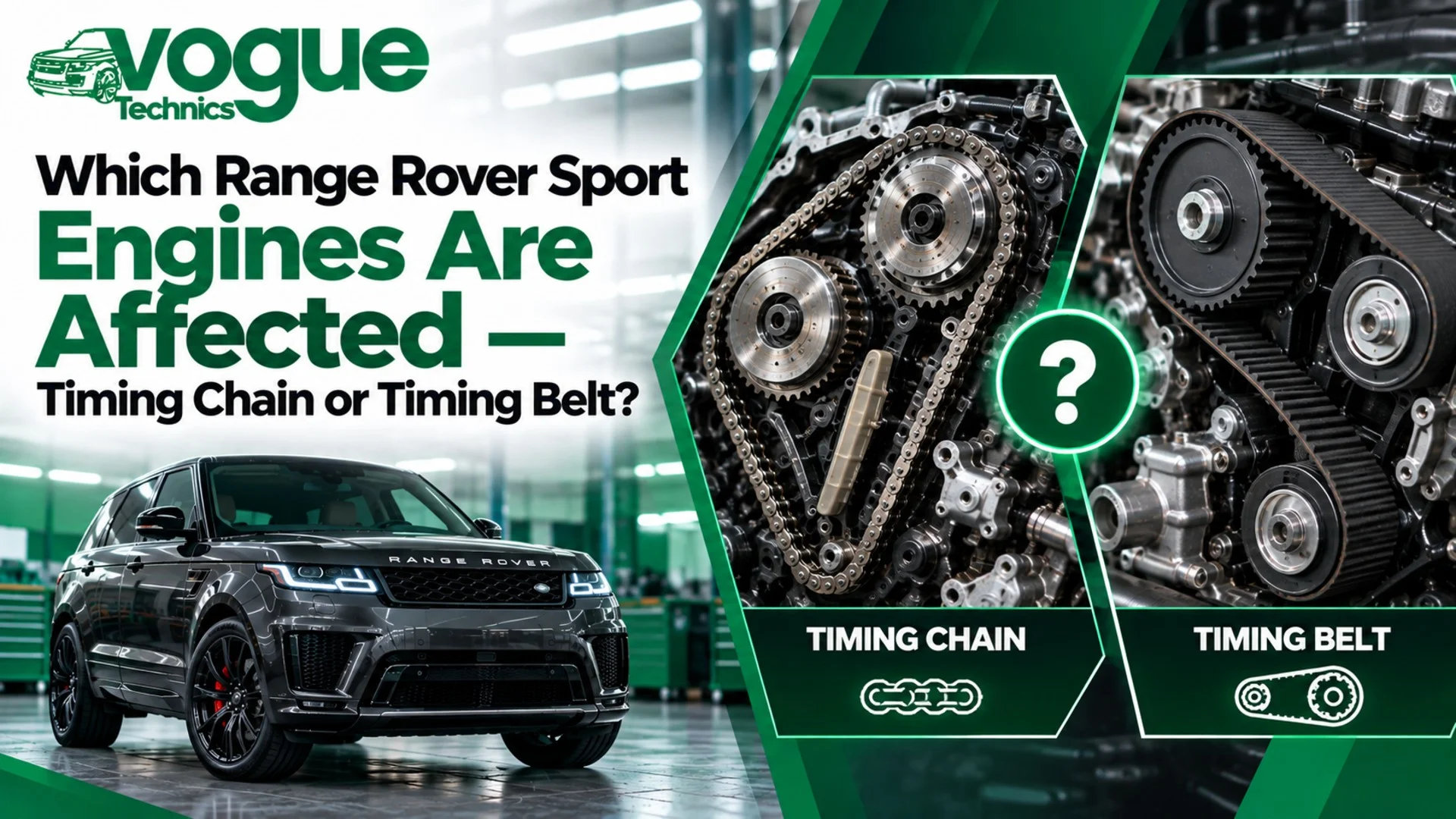
Here's where a lot of content online, including some of the current top-ranking guides, gets things wrong or oversimplifies. Not every Range Rover Sport engine uses a timing chain. Some use a timing belt as the primary drive for the camshafts, and treating every engine as if it has the same timing architecture leads to incorrect advice and, sometimes, incorrect repairs.
Getting this right matters, because the failure patterns, inspection intervals, and repair costs are genuinely different depending on which engine sits under the bonnet.
Does the 5.0 Supercharged V8 (AJ133) Use a Timing Chain?
Yes. The 5.0-litre supercharged AJ133 V8, found in higher-spec Range Rover Sport models and the SVR, uses a timing chain system, and it's the engine most commonly associated with timing chain wear, tensioner problems, and cold-start rattle in this range.
The AJ133 uses multiple chains and hydraulic tensioners to drive the camshafts, and wear typically develops at the tensioner and guide level before the chain itself shows significant stretch. SVR owners in particular should treat any cold-start rattle seriously, given the higher operating stresses this engine sees.
Does the 3.0 TDV6/SDV6 Diesel Use a Timing Chain or Timing Belt?
This is the single most misunderstood point across current online guidance, so it's worth being precise here.
The 3.0-litre TDV6 and SDV6 diesel engines primarily use a timing belt, not a timing chain, for the main camshaft drive. Land Rover's own maintenance documentation for Td6-equipped models specifies replacement of the front and rear camshaft timing belts as a scheduled service item, this is a belt system with a defined replacement interval, commonly cited around seven years or 112,000 miles, rather than a chain that's expected to last the life of the engine.
This distinction matters practically:
- A timing belt has a scheduled, mileage/time-based replacement interval regardless of symptoms, waiting for noise or failure is the wrong approach
- A timing chain is generally expected to last far longer but can fail prematurely due to poor maintenance, oil issues, or component wear
- Diagnosing "chain rattle" on a TDV6/SDV6 without checking which system is actually fitted can lead to the wrong repair being quoted
If you drive a 3.0 diesel Range Rover Sport, the more urgent question isn't "is my timing chain rattling", it's "when was my timing belt last replaced."
2.0 Ingenium Timing Chain Problems
The 2.0-litre Ingenium engine uses a timing chain, and like the AJ133, tensioner and guide wear tend to be the earlier failure points rather than the chain itself. Ingenium timing chain issues are typically linked to oil-related causes, a topic we'll cover in the next section, and tend to present with the same cold-start rattle and rough-running symptoms described above.
Timing System by Model, Generation and Engine (Comparison Table)
Generation | Model | Engine | Timing System | Primary Risk |
| L320 | Range Rover Sport | 3.0 TDV6 | Timing Belt | Scheduled belt replacement, not chain wear |
| L494 | Range Rover Sport | 3.0 TDV6/SDV6 | Timing Belt | Scheduled belt replacement, not chain wear |
| L494 | Range Rover Sport | 5.0 AJ133 V8 / SVR | Timing Chain | Tensioner and guide wear, chain stretch |
| L494 | Range Rover Sport | 2.0 Ingenium | Timing Chain | Tensioner wear, oil-related chain wear |
If you're not sure which engine and timing system your Range Rover Sport has, your V5C logbook or a quick VIN check will confirm it, and it's worth confirming before booking any repair, since chain and belt jobs are priced and carried out very differently.
What Causes Timing Chain Failure and How Is It Diagnosed?
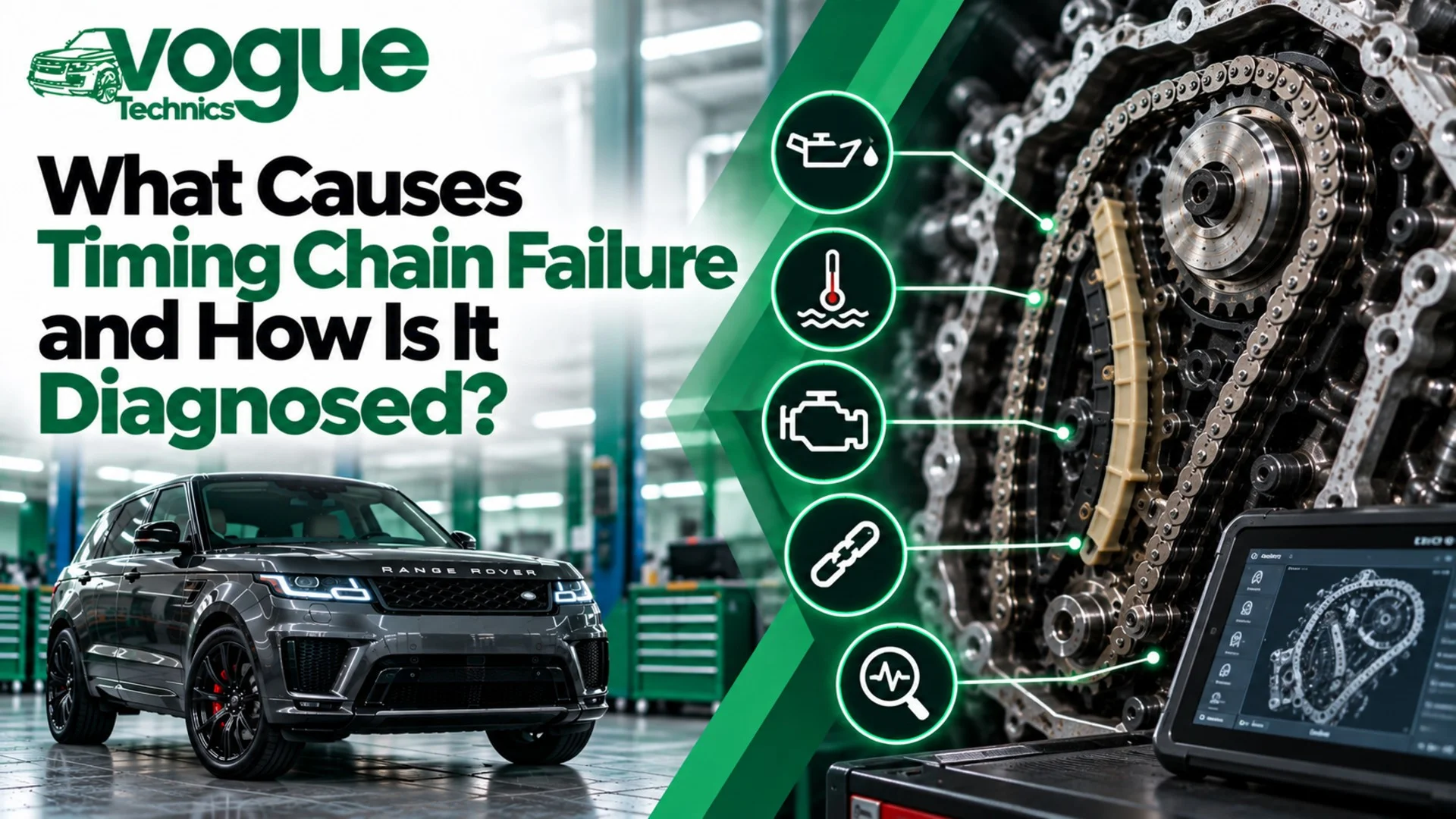
Timing chain problems rarely come out of nowhere. There's almost always a chain of cause and effect (no pun intended) that starts with something as simple as oil condition and ends with a worn, noisy, or failing timing system.
Common Causes of Timing Chain Wear
Low Oil Pressure and Poor Oil Quality
The timing chain tensioner is hydraulic, it relies entirely on oil pressure to keep the chain properly tensioned. If oil pressure is low, delayed in reaching the tensioner, or the oil itself has degraded, the tensioner can't do its job properly.
The most common contributors are:
- Extended oil change intervals, going beyond the recommended service schedule lets oil degrade and lose lubricating properties
- Incorrect oil viscosity, using the wrong oil grade affects how quickly and effectively it reaches the tensioner
- Oil contamination or sludge build-up, restricts oil flow through the passages that feed the tensioner
- Genuinely low oil level, reduces overall system pressure
This is why routine servicing on schedule isn't just a box-ticking exercise on these engines, it's directly protective of the timing system.
Worn Tensioners, Guides and Sprockets
Even with good oil maintenance, hydraulic tensioners, plastic or composite chain guides, and sprockets wear over time and mileage. Once a tensioner starts to weaken, it can no longer take up slack effectively, and that's when chain movement, rattle, and eventually measurable chain stretch begin.
Guides are a particularly common failure point, they're designed to keep the chain running true, and once they wear down or crack, the chain can shift out of alignment even if the chain itself still has reasonable life left in it.
Fault Codes That Indicate a Timing Chain Problem
Modern engine management systems are very good at detecting timing deviation, and they'll usually flag it well before you'd notice anything catastrophic.
P0016 and P0017 Explained
P0016 and P0017 relate to camshaft and crankshaft correlation faults, essentially, the ECU has detected that the camshaft and crankshaft are no longer rotating in the precise relationship they should be. This is one of the clearest and most direct fault code indicators of timing chain slack or stretch, and it's commonly seen on both the AJ133 and Ingenium engines when chain wear has progressed.
P0341 and P0342, Sensor Fault or Timing Issue?
P0341 and P0342 relate to the camshaft position sensor circuit. These codes can genuinely indicate a timing-related problem, but they can equally point to a faulty sensor, wiring fault, or connector issue that has nothing to do with the chain itself.
This is an important distinction: these codes should prompt further diagnostic investigation, not an automatic assumption that the timing chain has failed. A competent diagnostic check will differentiate between an electrical fault and an actual mechanical timing issue before any repair is recommended.
Can You Still Drive a Range Rover Sport With a Timing Chain Rattle?
Short answer: you can, but you shouldn't for long.
A brief, mild cold-start rattle that disappears within a couple of seconds isn't usually an immediate danger, plenty of these engines exhibit some degree of this and continue running for years with proper maintenance. But once the rattle lengthens, worsens, or is joined by rough running, misfires, or warning lights, continuing to drive carries real risk.
These engines are interference engines, meaning that if the timing chain skips or breaks, the pistons and valves can physically collide inside the cylinder head. That's the difference between a controlled, moderately priced timing chain repair and a catastrophic, engine-rebuild-level failure. If you're noticing worsening symptoms, the sensible move is to get it checked rather than wait for a clear-cut mechanical failure to force the decision for you.
Range Rover Sport Timing Chain Replacement, Cost, Process & Specialist Repair in Essex
How Much Does Timing Chain Replacement Cost in the UK?
Costs vary depending on engine, the extent of wear, and whether tensioners and guides are being replaced alongside the chain, which they generally should be, since replacing a chain without addressing worn guides and a tired tensioner often means revisiting the job again down the line.
As a general guide for UK repairs:
- Chain, tensioner and guide replacement (Ingenium/AJ133): this is a labour-intensive job given engine layout and accessibility, and pricing reflects both parts and the time involved
- Diagnostic assessment before repair: typically a smaller upfront cost that confirms exactly what's worn before committing to a full job
- Engine rebuild or replacement (where chain failure has caused internal damage): significantly higher, and the scenario every owner wants to avoid by catching symptoms early
Because pricing depends heavily on your specific engine, model year, and the extent of wear found on inspection, the most reliable way to get an accurate figure is a proper diagnostic assessment rather than a generic quote based on symptoms alone.
What Does the Timing Chain Replacement Process Involve?
A thorough timing chain job typically includes:
- Diagnostic scan to confirm fault codes and rule out sensor or wiring issues
- Physical inspection of chain tension, wear, and guide condition
- Removal of components required to access the timing system
- Replacement of the chain, tensioner, guides, and sprockets as needed
- Correct recalibration of camshaft and crankshaft timing
- Clearing of fault codes and a full post-repair test to confirm the fix has resolved the original symptoms
Skipping any of these steps, particularly proper recalibration and post-repair testing, is how "repairs" end up needing to be redone.
Reconditioned Engine vs Timing Chain Repair, Which Is Better?
This depends entirely on how far the problem has progressed.
- If caught early (rattle, fault codes, no internal damage), a timing chain, tensioner and guide replacement is almost always the more cost-effective and appropriate fix.
- If the chain has already jumped or broken and caused valve or piston damage, a full engine rebuild or a reconditioned engine often becomes the more practical option, since the internal damage typically extends well beyond the timing system itself.
This is exactly why early diagnosis matters so much. An owner who books a diagnostic check at the first sign of a worsening rattle is very often looking at a straightforward chain and tensioner job. An owner who ignores the same symptom for another 10,000 miles may end up choosing between a rebuild and a replacement engine instead.
Why Choose Voguetechnics for Range Rover Sport Timing Chain Repairs (Grays, Essex)
At Voguetechnics, based in Grays, Essex, timing chain diagnosis and repair on Range Rover Sport models, across the 2.0 Ingenium, 5.0 AJ133 V8, and diesel TDV6/SDV6 ranges, is a routine part of the work we carry out. We start every job with a proper diagnostic assessment rather than assuming the worst, because correctly identifying whether you're dealing with chain wear, a tensioner fault, a sensor issue, or a completely different noise source is what determines whether you need a modest repair or something more involved.
Our approach focuses on:
- Accurate diagnosis before any repair is recommended or costed
- Genuine engine-specific knowledge, treating the AJ133, Ingenium, and TDV6/SDV6 as the distinct systems they actually are
- Transparent, itemised pricing so you know exactly what you're paying for and why
- Full post-repair testing before your Range Rover Sport goes back on the road
If you're hearing an unusual noise, seeing a warning light, or simply want peace of mind before a long journey, getting it looked at properly now is almost always cheaper than waiting.
Frequently Asked Questions
Are Range Rover Sport timing chain problems common?
Timing chain wear is a recognised issue on the 5.0 AJ133 V8 and 2.0 Ingenium engines, particularly where oil maintenance has lapsed or intervals have been extended. It's less common as a sudden, unexplained failure and more often the result of a gradual process that gives clear warning signs, like cold-start rattle, well before anything serious happens.
How much does timing chain replacement cost in the UK?
Cost depends on the engine, the extent of wear, and whether the tensioner and guides need replacing alongside the chain. Because pricing varies significantly based on what's actually found during inspection, a diagnostic assessment is the most reliable way to get an accurate figure for your specific vehicle.
Can I drive with a timing chain rattle?
A brief rattle that clears within a couple of seconds on cold starts isn't usually an immediate emergency, but it shouldn't be ignored either. If the rattle is lengthening, worsening, occurring on warm starts, or accompanied by rough running or warning lights, it's best to get it checked before continuing to drive normally.
Does my Range Rover Sport have a timing chain or timing belt?
It depends on the engine. The 5.0 AJ133 V8 and 2.0 Ingenium engines use a timing chain. The 3.0 TDV6/SDV6 diesel primarily uses a timing belt for the main camshaft drive, with a scheduled replacement interval rather than a wear-and-tear chain system. Check your engine type before assuming which applies to your vehicle.
Do you offer nationwide or no-deposit engine/timing chain repairs?
Availability of no-deposit options and nationwide logistics can vary by job and vehicle. The most accurate way to confirm what's available for your specific Range Rover Sport is to get in touch directly with your registration and engine details so we can advise on the right options for your situation.
Final Thoughts
A cold-start rattle on a Range Rover Sport is easy to brush off, especially when the car is still driving normally in every other respect. But timing chain wear is progressive, and the gap between "slightly annoying noise" and "engine rebuild" is often smaller than owners expect, particularly on interference engines where a skipped or broken chain can cause internal damage in a matter of seconds.
The good news is that this is a well-understood, well-diagnosed problem. Knowing which engine you have, recognising the early warning signs, and getting a proper diagnostic check at the first sign of trouble puts you firmly in control of the outcome and the cost.
If your Range Rover Sport is rattling on start-up, running rough, or has thrown a fault code, don't wait for it to get worse. Get in touch with the team at Voguetechnics in Grays, Essex for an accurate diagnosis and a clear, honest repair plan, before a manageable fix turns into something far more costly.