Range Rover Sport L494 Timing Chain Issues: Symptoms, Causes, Diagnosis & Repair Cost (Essex Specialists)

You've just started your Range Rover Sport L494 on a cold morning, and there it is again, that faint metallic rattle from under the bonnet. It disappears after a few seconds, so you tell yourself it's nothing. Most owners do exactly that, right up until the rattle turns into a warning light, a limp mode, or a bill running into four figures.
Timing chain issues are one of the most common and most misunderstood faults on the Range Rover Sport L494. They're common because the design leans on hydraulic tensioners and chain guides that wear with age and poor servicing. They're misunderstood because the symptoms, rattling, rough idle, warning lights, overlap with half a dozen other faults, so plenty of owners either panic unnecessarily or ignore a real problem until it's catastrophic.
This guide walks through exactly what's going on: which engines are affected, what the early warning signs sound and feel like, how a proper diagnosis is done, and what you can expect to pay for a repair in the UK. If you're in Essex and want an actual inspection rather than more guesswork, we cover that too.
What Are the Common Range Rover Sport L494 Timing Chain Issues?

The L494 is the second-generation Range Rover Sport, built from 2013 onward and covering both petrol and diesel engine ranges. Across nearly all of these engines, the timing chain system relies on the same basic components: a chain (sometimes two, primary and secondary), plastic or composite guides, and a hydraulic tensioner that keeps everything under the correct load.
The problem is that none of these parts are designed to last the life of the vehicle without proper care. Chain guides wear down over time, tensioners lose their ability to take up slack, and the chain itself stretches, not physically lengthening, but developing play between the links as the pins and bushings wear. Once that happens, ignition and valve timing drift out of spec, and the engine starts telling you about it.
Which L494 Engines Are Most Affected by Timing Chain Problems?
Not every L494 engine suffers from the same failure pattern, and treating them as identical is where a lot of generic advice online falls short. Here's how the main engine variants compare:
Engine | Timing Chain Concern | Typical Symptoms | Diagnostic Focus |
| 5.0 V8 (AJ133) | Chain guide and tensioner wear | Cold-start rattle, chain chatter | Camshaft/crankshaft correlation |
| 3.0 SC V6 (AJ126) | Tensioner and chain wear | Rattle on startup, intermittent noise | Timing correlation, physical inspection |
| 3.0 SDV6 / TDV6 (306DT) | Chain wear alongside broader engine wear | Cold-start rattle, rough running | Mechanical inspection plus fault code scan |
| 4.4 SDV8 / TDV8 (448DT) | Rear-mounted timing chain system | Chain noise, harder to detect early | Physical inspection due to chain position |
| 2.0 Ingenium (AJ200D/P) | Chain stretch tied to oil dilution and service history | Cold-start rattle, worse with poor servicing | Oil condition check plus timing inspection |
A few things stand out here. The 5.0 AJ133 and 3.0 AJ126 petrol engines tend to show classic cold-start rattle from guide and tensioner wear. The diesel engines, particularly the 3.0 SDV6 and 2.0 Ingenium, are more closely tied to oil quality and servicing history, because diesel particulate matter and oil dilution accelerate wear on the tensioner and guides. The 4.4 SDV8 is a slightly different case: its timing chain sits at the rear of the engine, against the bulkhead, which makes both the noise harder to pinpoint and the eventual repair more labour-intensive.
What Causes Timing Chain Wear on the L494?
Timing chain failure rarely comes out of nowhere. In almost every case we see, it's the end result of one or more of these factors building up over months or years:
- Extended oil change intervals. Oil that's gone past its service life loses lubrication properties, and the tensioner and guides are among the first components to suffer.
- Incorrect oil specification. Using an oil that doesn't meet the correct approval for the engine can cause premature wear, even if changes are done on schedule.
- Low oil pressure at cold start. Hydraulic tensioners rely on oil pressure to stay tight. A cold engine with thick or degraded oil takes longer to build pressure, which is exactly why rattles are worst on startup.
- High mileage without preventative checks. Guides and tensioners are wear items. Past a certain mileage, they need inspecting, not just hoped along.
- Stop-start driving patterns. Short journeys that never let the engine reach full operating temperature prevent oil from doing its job properly and can accelerate wear on diesel variants in particular.
None of these causes are exotic. They're the same maintenance basics that affect any modern engine, but the L494's chain design happens to be less forgiving of neglect than some of its competitors.
What Are the Warning Signs of a Failing L494 Timing Chain?
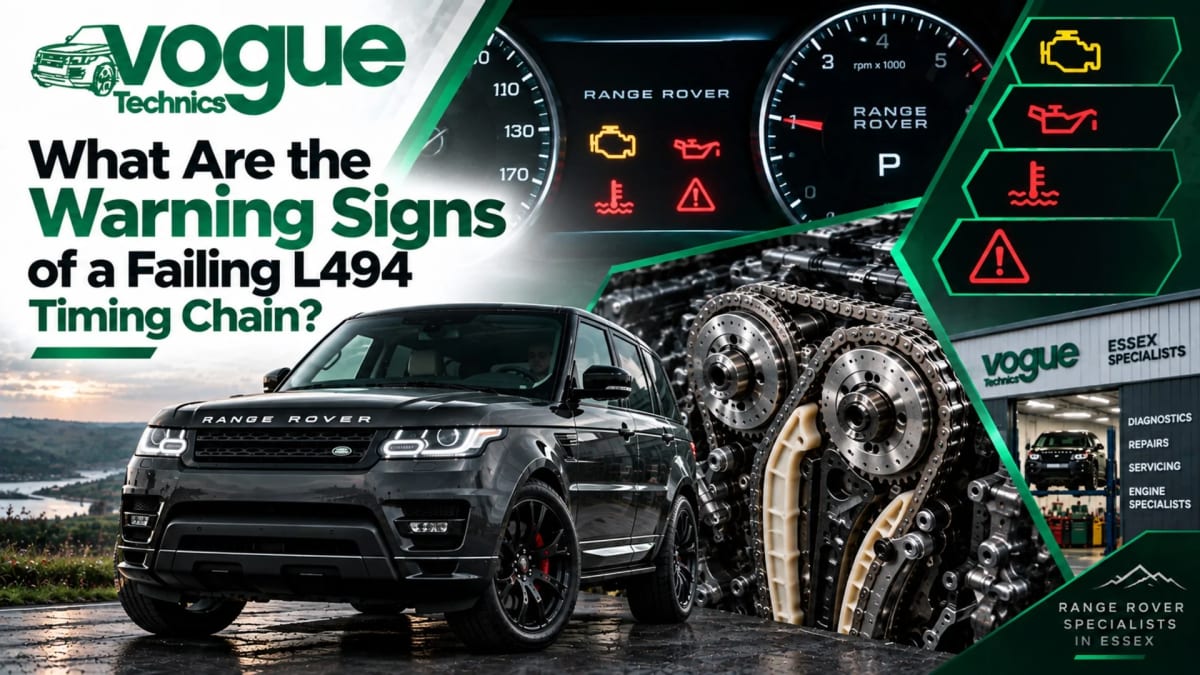
Catching timing chain wear early is almost always cheaper and less stressful than waiting for it to fail outright. The trouble is that the early signs are subtle, and it's easy to explain them away.
Why Does My Range Rover Sport L494 Rattle on Cold Start?
This is the single most common complaint we hear, and it follows a fairly predictable pattern. On a cold engine, oil hasn't built up pressure yet, so the hydraulic tensioner can't fully take up the slack in the chain. That slack shows up as a rattle, usually lasting a few seconds to maybe half a minute, that disappears once oil pressure rises and the engine warms through.
The problem is that this "it goes away" behaviour lulls a lot of owners into ignoring it. In reality, a cold-start rattle is very often the first sign of tensioner or guide wear, and it tends to get worse, longer duration, louder noise, over subsequent months rather than staying the same.
We'd put the progression roughly like this:
- A brief rattle lasting a few seconds on cold start
- The rattle lasting longer before disappearing
- A persistent mechanical noise that continues even once warm
- Fault codes appearing on the dash
- Rough running, misfires, or reduced power
- Timing deviation severe enough that the chain jumps
- In the worst cases, valve and piston contact from a jumped or snapped chain
Catching the problem at stage one or two is a tensioner and guide job. Catching it at stage six is an engine rebuild. That gap in cost is the entire reason this guide exists.
What Does L494 Timing Chain Noise Sound Like?
A genuine timing chain rattle has a specific character: it's a fast, metallic, almost "marbles in a tin" sound, concentrated at the front (or rear, on the 4.4) of the engine, and it's most pronounced immediately after startup.
That said, plenty of other faults produce noises that get mistaken for timing chain problems, and getting this wrong is one of the most common, and expensive, misdiagnoses we see. Before assuming the worst, it's worth ruling out:
- Injector noise, a tapping or clicking sound, often mistaken for chain chatter on diesel engines, especially the SDV6
- Auxiliary belt or pulley noise, a squeal or rumble linked to belt tension rather than engine timing
- Supercharger noise on the 3.0 SC V6 and 5.0 SC V8, which can produce a whine that's unrelated to the chain
- Exhaust leaks near the manifold, which can sound like a tapping or ticking noise under load
- A failing camshaft position sensor, which can trigger timing-related fault codes without the chain itself being at fault
This is exactly why a proper diagnosis matters more than a guess based on sound alone. We've had cars come in already booked for "timing chain replacement" by another garage that turned out to have a straightforward exhaust manifold leak.
Can Timing Chain Problems Trigger Fault Codes?
Yes, and this is often how a problem that's been ignored finally forces the issue. The most relevant codes to know are:
Fault Code | Meaning | Possible Timing Relationship |
| P0016 | Crankshaft/camshaft position correlation (Bank 1, Sensor A) | Chain stretch causing timing deviation |
| P0017 | Crankshaft/camshaft position correlation (Bank 1, Sensor B) | Chain stretch or tensioner failure |
| P0018 | Crankshaft/camshaft position correlation (Bank 2, Sensor A) | Chain wear on V6/V8 engines |
| P0019 | Crankshaft/camshaft position correlation (Bank 2, Sensor B) | Chain wear or guide failure |
| P0341 | Camshaft position sensor circuit range/performance | Can indicate timing deviation or a faulty sensor |
| P0342 | Camshaft position sensor circuit low input | Sensor fault or timing-related signal issue |
It's worth being clear about one thing: a fault code alone doesn't confirm chain failure. These codes point at a timing correlation issue, but that could be a genuinely stretched chain, a failing sensor, or even a wiring fault. That's why proper diagnosis always pairs the fault code reading with a physical inspection, checking chain slack, guide condition, and tensioner function, rather than jumping straight to "you need a new chain."
Is It Safe to Keep Driving With a Timing Chain Rattle?
In the short term, yes, most cars will get you from A to B with a mild cold-start rattle. But we wouldn't recommend treating it as a non-issue. Continued driving with a worn tensioner or guide increases the risk of the chain skipping a tooth on the sprocket, which throws valve timing out of sync. On an interference engine, which every L494 engine is, that can mean pistons contacting valves, and that turns a chain repair into an engine rebuild. If you're hearing a rattle, the sensible move is to get it inspected before your next long journey, not after.
How Are L494 Timing Chain Problems Diagnosed and Repaired?

How Do We Diagnose a Timing Chain Fault at Voguetechnics?
We don't diagnose timing chain issues off a single symptom. Our process typically covers:
- A full diagnostic scan to check for cam/crank correlation codes and rule out sensor faults
- A cold-start listening test, since this reproduces the fault under the exact conditions it occurs
- Physical inspection of chain slack, checking movement against manufacturer tolerances
- Timing mark verification, confirming actual cam and crank alignment rather than relying on codes alone
- Differential checks against injector noise, belt noise, and exhaust leaks, so we're not replacing a chain that isn't the actual problem
This combination, electronic and mechanical, is what separates an accurate diagnosis from a guess. It also protects you from paying for parts you don't need.
How Much Does L494 Timing Chain Replacement Cost in the UK?
Costs vary depending on the engine, the extent of wear, and whether the job is a tensioner/guide replacement or a full chain kit. As a general guide across the UK market:
- Tensioner replacement only (caught early): typically the lowest-cost repair, often a few hundred pounds in parts and labour
- Chain guide replacement: moderate cost, usually done alongside tensioner work since both wear together
- Full timing chain kit replacement (chain, guides, tensioner): the most involved job, particularly labour-intensive on the 4.4 SDV8 due to the rear-mounted chain position
- Engine damage from a jumped or snapped chain: by far the most expensive outcome, potentially requiring a partial or full rebuild
The honest advice here is the same every time: the earlier you catch it, the cheaper the fix. A tensioner replacement at the first sign of rattle is a completely different bill to a rebuild after the chain has jumped.
What's Included in a Full Timing Chain Replacement Service?
A proper replacement isn't just swapping the chain. It should include the full kit, chain, guides, and tensioner replaced together, since fitting a new chain to worn guides just shortens the lifespan of the repair. It should also include a post-repair timing verification and, where applicable, an ECU relearn or adaptation reset, so the engine management system recognises the new components correctly.
How Can You Prevent Timing Chain Problems on Your L494?
Prevention is genuinely straightforward, even if it's not exciting:
- Stick to manufacturer-approved oil, both in specification and change interval, don't stretch service intervals to save money
- Get cold-start noises checked early, rather than waiting to see if they get worse
- Avoid excessive short-journey driving where possible, since it prevents oil from reaching proper operating temperature
- Have timing chain condition checked at major services, particularly past 70,000–80,000 miles
- Address any check engine light promptly, since ignoring cam/crank correlation codes is how a manageable repair becomes a rebuild
Buying a Used L494 or Booking a Repair in Essex

What Should You Check Before Buying a Range Rover Sport L494?
If you're viewing a used L494, timing chain condition should be near the top of your checklist, not an afterthought. Before you buy:
- Start the car from cold, never view a car that's already been warmed up before you arrive, since that's exactly when a rattle would be masked
- Check the full service history, looking specifically for regular oil changes with the correct specification oil
- Ask about mileage relative to engine variant, since high-mileage diesel and Ingenium engines carry more risk if servicing has lapsed
- Look for any record of previous timing chain, tensioner, or guide work, which can indicate either a resolved issue or one that's about to resurface
- Run a diagnostic scan before purchase, checking specifically for cam/crank correlation fault codes
- Listen for any noise beyond a brief, mild cold-start rattle, anything prolonged or loud is a red flag worth walking away from, or at minimum negotiating on
A car with full service history, correct oil changes, and no cold-start noise is a genuinely different proposition to one with gaps in its records, even if both look identical on the driveway.
Why Choose Voguetechnics for L494 Timing Chain Repairs in Grays, Essex?
We work on Range Rover and Land Rover vehicles specifically, which means we're not diagnosing timing chain faults occasionally, we're doing it regularly, across the full range of L494 engines. That matters when the difference between a chain fault and an injector, belt, or exhaust noise isn't always obvious from the driver's seat.
Based in Grays, Essex, we combine proper diagnostic equipment with the physical inspection steps that a fault code scan alone can't replace. Whether you've noticed a new rattle on cold starts or you're trying to decide whether a used L494 is worth buying, an accurate answer now is worth far more than a guess later.
Book Your Range Rover Sport Timing Chain Inspection Today
If your Range Rover Sport L494 is rattling on startup, throwing a warning light, or you're weighing up a used purchase, get it checked properly before it becomes a bigger job. Contact Voguetechnics in Grays, Essex to book a timing chain diagnostic, and get a clear, honest answer on what's actually going on under the bonnet, not just an assumption.