Range Rover SDV8 Timing Chain Problems: Causes, Symptoms, Diagnosis & Cost (Grays, Essex)

That rattle you hear when you first turn the key on a cold morning isn't your imagination, and it isn't something to shrug off. If you're driving a Range Rover or Range Rover Sport fitted with the 4.4-litre SDV8 diesel engine, a metallic noise on start-up is one of the most searched-for, most misunderstood, and potentially most expensive warning signs this vehicle can give you.
At Voguetechnics in Grays, Essex, we see this exact complaint several times a month, owners convinced their engine is "about to go," and others who've been told by a garage that they need a full engine rebuild when the actual fix was far simpler. This guide walks through exactly what causes Range Rover SDV8 timing chain problems, how to tell genuine chain wear from a completely unrelated noise, what it costs to put right, and what to check before you buy a used one.
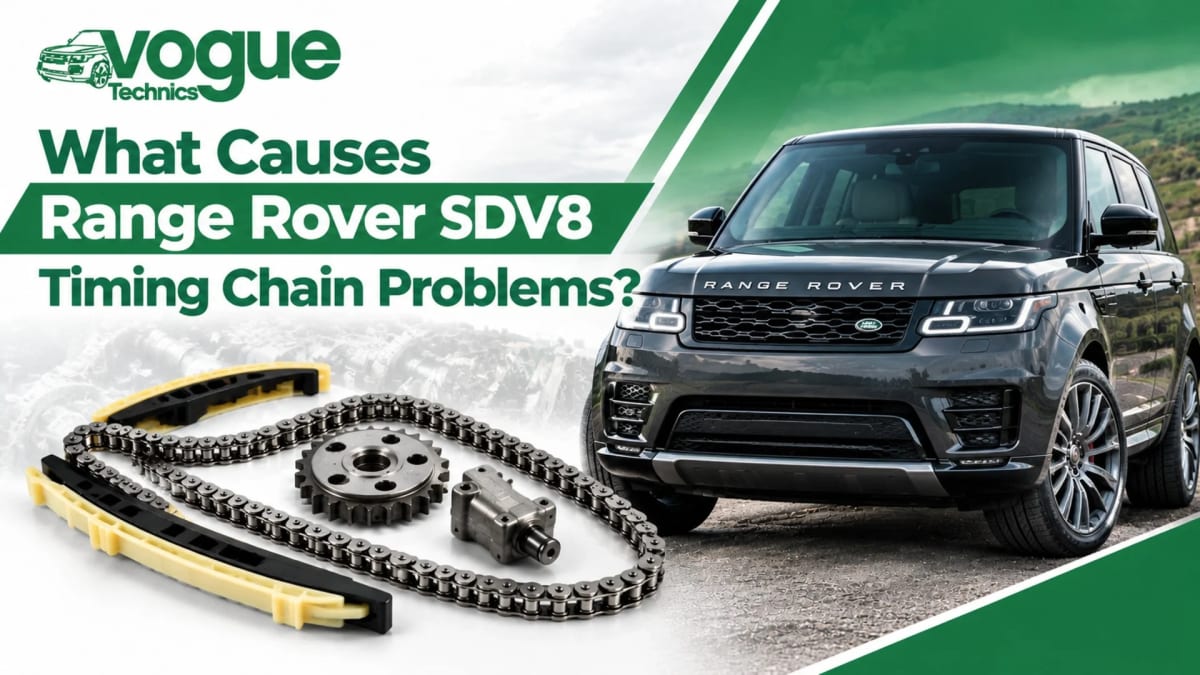
What Causes Range Rover SDV8 Timing Chain Problems?
Before diagnosing any noise or fault code, it helps to understand exactly what engine you're dealing with, because there's genuine confusion online about which Range Rover engines even have this issue.
Does the Range Rover 4.4 SDV8 Have a Timing Chain or a Belt?
Yes. The 4.4 SDV8 uses a timing chain, not a belt, to drive the camshafts from the crankshaft. This engine, known internally by its engine code 448DT, is a 4,367cc V8 diesel with twin turbochargers and a common-rail fuel injection system.
Chains have a reputation for lasting the life of the engine, and in many applications they do. The problem with the SDV8 isn't the chain concept itself, it's the location and design of the chain at the rear of the engine, which makes both inspection and replacement far more involved than on engines where the chain sits at the front.
That single design detail is the reason SDV8 timing chain jobs cost what they do, and why prevention matters so much more here than on most diesel engines.
Which Range Rover Models Use the 4.4 SDV8 (448DT) Engine?
The 448DT engine appears across two generations of Range Rover, and the symptoms and repair considerations are broadly similar between them, though we treat them as distinct cases when diagnosing, since mileage patterns and prior repair history often differ.
Range Rover L405 4.4 SDV8 Timing Chain Issues
The L405 (2012 onwards) was the first Range Rover generation to carry the 4.4 SDV8. Many of these vehicles are now well past 100,000 miles, which puts them squarely in the mileage range where chain, tensioner and guide wear becomes a realistic concern rather than a theoretical one.
Range Rover Sport L494 4.4 SDV8 Timing Chain Issues
The L494 Range Rover Sport shares the same 448DT engine and the same underlying timing chain design. We find L494 owners are slightly less aware of the issue simply because the model is perceived as newer, but the engine itself carries identical risk once it reaches comparable mileage and service history.
Why Do SDV8 Timing Chain Problems Actually Happen?
There's rarely one single cause. In our experience, SDV8 timing chain failure tends to result from a combination of the following:
- Chain wear and stretch over time, normal metal fatigue accelerated by mileage and oil condition
- Tensioner wear, the hydraulic tensioner loses its ability to keep the chain taut, allowing slack and noise
- Chain guide wear, plastic-faced guides wear down and can eventually fail completely
- Reduced oil pressure or poor lubrication, insufficient oil flow to the timing chain area accelerates wear on every component above
- Extended or missed service intervals, degraded oil loses its protective properties long before a warning light tells you
- High mileage combined with short journeys, an engine that rarely reaches full operating temperature suffers more timing-chain wear than one used on longer runs
None of these factors guarantee failure on their own. But stack two or three together, high mileage, a missed service, and mostly short journeys, and the risk rises considerably.
What Are the Symptoms of SDV8 Timing Chain Failure?

This is the section most people land on this page looking for, and it's also where we see the most misdiagnosis, both by owners and, frankly, by some garages.
Why Does My Range Rover SDV8 Rattle on Cold Start?
A cold-start rattle happens because oil drains away from the top of the engine overnight. When you start the engine, there's a brief window before oil pressure builds fully, and if the chain tensioner is worn, that's precisely when you'll hear a rattling or chattering noise from the rear of the engine.
The tell-tale pattern is:
- Noise present on a cold start
- Noise reduces or disappears within a few seconds as oil pressure builds
- Noise returns after the car has sat for several hours (not immediately after a short stop)
If that pattern matches what you're hearing, it strongly suggests tensioner or chain wear rather than a random one-off noise.
SDV8 Timing Chain Noise vs High-Pressure Fuel Pump Noise, How to Tell the Difference
This is genuinely one of the most confused areas in SDV8 diagnosis, and it's worth its own section because getting it wrong leads to unnecessary work and unnecessary cost.
The 4.4 SDV8's high-pressure fuel pump (HPFP) can produce a noise that sounds remarkably similar to timing chain rattle to an untrained ear. Both are metallic, both are most noticeable at idle, and both can vary with engine temperature. But they behave differently enough that a proper diagnostic can usually separate the two before any parts are ordered.
Characteristic | Timing Chain / Tensioner Noise | High-Pressure Fuel Pump Noise |
| When it's loudest | Cold start, fades as oil pressure builds | Can persist at idle regardless of temperature |
| Location | Rear of the engine, lower down | Often described as higher-pitched, front/side of engine |
| RPM behaviour | Often disappears as revs rise slightly | Frequently continues or changes pitch with RPM |
| Pattern over time | Gets worse gradually, especially after cold starts | Tends to be more consistent day to day |
| Confirmed by | Chain/tensioner inspection, oil pressure check | Fuel pressure diagnostic, pump inspection |
We'd never recommend diagnosing this by ear alone. A proper cold-start listening test combined with a diagnostic scan is the only reliable way to know which component you're actually dealing with, and it can save you from paying for chain work when the fuel pump was the real culprit, or vice versa.
Other Warning Signs: Fault Codes, Misfires and Poor Running
Beyond the audible rattle, a handful of other signs point toward timing-related problems:
- Illuminated engine management light
- Rough running or hesitation, particularly from cold
- Misfires that don't correspond to an obvious ignition or injector fault
- Reduced power or the vehicle entering limp mode
- Noticeably worse fuel economy with no other explanation
What Do Fault Codes P0016–P0019 Mean on an SDV8?
Codes in the P0016 to P0019 range relate to camshaft and crankshaft position correlation, essentially, the ECU detecting that the camshaft and crankshaft are no longer turning in the precise relationship they should be. This is the classic fault code signature of timing chain stretch or slack.
It's worth being clear, though: these codes don't automatically confirm the chain has failed outright. They confirm a timing discrepancy exists, which could mean anything from early-stage chain stretch to a sensor fault. That distinction is exactly why a proper diagnostic check matters before committing to any repair.
Can You Still Drive It, and How Is an SDV8 Timing Chain Problem Diagnosed?

This is usually the question underneath all the others: is this urgent, or can it wait?
Is It Safe to Keep Driving a Range Rover With a Noisy Timing Chain?
Short answer: not for long, and not without getting it checked. A rattle on cold start that disappears quickly is a warning sign, not an emergency, but it's a warning sign that tends to get worse, not better, over time.
We'd never tell someone to park the car immediately over a mild, brief cold-start rattle. But we would strongly recommend booking a diagnostic check within days rather than months, because the gap between "audible wear" and "chain failure" can close faster than owners expect, especially with continued short-journey use.
What Happens If the SDV8 Timing Chain Jumps or Snaps?
This is the scenario worth taking seriously. If a worn timing chain jumps time or fails completely, the camshaft and crankshaft fall out of sync, and on this engine, that typically results in valve-to-piston contact. In plain terms: bent valves, potentially damaged pistons, and in the worst cases, a cylinder head that needs to come off or an engine that needs a rebuild.
This is precisely why the cost difference between catching the problem early and catching it late is so significant, and why we treat any confirmed timing chain wear as something to act on rather than monitor indefinitely.
How We Diagnose SDV8 Timing Chain Problems at Voguetechnics
A proper diagnosis isn't guesswork, and it isn't just "listen and quote." Our process typically follows this sequence:
- Cold-start listening test, identifying exactly when and where the noise occurs
- Diagnostic fault code scan, checking for P0016–P0019 or other correlation faults
- Oil level and condition check, degraded or low oil is often part of the picture
- Oil pressure check, confirming the lubrication system is performing as it should
- Noise source isolation, ruling out the high-pressure fuel pump and other components before pointing to the chain
- Physical inspection where required, confirming chain, tensioner and guide condition directly rather than relying on noise alone
Cold-Start Listening Test and Diagnostic Scan
We specifically ask customers not to start the car before it arrives with us if possible, or to describe exactly how long it had been sitting beforehand. That cold-start behaviour is one of the single most useful diagnostic clues we have, and it costs nothing to preserve it before your appointment.
SDV8 Timing Chain Replacement Cost, Prevention & Buying Advice

How Much Does SDV8 Timing Chain Replacement Cost in the UK?
Costs vary depending on exactly what's worn and how far the problem has progressed, but there are broadly two scenarios:
- Chain, tensioner and guide replacement, the more contained repair, addressing worn components before consequential damage occurs
- Full engine rebuild or replacement, required where a chain has jumped or failed and caused valve or piston damage
The gap between these two outcomes is substantial, which is really the central message of this entire page: an early diagnostic appointment is inexpensive by comparison, and it's the single biggest factor in which of these two categories you end up in.
For an accurate quote based on your specific vehicle, mileage and symptoms, get in touch with our team in Grays, we'll talk you through the likely scope before any work begins.
How to Prevent SDV8 Timing Chain Problems
Prevention on this engine comes down to a handful of consistent habits rather than any single fix:
- Keep to regular oil changes using the correct specification oil, this is the single most influential factor in chain and tensioner longevity
- Don't ignore a mild cold-start rattle, get it checked while it's still a minor finding rather than an active fault
- Vary your journeys where possible, regular longer drives allow the engine to reach full operating temperature, which supports better long-term lubrication
- Keep a documented service history, this protects both the engine's health and the car's resale value
- Have oil pressure checked periodically, particularly once the vehicle passes higher mileage
None of these guarantee a chain will never wear, this is a known weak point of the design, not a maintenance myth, but consistent care measurably reduces the risk and, more importantly, buys you time to catch problems early.
What to Check Before Buying a Used Range Rover SDV8
If you're shopping for an L405 or L494 Range Rover with the 4.4 SDV8, the timing chain should be near the top of your pre-purchase checklist, alongside oil coolers and EGR condition.
Service History, Oil Records and Previous Repair Invoices
Ask specifically for:
- Full service history with oil-change intervals clearly dated
- Any invoices relating to previous timing chain, tensioner or guide work
- Confirmation of oil specification used at each service
A seller who can produce this documentation is a strong positive signal. A seller who can't, or who seems evasive about mileage-to-service-history ratio, is exactly the situation where we'd recommend a pre-purchase inspection before you commit.
We offer cold-start diagnostic checks specifically for buyers in this position, and it's one of the most valuable few hundred pounds you can spend before signing for a used SDV8.
Frequently Asked Questions
How Long Does an SDV8 Timing Chain Last?
There's no single mileage figure that applies to every car, because chain longevity depends heavily on service history, oil condition and driving pattern. Many SDV8s run well past 100,000 miles without issue when properly maintained, while others develop noticeable wear earlier. This is exactly why symptom-based monitoring matters more than relying on a mileage number alone.
Can I Just Replace the Tensioner Instead of the Whole Chain?
Sometimes, but only if the chain, guides and sprockets are confirmed to be within acceptable wear limits during inspection. Replacing a tensioner in isolation without checking the rest of the timing system is a false economy if the chain itself has already stretched, you'd likely be back with the same noise within a relatively short time.
Will My Warranty Cover SDV8 Timing Chain Failure?
This depends entirely on the type of warranty you hold and its specific terms around wear-and-tear versus mechanical failure. Manufacturer warranties on vehicles of this age have typically expired, and aftermarket warranty coverage varies significantly by provider. It's worth checking your policy wording directly, or asking us to help interpret it against your specific fault.
Should I Book a Diagnostic Check or Go Straight to Replacement?
Almost always, start with a diagnostic check. Jumping straight to a chain replacement without confirming the actual source of a noise risks paying for work that doesn't fix the problem, particularly given how easily timing chain noise can be confused with high-pressure fuel pump noise on this engine.
Get Your Range Rover SDV8 Timing Chain Checked Before It Becomes an Engine Rebuild
A cold-start rattle is easy to ignore on a busy morning. It's also the cheapest moment in the entire lifecycle of this problem to get it looked at. Once a worn chain jumps or fails, the conversation shifts from a straightforward repair to a full engine rebuild, and that's a gap in cost and inconvenience nobody needs to find out about the hard way.
If your Range Rover or Range Rover Sport is making an unusual noise on start-up, or you're weighing up a used SDV8 purchase and want peace of mind before you buy, our team at Voguetechnics in Grays, Essex, can carry out a proper cold-start diagnostic and give you a clear, honest picture of what you're dealing with, no guesswork, no unnecessary parts.
Get in touch with Voguetechnics today to book your SDV8 diagnostic check.