
Range Rover L405 Timing Chain Problems: Symptoms, Causes & Repair Options in Essex

A rattle on a cold morning doesn't sound like much at first. Then it happens again the next day. And the day after that. If you're hearing a metallic tapping or rattling noise from your Range Rover L405 when you start it up, you're not imagining things, and you're not alone. Timing chain problems on the L405 are one of the most searched, most discussed, and most misunderstood issues affecting this generation of Range Rover.
The good news is that a noisy timing chain rarely fails overnight. The bad news is that ignoring it can turn a manageable repair into a full engine rebuild. This guide walks through exactly what's going on inside your engine, which L405 variants are most at risk, how to tell the difference between a genuine timing chain fault and something else entirely, and what your realistic repair options look like, including what it costs to put right here in Essex.
Does the Range Rover L405 Have Timing Chain Problems?
Yes, timing chain issues are a well-documented weak point across several Range Rover L405 engine variants, particularly the petrol models. This isn't a rumour circulating on owners' forums; it's a pattern confirmed repeatedly by independent specialists, diagnostic data, and thousands of real-world repair cases.
The L405, built from 2013 through to 2022, was fitted with a range of engines, some far more prone to timing chain wear than others. Understanding which engine sits under your bonnet is the single most important factor in understanding your actual risk level.
Which L405 Engines Are Most Affected?
The 5.0-litre V8 petrol engines, badged AJ133, are the most frequently flagged for timing chain guide and tensioner wear, both in supercharged and naturally aspirated form. The 3.0-litre supercharged V6 (AJ126) shares some of the same architecture and has its own documented tensioner concerns. Diesel variants aren't immune either, though the nature of their timing-drive systems differs, which we'll cover in detail further down.
How Common Are Timing Chain Failures on the L405?
Genuine catastrophic failure, where the chain actually jumps or breaks, is relatively rare if the vehicle has been serviced properly. What's far more common is progressive wear: chain guides degrading, hydraulic tensioners losing pressure, and the chain developing slack long before anything catastrophic happens. Caught early, this is a manageable repair. Left unchecked, it isn't.
Is This a Design Fault or a Maintenance Issue?
Realistically, it's both. The AJ133 and AJ126 engines use plastic-composite timing chain guides that were, in hindsight, undersized for the loads and heat cycles involved, a known limitation across several Jaguar Land Rover petrol engines of this era. But oil quality, service intervals, and how the car is actually driven (short journeys, cold starts, infrequent oil changes) significantly accelerate the problem. Two identical L405s can have completely different outcomes depending purely on how they were looked after.
Range Rover L405 Timing Chain Symptoms and Warning Signs

Your engine will almost always tell you something is wrong before it actually fails. The trick is knowing what to listen and look for, and not dismissing it as "just an old engine noise."
What Does L405 Timing Chain Rattle Sound Like?
Owners typically describe it as a metallic, ticking or rattling noise coming from the front of the engine, most noticeable in the one to three seconds immediately after startup. It's often compared to a loose chain slapping against a cover, or a fast marble-in-a-tin sound. If you've heard a diesel engine rattle before you've started the car properly warm, that's roughly the texture, though the pitch tends to be sharper on the petrol V8 and V6 units.
Cold-Start Rattle vs Rattle That Persists When Warm
This distinction matters more than most owners realise:
- Rattle only on cold start, gone within a few seconds, typically points to a hydraulic tensioner that's slow to build oil pressure. Still worth investigating, but often an earlier-stage issue.
- Rattle that continues once the engine is warm, or gets louder under load, a stronger indicator of genuine chain slack, guide wear, or tensioner failure that needs prompt attention.
Neither should be ignored, but the second scenario generally means less time before intervention is needed.
Timing Chain Rattle vs Supercharger Noise, How to Tell the Difference
This is where a lot of owners, and, frankly, a lot of general mechanics, get it wrong. The supercharged 5.0 V8 has its own drivetrain component, the torsional isolator or supercharger coupler, which can also generate a rattling or clattering noise from the front of the engine. Confusing the two leads to unnecessary parts being replaced while the actual fault goes untreated.
Symptom | Timing Chain Issue | Supercharger Coupler Issue |
| Noise on cold start | Very common | Possible |
| Noise changes with engine RPM | Yes, chain-slap pattern | Yes, but often more constant whine/rattle |
| Noise location | Front, lower engine | Front, upper engine near supercharger housing |
| Diagnostic trouble codes present | Sometimes (P0016–P0019) | Usually none |
| Requires specialist mechanical inspection | Yes | Yes |
The only reliable way to distinguish between the two is a proper mechanical inspection, ideally a borescope check combined with a listening tool placed at specific points on the engine. Guessing based on sound alone, even for experienced ears, leads to misdiagnosis often enough that it's worth paying for a proper assessment before committing to a repair.
Check Engine Light and Fault Codes (P0008, P0016–P0019)
If the timing chain has developed enough slack to affect camshaft or crankshaft timing, the engine control module will usually flag it. The codes to watch for include:
- P0008 – Engine position system performance (bank 1)
- P0016 – Crankshaft/camshaft correlation, bank 1 sensor A
- P0017 – Crankshaft/camshaft correlation, bank 1 sensor B
- P0018 – Crankshaft/camshaft correlation, bank 2 sensor A
- P0019 – Crankshaft/camshaft correlation, bank 2 sensor B
Important caveat: these codes don't automatically confirm a mechanical timing chain fault. A faulty camshaft or crankshaft position sensor can throw identical codes. That's why proper diagnostics, not just a code reader plugged in for five minutes, matter so much here. A specialist will check sensor readings, oil condition, and mechanical timing correlation before recommending a repair path.
Rough Idle, Misfires and Loss of Power
As timing deviation increases, the engine's ability to fire cylinders at the correct point in the cycle degrades. This shows up as a rough or uneven idle, occasional misfires, hesitant acceleration, or a noticeable drop in overall power delivery, sometimes accompanied by the vehicle entering a "reduced performance" or limp mode as the ECM protects the engine from further damage.
What Causes Timing Chain Failure on the Range Rover L405?
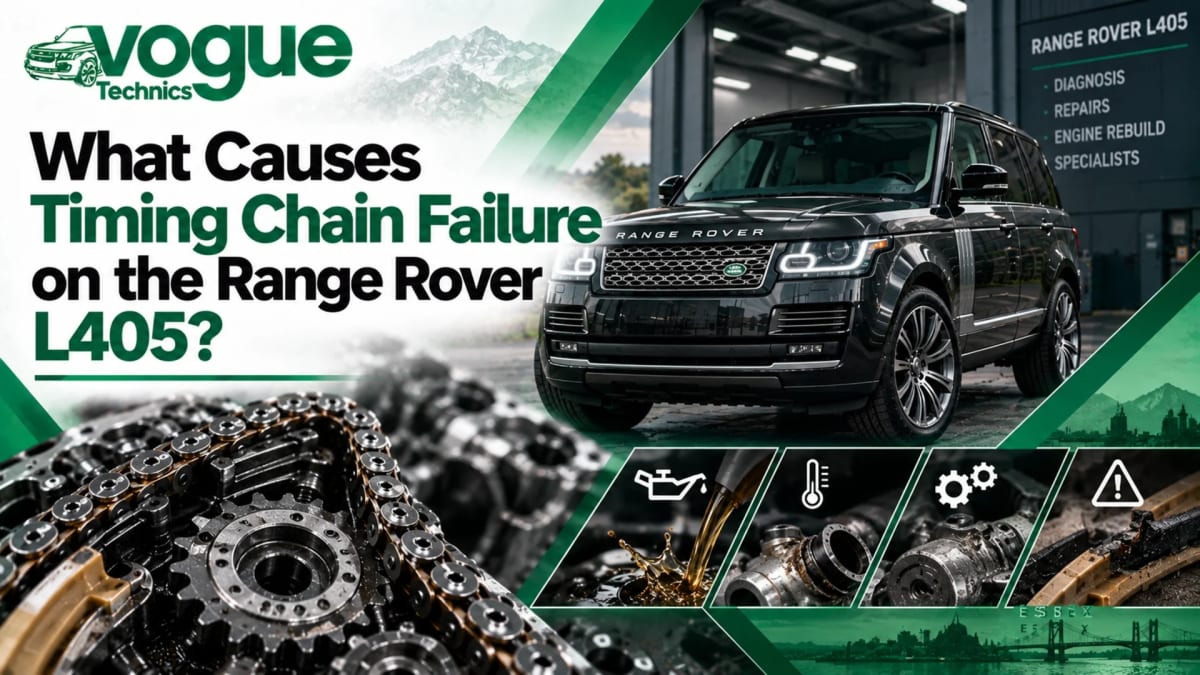
Understanding the mechanics behind the failure helps make sense of why some L405s develop problems at 60,000 miles while others run well past 120,000 without issue.
Worn Guides and Failed Hydraulic Tensioners
The timing chain itself sits under constant tension, guided by plastic composite guides and kept tight by hydraulic tensioners that rely on consistent engine oil pressure. Over time, the guides wear down, sometimes shedding small fragments into the oil system, and the tensioners lose their ability to maintain proper chain tension. Once tension is lost, the chain begins to slap against its guides on every rotation, accelerating wear in a feedback loop that only gets worse.
Chain Stretch and Oil Servicing Neglect
"Chain stretch" is a slightly misleading term, the chain links themselves don't physically elongate so much as the pins and bushings wear, effectively lengthening the chain's pitch. This happens faster when:
- Oil change intervals are extended beyond manufacturer recommendations
- Lower-quality or incorrect-viscosity oil is used
- The vehicle does frequent short journeys that don't let the oil reach full operating temperature
- Oil pressure is already marginal due to other wear elsewhere in the engine
None of these factors alone will destroy a timing chain. Combined, and sustained over years, they're the most common real-world cause of premature failure.
L405 Timing Chain Problems by Engine
Not every L405 engine faces the same risk profile, and treating them as one homogenous group is where a lot of generic advice online falls short.
5.0 V8 (AJ133) Timing Chain Issues
Both the supercharged (508PS) and naturally aspirated (508PN) versions of the AJ133 are the engines most frequently associated with timing chain guide and tensioner wear. The chain sits at the rear of the engine on this unit, which, while it protects the components from road debris and weather, makes inspection and replacement considerably more labour-intensive, directly affecting repair cost.
3.0 SCV6 (AJ126) Timing Chain Issues
The supercharged 3.0-litre V6 shares design DNA with the AJ133 and has its own documented tensioner wear pattern, though generally reported slightly less frequently than the V8. The same rear-mounted chain layout applies, and the same diagnostic caution around correlation fault codes is relevant.
3.0/4.4 Diesel (306DT/448DT) Timing Chain vs Belt Explained
This is where confusion is common. Not every L405 diesel uses the same timing-drive arrangement:
- The 3.0 TDV6/SDV6 (306DT) engines use a timing chain arrangement, though the failure pattern and typical mileage differ from the petrol V8/V6 units.
- The 4.4 SDV8 (448DT) uses its own chain configuration with a separate risk profile, generally considered more robust than the petrol variants but not immune to wear over high mileage.
If you're researching your specific L405 and finding conflicting information about "timing belt" versus "timing chain," it usually comes down to which engine variant the source is actually discussing, another reason generic, engine-agnostic articles tend to mislead more than they help.
What Happens If You Keep Driving With a Timing Chain Fault?
This is the question that matters most, because it's the difference between a £1,500–£3,000 repair and a £6,000+ engine replacement.
The progression typically looks like this: chain slack develops → timing deviation increases → in more advanced cases, the chain can skip a tooth on the sprocket → this throws camshaft and crankshaft timing out of sync → valve timing becomes incorrect → in a worst-case scenario, this leads to piston-to-valve contact → bent valves and, in severe cases, catastrophic engine damage requiring a full rebuild or replacement.
Not every case reaches that final stage. Plenty of owners drive for months with a mild rattle and never experience total failure. But there's no reliable way to predict which category your car falls into without a proper inspection, which is exactly why "it's probably fine" is the most expensive assumption you can make with this particular fault.
Range Rover L405 Timing Chain Repair, Cost & Inspection in Essex

Once you know (or strongly suspect) you're dealing with a genuine timing chain issue, the real question becomes: what does fixing it actually involve, and what should you expect to pay?
How Much Does L405 Timing Chain Replacement Cost?
Costs vary significantly depending on engine type, extent of the damage, and whether the work is preventative or reactive. As a general guide for the UK market:
- Diagnostic inspection and assessment: typically a few hundred pounds, and money well spent before committing to major work
- Timing chain guide and tensioner replacement (caught early): a significant but contained repair, usually the most cost-effective outcome
- Full timing chain kit replacement (chain, guides, tensioners, sprockets): a larger job, particularly labour-intensive on the rear-mounted AJ133/AJ126 layout where the transmission may need to be dropped for access
- Engine damage from prolonged timing chain failure: this is where costs escalate sharply, potentially requiring a reconditioned or replacement engine
Exact pricing depends on your specific vehicle, engine variant, and the condition found during inspection, which is why we recommend a proper diagnostic assessment rather than working from a generic estimate found online.
Repair vs Engine Replacement, Which Is Right for You?
This decision usually comes down to three factors: how far the timing chain fault has progressed, the overall condition and mileage of the rest of the engine, and how long you intend to keep the vehicle.
If the fault is caught at the rattle or fault-code stage, a targeted chain, guide, and tensioner replacement is almost always the right call, it's a contained job with a predictable outcome. If the engine has already suffered valve or piston damage from prolonged timing deviation, a rebuild or reconditioned engine often becomes the more sensible long-term investment, since a rebuild that only addresses the timing chain while ignoring collateral damage rarely holds up.
How to Check the Timing Chain Before Buying a Used L405
If you're shopping for a used Range Rover L405, a few minutes of due diligence can save you thousands. Before you commit to a purchase:
- Listen to a genuinely cold start. Ask the seller not to start the engine before you arrive, and insist on hearing the very first startup yourself.
- Request full service history, paying particular attention to oil change frequency and whether OEM or high-quality oil was consistently used.
- Ask about any prior timing chain work or stored diagnostic codes, and request a diagnostic scan as part of the sale.
- Check the specific engine variant, a 5.0 V8 with 90,000 miles carries a different risk profile than a 4.4 diesel with the same mileage.
- Get a specialist pre-purchase inspection. This is the single most reliable safeguard, and considerably cheaper than discovering a timing chain problem after you've already bought the car.
A rattle on a test drive isn't automatically a deal-breaker, but it should absolutely be a negotiating point, or a reason to walk away if the seller can't provide clear service history to support the car's condition.
Why Choose Voguetechnics for L405 Timing Chain Repairs in Grays, Essex
We work on Range Rover L405s day in, day out, across the full engine range, from the 5.0 V8 to the 4.4 SDV8 diesel, and timing chain diagnosis is one of the jobs we're asked to get right most often, because getting it wrong is expensive. Based in Grays, Essex, we combine proper mechanical diagnostics (not just a code reader) with genuine, experience-led inspection to tell you exactly what's happening under the bonnet before any work begins.
What that means for you as a customer:
- Accurate diagnosis that distinguishes genuine timing chain wear from sensor faults or unrelated noises like supercharger coupler wear
- Clear, honest guidance on whether a targeted repair or a more substantial rebuild is the right call for your specific car
- Transparent pricing before any work is carried out, no surprises once the engine is opened up
- Specialist experience across the full L405 engine range, not a one-size-fits-all approach
Book a Diagnostic or Get a Quote
If you've noticed a rattle, a warning light, or you're simply due a check before it becomes a problem, get in touch with our Grays, Essex team for a proper diagnostic assessment. Catching a timing chain issue early is almost always the difference between a manageable repair and a five-figure engine replacement.
Frequently Asked Questions
Does the Range Rover L405 have timing chain problems?
Yes, particularly the petrol variants, the 5.0 V8 (AJ133) and 3.0 supercharged V6 (AJ126), which are known for timing chain guide and hydraulic tensioner wear. Diesel variants have their own, generally lower, risk profile.
What are the symptoms of L405 timing chain failure?
The most common early symptom is a metallic rattling noise on cold start, particularly in the first few seconds after startup. As it progresses, you may see a check engine light, rough idle, misfires, or reduced engine performance.
How much does L405 timing chain replacement cost?
Costs vary widely depending on whether it's a targeted guide and tensioner replacement or a full kit replacement, and whether any collateral engine damage has occurred. A proper diagnostic inspection is the only reliable way to get an accurate figure for your specific vehicle.
Is timing chain rattle on an L405 normal?
No. While some very minor, brief noise on cold start can occur on any high-mileage engine, a persistent or worsening rattle is a warning sign that should be inspected promptly rather than dismissed as normal wear.
Can a Range Rover L405 timing chain actually break?
It's possible in advanced, untreated cases, though more commonly the chain develops excessive slack or skips timing before a complete break occurs. Either scenario can cause serious engine damage if left unaddressed.
Which L405 engine has the most timing chain problems?
The 5.0-litre V8 (AJ133), in both supercharged and naturally aspirated form, is the engine most frequently associated with timing chain issues, followed by the 3.0 supercharged V6 (AJ126).
How do I know if it's the timing chain or the supercharger making the noise?
Both can produce a rattling noise from the front of a supercharged L405 engine, and they're easily confused. A proper mechanical inspection, ideally with a borescope and diagnostic listening equipment, is the only reliable way to tell the difference.
Should I buy a used L405 with a timing chain rattle?
Not without a specialist inspection first. A rattle doesn't automatically mean the car is a write-off, but you should treat it as a serious negotiating point and get a proper diagnostic assessment before committing to the purchase.
A timing chain rattle on your Range Rover L405 isn't something that fixes itself, but it's also not automatically a disaster, the outcome depends entirely on how quickly it's properly diagnosed and addressed. Whether you're hearing an unfamiliar noise on cold mornings, you've had a warning light appear, or you're about to buy a used L405 and want peace of mind before you sign anything, getting an accurate assessment now is far cheaper than dealing with the consequences later.
If you're in Essex or the wider London area and want a straight answer on what's going on under your bonnet, get in touch with Voguetechnics in Grays for a specialist diagnostic and honest advice on the best way forward.