
Range Rover Ingenium Timing Chain Problems: Symptoms, Causes, Repair Cost and What to Do Next
You start the engine on a cold morning and hear a brief metallic rattle. It lasts a few seconds and then fades. Most owners shrug it off. With a 2.0 Ingenium, that sound is worth taking seriously.
Range Rover Ingenium timing chain problems usually start with chain stretch, along with wear in the tensioner and plastic guides. The first sign is often that cold-start rattle. Left alone, a slack chain can jump a tooth, upset the valve timing and turn a manageable repair into an engine rebuild.
This guide explains what goes wrong, how to tell whether your engine is affected, what diagnosis involves and what repair costs. At Vogue Technics in Grays, Essex, we work on Ingenium engines for customers across the UK. [Insert real figure: years of experience / number of Ingenium jobs completed.] If you're hearing something you don't like, you can get a free quote or inspection at any point.
What Are the Most Common Range Rover Ingenium Timing Chain Problems and Why Do They Happen?
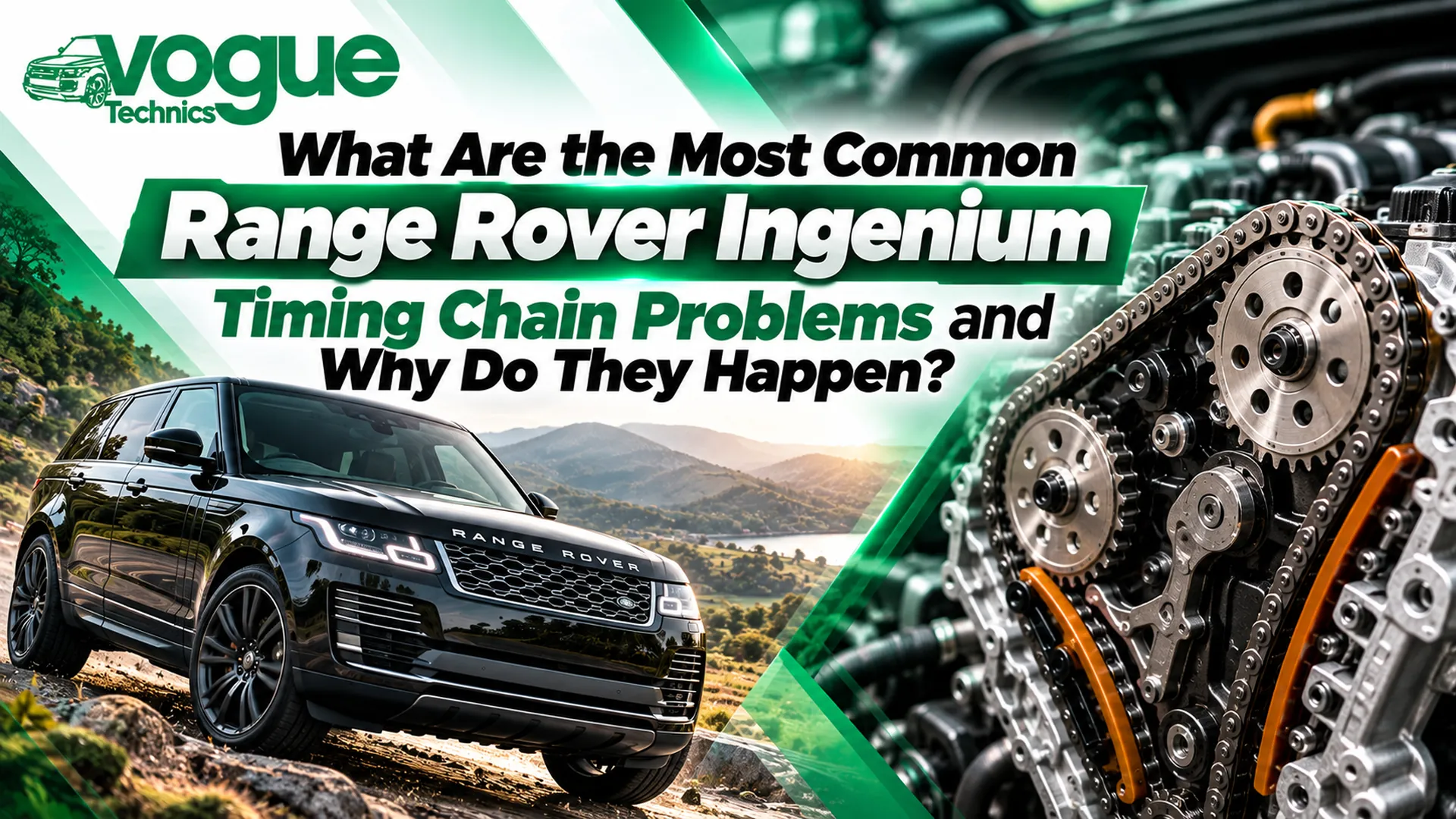
Three parts do most of the work in the timing system: the chain, the hydraulic tensioner and the plastic guide rails. The chain links the crankshaft to the camshafts, so the valves open and close at exactly the right moment relative to the pistons. The tensioner uses oil pressure to keep the chain tight, and the guides steer it around its path.
Problems usually follow one of these patterns:
- Chain stretch (elongation): Metal wear lengthens the chain over time, so it develops slack.
- Tensioner wear: The hydraulic tensioner can't hold tension properly, especially at cold start before oil pressure builds.
- Guide wear: Plastic guide rails wear or degrade, letting the chain move about more than it should.
- Lubrication problems: Low oil pressure, degraded oil or the wrong specification speeds up all of the above.
These parts work together, so one worn component tends to accelerate wear in the others. Treat any single symptom as a warning about the whole timing system.
Which Range Rover Models and Ingenium Engines Are Affected?
The 2.0-litre Ingenium four-cylinder is shared across the Jaguar Land Rover range. For Range Rover customers, the Evoque and Velar are the most common vehicles we see with these concerns. Some Range Rover Sport variants use 2.0 Ingenium engines, mainly petrol and plug-in hybrid versions depending on year and market. The same engine family also appears in the Discovery Sport, the Defender and several Jaguar models (XE, XF, E-Pace and F-Pace), which is why owners of those vehicles often search the same terms.
Diesel and petrol Ingenium engines are different units with different codes and different failure patterns. Don't assume one engine code applies to every model or year. Always confirm yours from the engine code stamped on the block or by VIN lookup before ordering parts or agreeing a repair.
Engine | Fuel | Typical applications | Timing system | How to verify |
| 204DTA | Diesel | Evoque, Velar and other JLR models | Chain | VIN / engine code |
| 204DTD | Diesel | Later JLR diesel applications | Chain | VIN / engine code |
| AJ200D | Diesel | JLR applications (Jaguar designation) | Chain | VIN / engine code |
| AJ20D | Diesel | Jaguar / JLR applications | Chain | VIN / engine code |
| 2.0 Ingenium petrol variants | Petrol | Evoque, Velar, Jaguar and others | Chain | VIN / engine code |
If you're unsure which engine you have, send us your registration and we'll confirm it before quoting. [Internal link: free engine quote page]
Can Oil Dilution and DPF Regeneration Cause Ingenium Timing Chain Stretch?
They can contribute, particularly on diesel engines. This is a risk pathway, and it doesn't explain every failure.
Here is how it works. A diesel particulate filter (DPF) needs regular high-temperature regeneration to burn off soot. On short journeys the regeneration often doesn't finish. Some of the extra fuel injected during regeneration can then find its way into the engine oil, which is called fuel dilution. Diluted oil is thinner and protects less. It can slow oil pressure build-up at cold start, which is exactly when the tensioner needs pressure to keep the chain tight.
The chain of events looks like this:
- Short journeys prevent complete DPF regeneration.
- Fuel dilutes the engine oil.
- Oil quality and lubrication decline.
- Tensioner and guide wear increase.
- The chain develops slack and the timing starts to drift.
Some failures happen with clean oil and long-distance driving, and some engines with poor oil habits last well. The point is that oil condition is one of the few factors you control.
Do Short Journeys and Extended Oil Change Intervals Make Timing Chain Wear Worse?
Yes, both raise the risk. Short trips mean the engine spends most of its running time cold, when wear is highest and oil hasn't reached full pressure. They also leave the DPF unable to finish regenerating. Long service intervals then leave that degraded oil in the engine for longer.
A sensible approach for Ingenium owners:
- Use the oil specification approved for your exact engine and model year, and confirm it before every service.
- Consider changing oil more often than the longest interval on the schedule, especially if most of your driving is short-distance. [Insert Vogue Technics' recommended interval.]
- Take the car on a longer run now and then so the DPF can regenerate.
- Ask your garage to check oil level and condition, since a rising oil level on a diesel can point to fuel dilution.
What Are the Symptoms of a Failing Ingenium Timing Chain and How Is It Diagnosed?
Timing chain wear rarely arrives without warning. The signs build gradually, and they're easy to dismiss until the engine starts to run badly. Watch for:
- A metallic rattle at cold start, usually the earliest sign
- Engine management or check engine light
- Restricted performance or limp mode
- Rough or unstable idle
- Loss of power and poor acceleration
- Difficult starting
- Misfires and increased emissions in some cases
Any one of these can have other causes. Several together, particularly a cold-start rattle alongside a warning light, point strongly at the timing system.
Why Does My Range Rover Rattle on Cold Start, and What Do P0016 and P0017 Fault Codes Mean?
The rattle happens because the tensioner hasn't yet built full oil pressure. For a few seconds the chain runs slack and slaps against its guides, which produces a brief, sharp, metallic sound. Once oil pressure rises, the tensioner tightens the chain and the noise stops. That's why the sound is so easy to ignore, and why it matters. It means the chain and tensioner are struggling to hold tension when the engine is cold.
The engine control unit compares the camshaft and crankshaft position signals constantly. When they stop matching, it stores a correlation fault code.
Code | General meaning | What it may indicate |
| P0016 | Crankshaft / camshaft position correlation (Bank 1, Sensor A) | Stretched chain, timing drift, sensor or VVT fault |
| P0017 | Crankshaft / camshaft position correlation (Bank 1, Sensor B) | As above, relating to the second camshaft signal |
| P0018 | Crankshaft / camshaft position correlation (Bank 2, Sensor A) | Less common on four-cylinder engines; check the specific application |
| P0019 | Crankshaft / camshaft position correlation (Bank 2, Sensor B) | As above |
Bear in mind that these codes point to a timing correlation problem. They don't prove the chain is stretched. A faulty sensor, a failing VVT solenoid or an oil pressure issue can trigger the same codes, so a code alone isn't a diagnosis.
What this could be instead: Not every noise at start-up is the chain. Exhaust heat shields, ancillary components, injectors and turbocharger noises can all sound similar to an untrained ear. That's why we work through a proper sequence rather than guessing:
- Listen and record when the noise occurs (cold, hot, at idle or under load).
- Scan for fault codes, including correlation and VVT-related faults.
- Check oil level and condition, looking for dilution or degradation.
- Verify camshaft and crankshaft correlation using live data.
- Inspect the timing system (chain, tensioner, guides).
- Decide the repair scope based on what the inspection shows.
If you'd like this done properly, book a diagnostic check with us.
Can You Drive a Range Rover With a Rattling Timing Chain, and What Happens If You Ignore It?
Short answer: you shouldn't, once the noise or codes are confirmed. The engine may keep running for a while, but you're gambling on how long. The risk is that the chain jumps a tooth on the sprocket.
Failure typically progresses like this:
- Chain wear leads to chain slack.
- Slack causes timing deviation.
- Deviation can become jumped timing.
- Jumped timing puts valve timing out of step with the pistons.
- On an interference engine, that can cause valve-to-piston contact.
- The result can be bent valves, damaged pistons and internal engine damage.
The early stage might mean a timing chain kit. The late stage might mean a cylinder head repair or a full engine rebuild. The gap in cost between those two is often large, which is why early action pays off.
Hearing this noise? Book a diagnostic check before it escalates. We'll tell you plainly what we find and what it needs.
How Much Does Range Rover Ingenium Timing Chain Replacement Cost in the UK, and Should You Repair, Rebuild or Replace the Engine?
The honest answer is that cost depends on the stage of the problem. Caught early, a timing chain replacement is a defined job with a predictable price. After a jump or valve damage, the scope and the bill change completely.
Factors that affect Range Rover Ingenium timing chain replacement cost:
- Which engine and model you have (diesel or petrol, Evoque or Velar, and so on)
- Whether the tensioner, guides and sprockets need replacing with the chain
- How much access work is needed to reach the timing system
- Whether any damage has already occurred
- Parts choice (genuine, OEM or quality aftermarket)
Indicative pricing: [confirm price range for timing chain kit replacement]. Labour time: [confirm]. Warranty: [confirm parts and labour warranty terms]. We'll always give you a written quote before any work starts.
How Do You Get an Ingenium Timing Chain Checked, Quoted and Repaired in Grays, Essex or Nationwide?
A full timing chain job on an Ingenium normally covers:
- Replacing the timing chain, tensioner and guides together as a kit
- Checking the sprockets for wear
- Timing verification after fitting, so cam and crank alignment is correct
- Fresh oil and filter
- Post-repair testing and a fault code check
Replacing the chain but leaving worn guides or a tired tensioner is a false economy. The old parts wear the new chain and you pay for the same access work twice. Duration: [confirm typical turnaround time].
Which repair route you need depends on what the inspection shows:
Condition found | Likely route |
| Early chain wear | Timing chain repair |
| Worn guides or tensioner | Full timing chain kit |
| Timing jumped, limited damage | Timing repair plus inspection |
| Bent valves | Cylinder head repair or rebuild |
| Major piston and valve damage | Engine rebuild or replacement |
| Severe bottom-end damage | Reconditioned replacement engine |
If the engine has suffered serious damage, you'll usually choose between a reconditioned engine and a used one. A reconditioned engine is rebuilt to specification with worn components replaced and typically comes with a warranty. A used engine is cheaper up front but carries an unknown history, so you're taking on the risk that whatever wore the first engine may already be affecting this one. For most owners planning to keep the car, reconditioned is the safer choice. [Confirm warranty and options offered.]
Frequently asked questions
How much does Ingenium timing chain replacement cost?
It depends on the engine, the parts needed and whether damage has occurred. Get a written quote after inspection.
How long does the replacement take?
Timing work is precise, so a rushed job isn't a good sign.
Does the engine need to come out?
It depends on the model and the extent of the work. Some jobs can be done with the engine in the vehicle, but access varies. We confirm this at inspection.
Can the tensioner be replaced on its own?
Technically yes, but it's rarely the right call. If the tensioner has worn, the chain and guides have usually worn with it.
Can you drive with a rattling Ingenium timing chain?
It's risky. Once the noise or codes are confirmed, avoid driving the car until it's inspected.
Is the Ingenium timing chain a known problem?
Some 2.0 Ingenium engines have shown chain, tensioner and guide wear, particularly where oil condition or service history has been poor. Not every engine is affected, and it varies by model and year.
Ready to find out where your engine stands? Enter your registration for a free quote, call us, or book an inspection at our Grays, Essex workshop. The sooner we look, the more options you have.