
Range Rover Ingenium Timing Chain Problems: Symptoms, Causes, Diagnosis & Replacement Cost
If your Range Rover rattles for a few seconds every time you start it on a cold morning, you're not imagining things, and you're not alone. Across workshops in the UK, "Range Rover Ingenium timing chain problems" is one of the most searched issues by owners of the 2.0-litre Ingenium diesel and petrol engines, and for good reason. What starts as a faint metallic tick on start-up can, if ignored, turn into a five-figure engine replacement bill.
At Voguetechnics, based in Grays, Essex, we've stripped down more Ingenium engines than we'd like to admit purely because of timing chain failure. This guide walks you through exactly what causes it, how to spot it early, what the fault codes actually mean, and what realistic repair costs look like in the UK, so you can make an informed decision before the problem gets worse.
What Causes Range Rover Ingenium Timing Chain Problems?
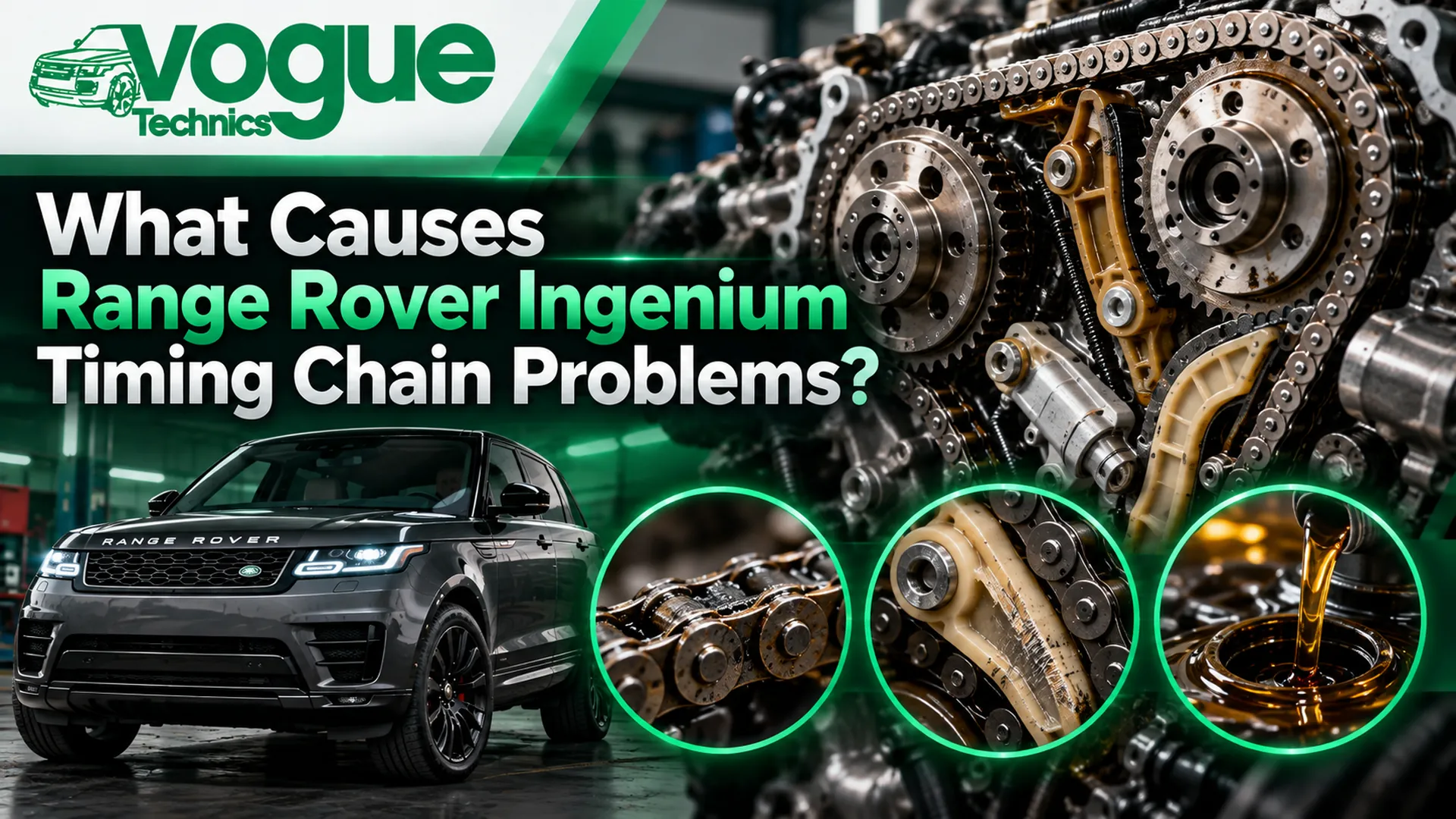
The Ingenium timing chain doesn't usually fail out of nowhere. It's almost always the end result of a slow chain of mechanical events, pun intended, that starts with something as ordinary as short school-run journeys.
Unlike a timing belt, which is designed to be replaced on a fixed schedule, a timing chain is meant to last the lifetime of the engine. On the 2.0 Ingenium, that promise hasn't always held up, and the reasons are fairly well understood by specialists who work on these engines every day.
Chain Wear, Guides and Tensioner Failure Explained
The timing chain itself rarely snaps out of the blue. What actually happens is gradual chain elongation, commonly (if a little loosely) referred to as "chain stretch." In reality, the chain's individual links and pins wear against each other over time, which lets the chain sit looser on its sprockets than it should.
That slack has to be taken up somewhere, and that's the job of the:
- Timing chain guides, plastic or composite rails that keep the chain running true
- Hydraulic timing chain tensioner, maintains constant chain tension as the engine runs
When oil quality drops or lubrication becomes inconsistent, these components wear faster than they should. Worn guides can crack or shed material into the oil, and a failing tensioner allows the chain to slap against the timing cover, which is exactly where that rattling noise comes from.
How Low Oil Pressure Leads to Timing Chain Failure
Oil pressure is the unsung hero of any timing system. The tensioner relies on consistent hydraulic oil pressure to keep the chain taut. When oil pressure drops, even briefly, such as during cold starts before oil has properly circulated, the tensioner can't do its job properly.
Repeated cycles of low oil pressure accelerate wear on the chain, guides, and tensioner simultaneously. Over enough short journeys and cold starts, this becomes a self-reinforcing problem: worn components need more oil pressure to compensate, but wear itself makes maintaining that pressure harder.
How DPF Regeneration and Oil Dilution Affect the Timing Chain
This is where the 2.0 Ingenium diesel has a problem that's genuinely unique to how modern emissions systems work, and it's one of the biggest content gaps in most guides online.
Here's the full causal chain, step by step:
- Short journeys don't let the engine reach the sustained temperatures needed for a complete DPF regeneration
- The engine compensates by injecting extra fuel into the cylinder during the exhaust stroke to burn off soot in the DPF
- Some of that unburned fuel washes past the piston rings and ends up in the engine oil, this is fuel dilution
- Diluted oil has reduced viscosity, meaning it's thinner and less able to maintain proper film strength and pressure
- The timing chain tensioner, which depends on correct oil pressure and viscosity, can no longer maintain proper chain tension
- The chain, guides and tensioner all wear faster under these conditions
- Left unaddressed, this ends in timing deviation, fault codes, and potentially a chain jump
If you mostly do short, stop-start driving, the school run, quick trips to the shops, your Ingenium diesel is statistically more exposed to this failure chain than one used mainly for motorway journeys.
Which Ingenium Engines and Range Rover Models Are Affected?
The 2.0 Ingenium engine (badged internally as AJ200D for diesel and AJ200P for petrol, with variants like 204DTD and 204DTA) has been fitted across almost the entire modern JLR line-up.
2.0 Ingenium Diesel vs Petrol, Is the Risk the Same?
The diesel Ingenium is more exposed to timing chain problems because of the DPF regeneration and oil dilution pathway described above. The petrol Ingenium doesn't carry a DPF, so it avoids that specific failure route, but it isn't immune to chain wear caused by extended oil-change intervals, poor-quality oil, or general high mileage. If you're comparing the two purely on timing chain risk, the diesel carries the higher documented failure rate, but petrol owners shouldn't assume they're completely in the clear.
Evoque, Velar, Range Rover Sport, Discovery Sport & Discovery
Model | Engine | Timing Chain Relevance |
| Range Rover Evoque | 2.0 Ingenium | High, common failure reports, especially diesel |
| Range Rover Velar | 2.0 Ingenium | High, same engine family and known symptoms |
| Range Rover Sport | 2.0 Ingenium | Moderate-high, depending on model year |
| Land Rover Discovery Sport | 2.0 Ingenium | High, shares engine and oiling system design |
| Land Rover Discovery | 2.0 Ingenium | Moderate, varies by year and variant |
| Land Rover Defender | Later Ingenium variants | Lower reported frequency, still monitored |
Jaguar models built on the same platform, the XE, XF, E-Pace and F-Pace, use the same 2.0 Ingenium engine family and share an identical risk profile, so if you're cross-shopping between brands, the underlying mechanical exposure is the same.
Signs and Symptoms of a Failing Ingenium Timing Chain
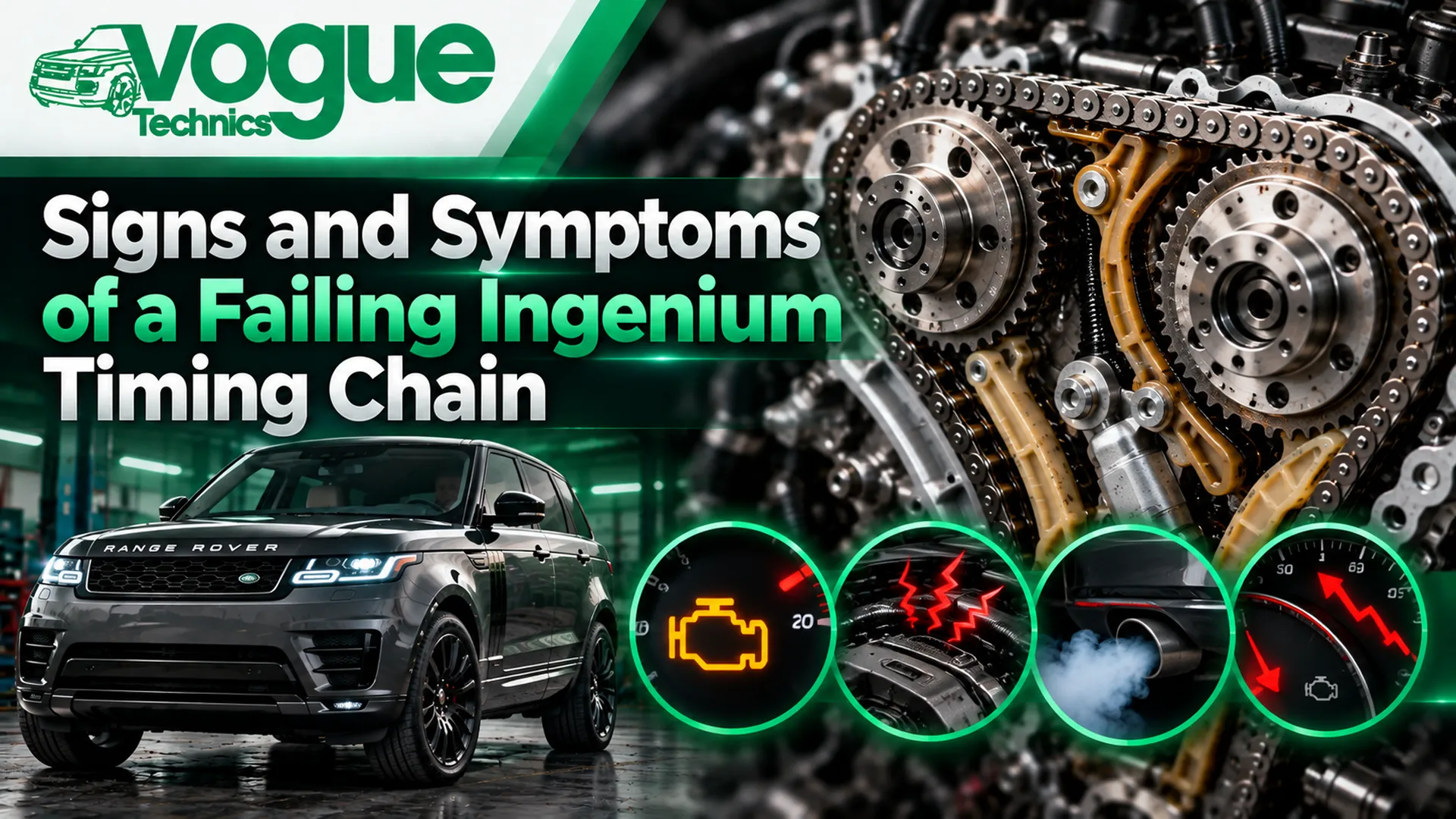
Catching timing chain wear early is genuinely the difference between a few hundred pounds and a few thousand. The symptoms tend to build gradually, so it's worth knowing exactly what to listen and watch for.
What Does an Ingenium Timing Chain Rattle Sound Like on Cold Start?
Owners typically describe it as a metallic rattle or chatter lasting one to three seconds immediately after starting the engine from cold, which then disappears once oil pressure builds. It's most noticeable:
- On the first start of the day
- After the car has sat for several hours or overnight
- In cold weather, when oil is thicker and slower to circulate
A rattle that clears within a second or two isn't automatically catastrophic, but it is a genuine early warning sign, not something to dismiss as "just how these engines sound." The longer that rattle persists or the louder it gets, the more urgent an inspection becomes.
Warning Lights, Restricted Performance and Rough Idle
As chain wear progresses, symptoms tend to move beyond noise alone:
- Rough idle, the engine feels less smooth at standstill than it used to
- Loss of power, noticeably sluggish acceleration, particularly under load
- Check engine / engine management light, often the first symptom some owners actually notice
- Restricted Performance mode, the vehicle deliberately limits power output to protect the engine once the ECU detects a timing fault
- Hesitation on acceleration, a slight delay or stumble when you put your foot down
- Starting problems, longer than usual cranking before the engine catches
If your Range Rover suddenly drops into Restricted Performance mode, that's the car actively protecting itself, it's not a fault to drive through or ignore.
Ingenium Timing Chain Fault Codes Explained
When a diagnostic scan is run, certain fault codes come up repeatedly in connection with timing chain wear. It's worth being clear upfront: a fault code alone does not confirm the timing chain is defective. It points diagnosticians toward the timing system, but proper mechanical inspection is still required to confirm the root cause.
P0016 and P0017, Camshaft/Crankshaft Correlation
These codes indicate that the camshaft and crankshaft are no longer rotating in the correct relative position, in other words, the engine has detected timing deviation. This is one of the strongest indicators of chain elongation or slack, since a stretched chain physically allows this misalignment to occur.
P0341 and P0011, Camshaft Position Faults
P0341 relates to a camshaft position/performance fault, while P0011 points to a camshaft timing issue, sometimes linked to variable valve timing (VVT/VCT) rather than the chain itself. Both can overlap with chain wear symptoms, which is why a proper diagnostic inspection, not just a code reader, is essential before committing to any repair.
What Happens If You Ignore Timing Chain Warning Signs?
This is the part that turns a moderate repair into a catastrophic one. If chain wear continues unchecked:
- The chain can jump a tooth on the camshaft or crankshaft sprocket, instantly throwing valve timing out of sync
- Pistons and valves can physically collide inside the cylinder, since they're no longer moving in correct relation to each other
- In the worst cases, this results in bent valves, damaged pistons, or a cracked cylinder head, meaning a full engine rebuild or replacement, not just a chain repair
A cold-start rattle that costs a few hundred pounds to fix today can become an engine that costs several thousand pounds to replace in six months. That's the single biggest reason we tell owners not to sit on this symptom.
Ingenium Timing Chain Diagnosis, Repair & Replacement Cost
Once you suspect a timing chain issue, the next steps matter. Here's what a proper diagnosis and repair actually involves, and what it's likely to cost in the UK.
How We Diagnose a Range Rover Ingenium Timing Chain Fault
A genuine diagnosis goes well beyond plugging in a code reader. At Voguetechnics, our process typically includes:
- Full diagnostic scan to check for P0016, P0017, P0341, P0011 and any related codes
- Cold-start listening test to assess rattle duration and severity
- Oil condition inspection, checking for signs of fuel dilution, contamination, or unusually high oil level (a classic sign of diesel entering the sump)
- Camshaft/crankshaft correlation test using the scan tool to measure actual timing deviation
- Physical inspection of the chain, guides and tensioner where access allows, before recommending replacement
This combination is what separates a genuine diagnosis from a guess. Two different vehicles can throw the same fault code for two completely different underlying reasons.
What's Included in a Timing Chain Replacement
A proper Ingenium timing chain replacement isn't just swapping the chain itself. It typically includes:
- Full timing chain kit, chain, both guides, and the hydraulic tensioner as a matched set
- Timing sprockets on the camshaft and crankshaft, inspected and replaced if worn
- Fresh engine oil and filter, since old, diluted oil is often part of what caused the failure in the first place
- Reset and recalibration of camshaft/crankshaft timing using manufacturer procedures
- A post-repair diagnostic scan to confirm correlation values are within spec and no fault codes remain
Fitting guides and tensioner without replacing a genuinely worn chain, or vice versa, is a false economy. Specialists who've done this job repeatedly will always recommend replacing the kit as a complete set.
Why Is the Ingenium Timing Chain Expensive to Replace?
This is a question we get constantly, and it comes down to one design factor: the timing chain assembly on the Ingenium sits at the rear of the engine, toward the gearbox and flywheel, not at the front like most traditional engines.
That positioning means access for a technician is significantly more labour-intensive. In many cases, the gearbox has to be at least partially separated from the engine to reach the timing components properly. More labour hours directly translate to a higher bill, even though the parts themselves aren't dramatically expensive.
Range Rover Ingenium Timing Chain Replacement Cost (UK Guide)
Costs vary depending on the model, the extent of damage, and whether it's a straightforward chain kit replacement or something that's escalated into engine damage. As a general UK guide:
Repair Type | Approximate Cost (UK) |
| Diagnostic inspection | £80 – £150 |
| Timing chain kit replacement (chain, guides, tensioner) | £1,200 – £2,200 |
| Timing chain replacement + oil pump/additional wear parts | £1,800 – £2,800 |
| Full engine rebuild (after chain jump/damage) | £3,500 – £6,000+ |
| Engine replacement (reconditioned unit) | £4,500 – £7,500+ |
These figures are indicative and will vary by garage, model year, and specific vehicle condition, but they illustrate the scale of the gap between catching the problem early and letting it escalate. A £1,500 chain replacement is a very different conversation to a £6,000 engine rebuild.
Timing Chain Repair vs Engine Rebuild vs Engine Replacement
Which route makes sense depends entirely on how far the damage has progressed:
- Timing chain replacement alone, appropriate when caught early, before any valve or piston contact has occurred
- Engine rebuild, necessary when a chain jump has caused localised damage (bent valves, minor piston marking) but the block and crankshaft are still sound
- Engine replacement, the realistic option when damage is extensive, or when a reconditioned/used engine works out more cost-effective than a full rebuild given labour hours involved
A reconditioned engine generally offers more predictable reliability than a used engine of unknown history, since it's been rebuilt to a known standard with new wear parts, including, critically, a new timing chain kit.
Why Choose Voguetechnics, Range Rover Engine Specialists, Grays, Essex
We specialise specifically in JLR engines, which means we're not learning the Ingenium's quirks on your car. We see this exact fault pattern regularly, and that repetition is what lets us diagnose accurately rather than replacing parts on guesswork.
Nationwide Collection & Delivery
Based in Grays, Essex, we work with customers across the UK, not just locally. We offer nationwide collection and delivery, so distance from our workshop isn't a barrier to getting a proper specialist repair rather than a generic garage fix.
Get a Free Quote / Book a Diagnostic Today
If your Range Rover or Land Rover is showing any of the symptoms covered above, cold-start rattle, warning lights, Restricted Performance, or a fault code your local garage can't fully explain, get in touch for a diagnostic. Catching this early is genuinely the single biggest factor in keeping repair costs manageable.
Range Rover Ingenium Timing Chain FAQs
How Long Does an Ingenium Timing Chain Last?
There's no fixed replacement interval published for the Ingenium timing chain, unlike a cambelt, it's designed to last the life of the engine. In practice, failures have been reported anywhere from around 60,000 miles onward, though driving style (particularly short journeys) plays a bigger role than mileage alone in how early problems appear.
Can a Stretched Timing Chain Be Repaired Without Replacing the Engine?
Yes, in most cases, provided it's caught before the chain has jumped and caused internal damage. A straightforward chain, guide and tensioner replacement is a contained repair that doesn't require touching the rest of the engine, which is exactly why early diagnosis matters so much.
Is a Reconditioned Engine Better Than a Used One After Timing Chain Failure?
Generally, yes. A reconditioned engine has been stripped, inspected, and rebuilt with new wear components, including a fresh timing chain kit, to a known standard. A used engine from a breaker's yard carries unknown history, which means you could be buying someone else's timing chain problem all over again.
Should You Buy a Used Range Rover with an Ingenium Engine?
It can still be a sound purchase, but it's worth doing your homework first. Before buying, check:
- Full service history, including oil change intervals
- Whether the timing chain has already been replaced (and if so, when)
- Cold-start behaviour, listen for rattle yourself if possible
- Oil condition and level, an overfilled sump can indicate fuel dilution
- A pre-purchase diagnostic scan for any stored or pending fault codes
A car with documented servicing and no rattle on cold start is a very different proposition to one with patchy history and an unexplained engine light.
How Can You Reduce the Risk of Timing Chain Problems?
While you can't eliminate the risk entirely on an engine with this design history, you can significantly reduce it:
- Use the correct oil specification and don't stretch service intervals to save money
- Try to include occasional longer, sustained drives to allow full DPF regeneration on diesel models
- Investigate any cold-start rattle immediately rather than waiting for it to worsen
- Keep an eye on oil level changes between services, a rising level can signal fuel dilution
- Have a specialist perform periodic diagnostic checks, particularly once the vehicle passes 60,000–70,000 miles
Final Thoughts
Timing chain problems on the Range Rover Ingenium engine aren't a myth or internet exaggeration, they're a well-documented mechanical issue with a clear, traceable cause. The good news is that the warning signs are consistent and recognisable, and early action genuinely changes the outcome.
If you've noticed a rattle on cold starts, an unexplained warning light, or your Range Rover has recently dropped into Restricted Performance mode, don't wait for it to resolve itself. Get a proper diagnostic scan and inspection from a specialist who works on these engines every day.
Get in touch with Voguetechnics in Grays, Essex for a free quote or to book a diagnostic, with nationwide collection and delivery available, you don't need to be local to get this looked at properly.