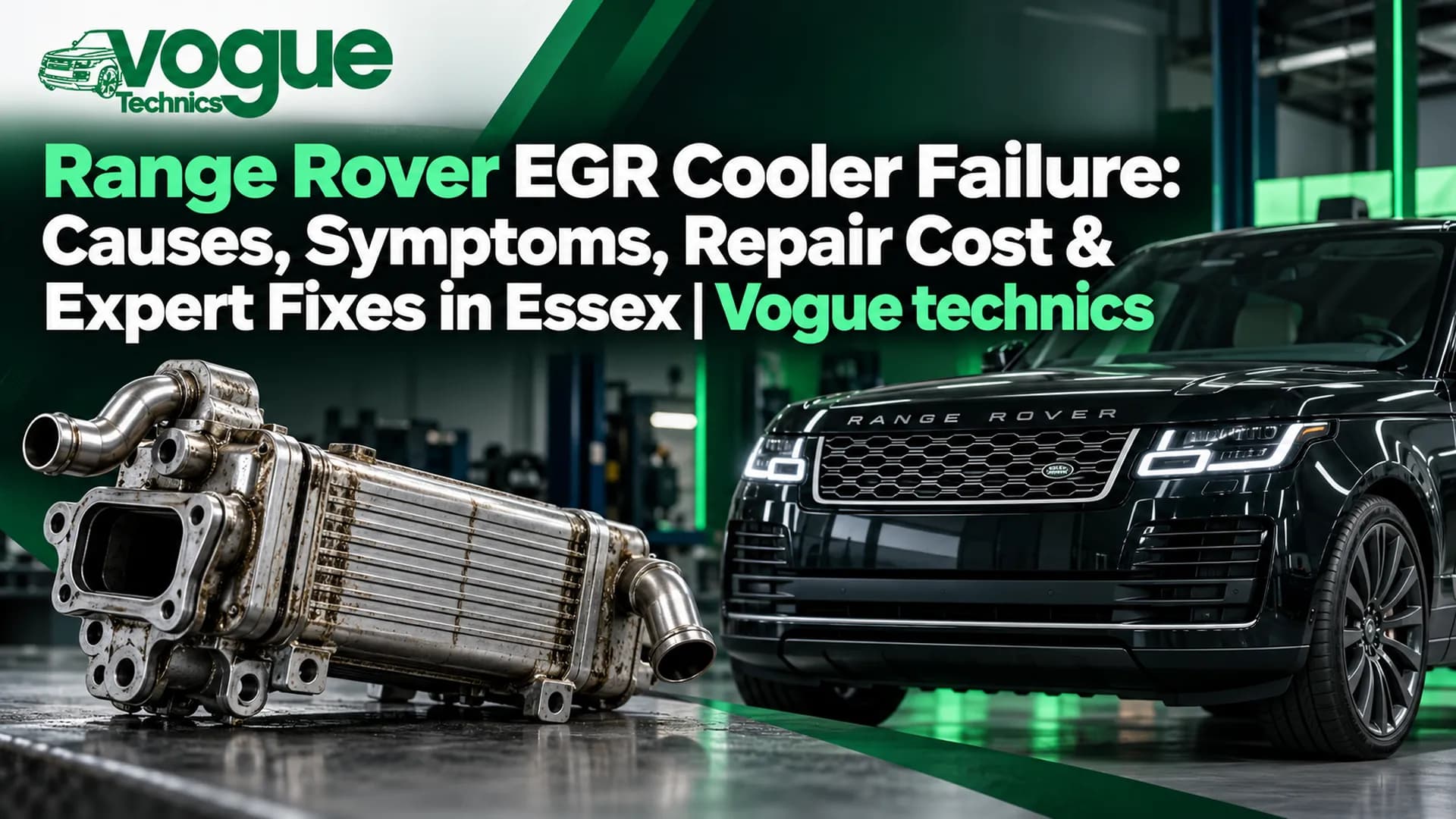
Range Rover EGR Cooler Failure: Causes, Symptoms, Repair Cost & Expert Fixes in Essex
Your coolant level keeps dropping, but there's no puddle on the drive. Then white smoke starts trailing behind you on a cold morning, and the car feels flat on the motorway.
If that sounds familiar, Range Rover EGR cooler failure is one of the first things to rule out. At Voguetechnics in Grays, Essex, we see this fault often enough to know how it starts, how fast it gets worse, and what it costs when it's left alone.
Short version: a failed EGR cooler can push coolant into the intake and exhaust. Caught early, it's a straightforward repair. Left too long, it can wreck the engine. Below you'll find the causes, the warning signs, realistic UK costs and what a proper repair involves.
What Causes EGR Cooler Failure in a Range Rover, and What Happens When It Fails?
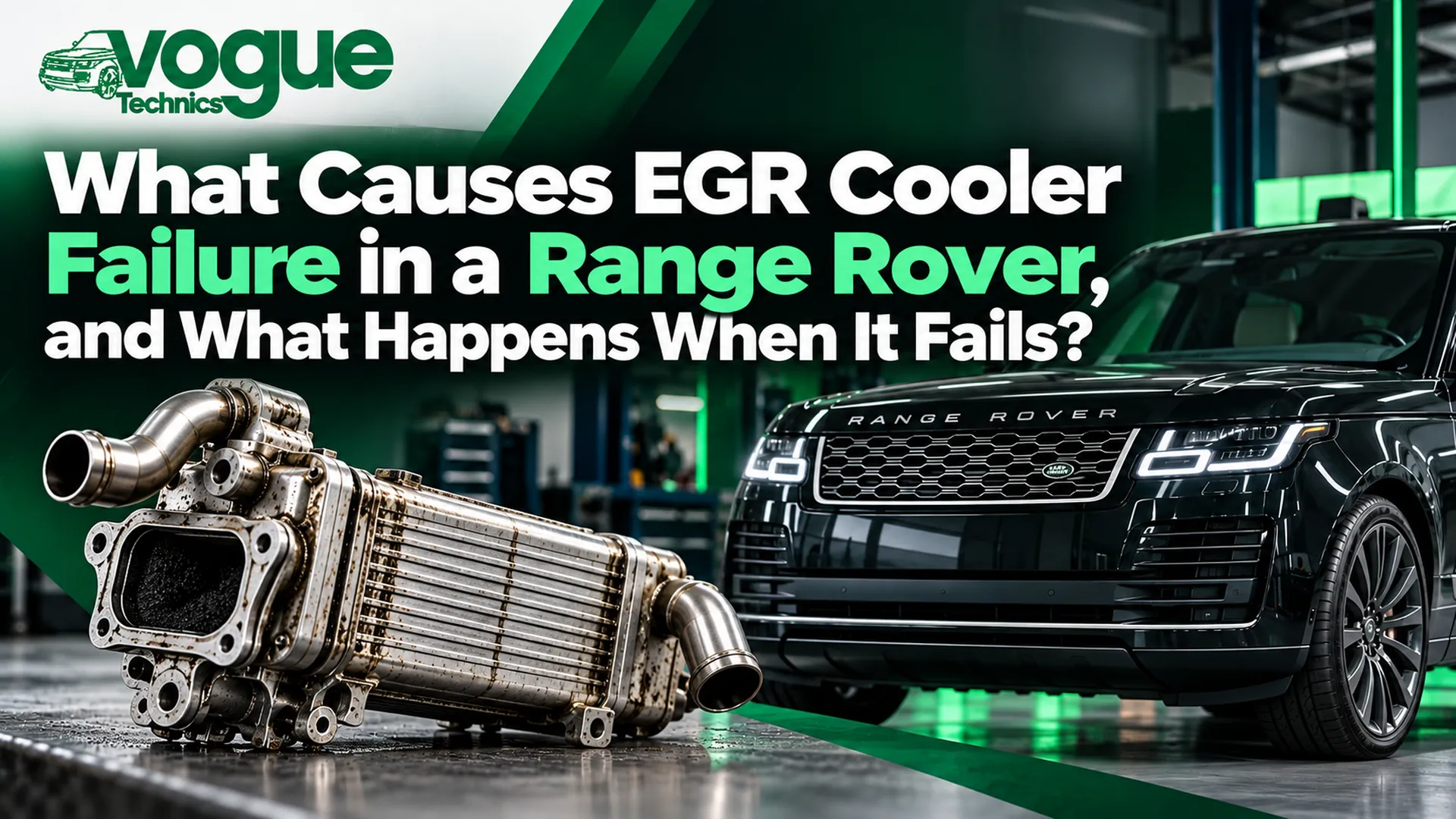
The EGR (Exhaust Gas Recirculation) system sends a portion of exhaust gas back into the engine to cut NOx emissions. Because exhaust gas is extremely hot, it passes through a small heat exchanger first, the EGR cooler, which uses engine coolant to bring the temperature down.
So the cooler has hot, sooty exhaust on one side and pressurised coolant on the other, separated by thin metal. That's the weak point.
What causes EGR cooler failure? In our experience, it's a mix of these:
- Thermal fatigue. Constant heating and cooling cycles crack the thin internal walls over time.
- Soot and carbon build-up. Deposits restrict flow, create hot spots and add stress.
- Short-trip driving. The engine rarely reaches full temperature, so condensation and carbon accumulate rather than burn off.
- Poor engine health. Worn injectors or a blocked DPF increase soot loading.
- Age and mileage. Most failures we see are on diesel Range Rovers with several years and a good number of miles behind them.
What happens when an EGR cooler fails? A crack lets coolant seep into the exhaust stream. The coolant is drawn into the intake or burnt off as steam, which is why you lose coolant with no visible leak. Early on, the leak can be tiny. As the crack widens, the symptoms get hard to miss.
What Damage Can a Faulty EGR Cooler Cause If You Keep Driving?
A leaking cooler doesn't stay a cooler problem. The longer you drive on it, the more it spreads:
- Overheating from steady coolant loss, which can lead to head gasket failure or a warped cylinder head.
- DPF contamination. Coolant in the exhaust can clog or damage the diesel particulate filter, and a replacement is far more expensive than the cooler.
- Hydrolock. If enough coolant enters a cylinder, the piston can't compress liquid. The result can be bent connecting rods and an engine replacement.
- Turbo and intake damage from coolant and sludge passing through the air path.
A customer once brought in a Range Rover after topping up coolant every few days for two months, assuming a slow hose leak. The pressure test pointed straight at the EGR cooler. That was a repair job. A few weeks more and it could have been an engine job.
What Are the Signs of EGR Cooler Failure on a Range Rover?
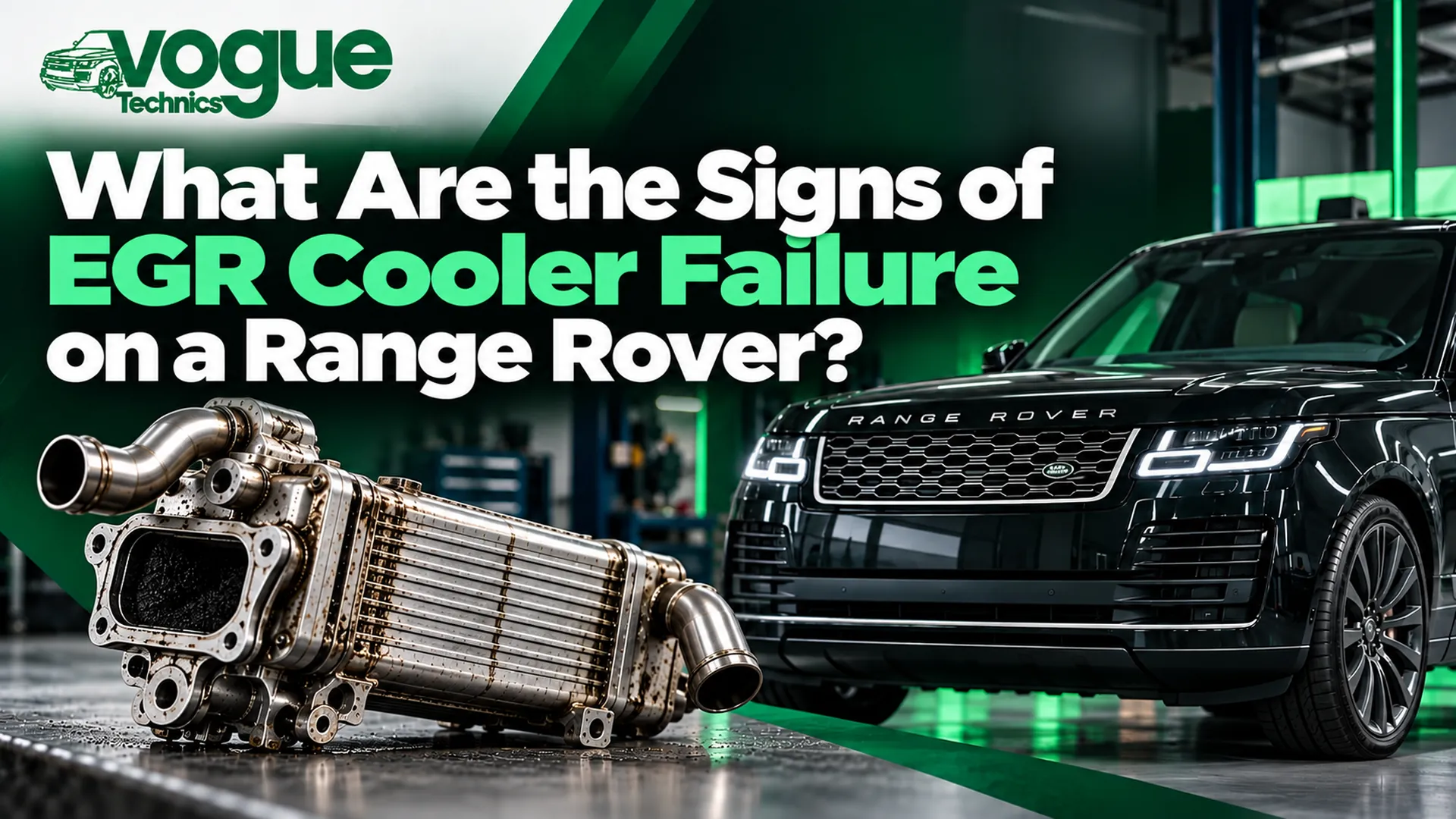
The signs can look like other faults at first, so it helps to know the pattern. For a deeper rundown on related problems, see our guide to [DPF blockage and failed regeneration] (internal link).
Which Range Rover EGR Cooler Failure Symptoms Should You Never Ignore?
Here are the signs of EGR cooler failure we see most often, roughly in the order owners notice them:
- Unexplained coolant loss with no wet patches under the car
- White exhaust smoke, often thick on start-up and sometimes with a sweet smell
- Rising temperature gauge or overheating warnings
- Loss of power or limp mode
- Engine management light with EGR-, coolant- or emissions-related fault codes
- Bubbling or pressurised coolant in the expansion tank
- Rough idle or misfires as coolant reaches the combustion chamber
Any one of these can have another cause. Two or three together, especially coolant loss plus white smoke, make the EGR cooler a prime suspect.
A quick note on "6.4 EGR cooler failure symptoms." That search usually refers to the 6.4L Ford Power Stroke truck engine, which isn't a Range Rover engine. The symptoms are similar in principle (coolant loss, white smoke, power loss), but the engines are different. This article focuses on Range Rover diesel models such as the 3.0 TDV6/SDV6 and 4.4 SDV8.
Is it the EGR cooler, the EGR valve or the head gasket? This table helps separate them:
Symptom | EGR cooler failure | EGR valve fault | Head gasket failure |
| Coolant loss, no visible leak | Very common | Rare | Common |
| White smoke | Common | Uncommon | Common |
| Power loss / limp mode | Common | Common | Sometimes |
| Rough idle, stalling | Sometimes | Common | Sometimes |
| Oil contaminated with coolant | Rare | No | Common |
| Fixed by cleaning alone | No | Often | No |
Only a proper test confirms the cause, which is why we pressure-test the cooling system rather than guess.
Is Your Range Rover Evoque EGR Cooler Leaking or Faulty?
Many owners search for Range Rover Evoque EGR cooler leak or Range Rover Evoque EGR cooler fault because the signs appear in similar ways: dropping coolant, white smoke and warning lights.
Here is how to tell a leak from a general fault:
- A leak usually shows as steady coolant loss and white smoke, and a coolant pressure test or exhaust gas test points to internal leakage.
- A fault (without a leak) often shows as an EGR-related fault code, rough running or reduced power, with coolant level staying stable.
Don't assume which one you have from the dash alone. A scan, live EGR data and a pressure test separate the two in a single visit.
How Much Does Range Rover EGR Cooler Failure Cost to Fix in the UK?
Cost is the question most owners ask first. The honest answer is that it depends on the engine, the extent of the damage and how long the car has been driven with the fault.
For a straightforward EGR cooler replacement caught early, UK independent specialists typically charge roughly £600 to £1,500, covering parts, labour and a cooling system flush. Main dealers are usually higher. The real cost jump comes from damage that follows: a contaminated DPF, a head gasket or an engine rebuild can run into several thousand pounds.
What moves the price:
- Engine type (3.0 V6 vs 4.4 V8 and how accessible the cooler is)
- Parts choice (genuine, OEM-equivalent or uprated)
- Additional damage found during diagnosis
- Flush and coolant renewal, which is essential after a cooler leak
Does the Repair Cost Differ for a 2013, 2016 or 2017 Range Rover?
Model year matters less than engine and mileage, but patterns do emerge. Treat these as indicative guides, not quotes.
Model year | Typical issue we see | Indicative repair range |
| 2013 Range Rover EGR cooler failure | Age-related cracking, higher mileage, often with soot build-up | £700 – £1,600 |
| 2016 Range Rover EGR cooler failure | Early coolant loss, white smoke, fault codes | £650 – £1,500 |
| 2017 Range Rover EGR cooler failure | Similar wear, often caught earlier with warnings | £650 – £1,500 |
The cheapest repair is always the early one. A cooler replaced at the first coolant-loss warning costs a fraction of an engine replaced after hydrolock.
Why Choose Voguetechnics for EGR Cooler Repair in Grays, Essex?
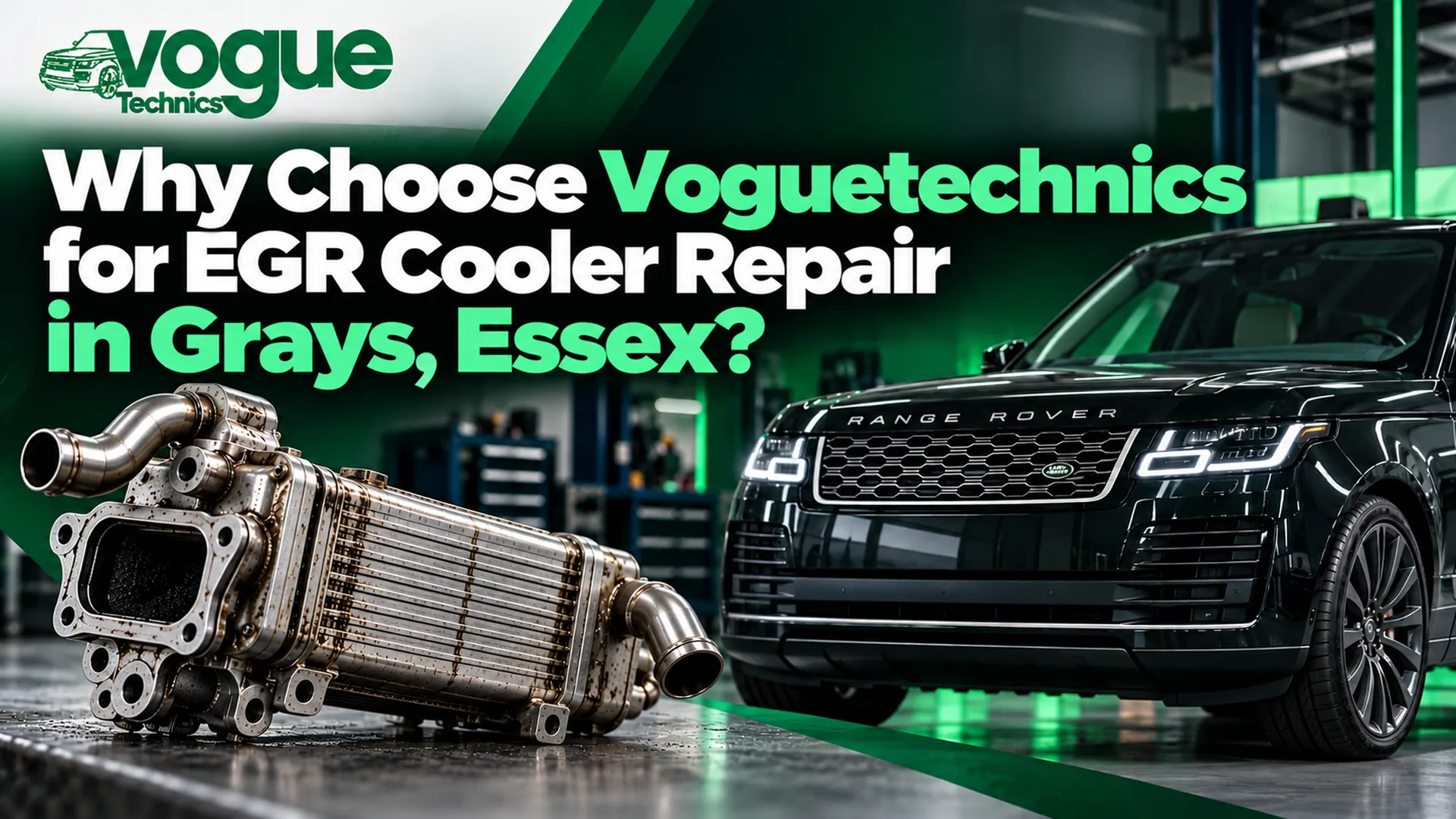
When a repair can save or cost you an engine, who does the work matters. Voguetechnics is based in Grays, Essex, and works on Range Rover and wider Land Rover diesel models. We aim to find the real cause, not swap parts and hope.
How Does Voguetechnics Diagnose and Repair a Failed EGR Cooler?
Our process is deliberately thorough:
- Diagnostic scan to read stored fault codes.
- Live data check of EGR position and operation.
- Visual inspection of the cooler, pipework and surrounding components.
- Coolant pressure test to detect internal leakage.
- Exhaust gas test to check for combustion gases or coolant vapour.
- Repair: replacing the failed cooler, cleaning contaminated intake and EGR passages, and flushing the cooling system.
- Final checks: a road test and re-scan, with before/after results shared with you.
We explain what we find in plain English, show you the evidence and quote before we start. If the damage goes beyond the cooler, you'll hear that early, not after the invoice.
[Insert verified customer review and workshop photo here to strengthen trust signals.]
Frequently Asked Questions
Can I drive a Range Rover with a failed EGR cooler?
We advise against it. Continued driving risks overheating, DPF damage and, in severe cases, hydrolock. If you must move the car, keep it short and check coolant first.
Can I clean the EGR cooler myself?
Cleaning can help a sooty EGR valve, but it won't repair a cracked cooler. If coolant is going missing, the cooler needs testing and likely replacing.
How long does the repair take?
Most replacements are completed within a day, depending on parts and any further damage found.
Are there recalls for Range Rover EGR cooler issues?
Recall and service-campaign status depends on the exact model and VIN. Check with Land Rover or ask us, and we can look at your car's history.
Is EGR cooler failure a sign of something more serious?
It can be the first sign of a wider problem if ignored, because coolant contamination affects the DPF, turbo and engine internals.
Don't Wait for the Warning to Get Worse
A Range Rover EGR cooler failure rarely fixes itself, and it rarely stays small. Coolant loss and white smoke are your car telling you something needs attention now, while the repair is still manageable.
Book a diagnostic with Voguetechnics in Grays, Essex. We'll pressure-test the system, tell you exactly what's failing and give you a clear price before any work begins. Call us or use our booking form to get started. To learn more about related faults, browse our [Land Rover diagnostics and repair guides] (internal link).