Range Rover Cranks But Won't Start: Causes, Quick Checks and Repair in Grays, Essex
You turn the key or press the start button. The dashboard lights up, the engine turns over, and then nothing. No fire, no catch, just that long, hopeful cranking sound. If your Range Rover cranks but won't start, you are probably standing in a car park or on your driveway wondering whether this is a ten-minute fix or a recovery truck job.
The good news is that a crank-no-start fault almost always comes down to a short list of causes: fuel delivery, battery voltage under load, a failed sensor or an immobiliser fault. The better news is that you can rule out several of them yourself in a few minutes. This guide walks you through what is happening, what to check safely, and how we diagnose and repair these faults at Vogue Technics in Grays, Essex.
Why Does My Range Rover Crank But Won't Start?
An engine needs three things to run: air, fuel and a spark (or, on a diesel, enough compression and correctly timed injection). When a Range Rover turns over but won't start, one of those is missing, or the engine's computer has decided not to allow it. Because modern Range Rovers rely heavily on sensors and modules, the fault is often electronic rather than mechanical.
What Is the Most Common Reason a Range Rover Turns Over But Won't Start?
In our workshop, the same causes come up again and again. Here they are, roughly in the order we see them:
- Fuel pump or fuel pressure loss: If the pump is weak or has failed, the engine spins but never receives enough fuel to fire. Many owners tell us they heard no humming from the rear of the car when they switched the ignition on.
- Crankshaft position sensor failure: This sensor tells the engine computer where the engine is in its rotation. If the signal drops out, the computer cuts fuel and spark. The engine cranks happily and never starts. A common clue is a car that cut out while driving, then refused to restart.
- Battery voltage dropping under cranking load: A battery can show 12 volts at rest and still collapse the moment the starter draws current. The lights come on, the engine turns slowly or oddly, and the modules reset or misbehave.
- Injector or high-pressure rail faults (diesel): Worn injectors, a leaking return or a failing rail pressure regulator stop the engine building enough pressure to fire.
- Immobiliser or key recognition faults: If the car does not recognise the key, it will crank but deliberately refuse to run. A flat key battery or a faulty receiver is often behind it.
Here is a quick way to match what you notice to the likely cause:
What You Notice | Likely Cause | Urgency |
| No fuel pump hum at ignition on | Fuel pump, relay or fuse | High. Don't keep cranking |
| Slow, laboured crank, flickering dash | Battery or charging fault | Moderate. Test before cranking more |
| Engine cut out while driving, then won't restart | Crankshaft sensor | High |
| Security light flashing or key warning | Immobiliser or key fault | Moderate |
| Long crank, rough start on cold mornings, then total failure | Injectors or rail pressure | High |
| Smell of fuel when cranking | Flooding or leak | Critical. Stop and check |
A scenario we see often: an owner drives home normally, parks up, and the car refuses to start the next morning. The battery tests fine, the fuel level is good, but the crankshaft sensor has failed overnight. It looks like a mystery until the fault code is read.
Why Won't My Range Rover Sport, Evoque, L322 or P38 Start When It Turns Over?
Every model has its own weak spots, which is why a "one fix fits all" answer rarely works.
- Range Rover Sport: A Range Rover Sport turns over but won't start complaint on the 2.7 and 3.0 diesels often points to fuel pressure or sensor faults. On a Range Rover Sport 2.7, we regularly check the fuel system and crank sensor first. Older Sport models can also suffer from low battery voltage affecting the control modules.
- Range Rover Evoque: When an Evoque turns over but won't start, we look hard at fuel delivery, battery health and software or module faults. Evoques used mainly for short trips tend to have tired batteries sooner.
- Range Rover L322: On an L322 that turns over but won't start, electrical gremlins are the usual suspect. Corroded earth points, a weak battery and failing relays are all common on cars of this age.
- Range Rover P38: A P38 that cranks but won't start often points to the engine management system, immobiliser faults or ageing fuel system components. These are older, so wear and corrosion play a bigger part.
- Land Rover Discovery and Discovery Sport: A Discovery 4 that cranks but won't start frequently comes down to fuel system or sensor faults, while a Discovery Sport crank no start is more often battery, module or fuel-related. The same checks apply to any Land Rover Discovery that turns over but won't start.
If you are asking "what is the most common problem with the Range Rover?", the honest answer is that it depends on the age. Newer cars tend to suffer sensor and electrical faults. Older ones suffer fuel system wear, corrosion and suspension-related battery drain.
How Can I Diagnose a Range Rover That Won't Start When the Lights Come On?
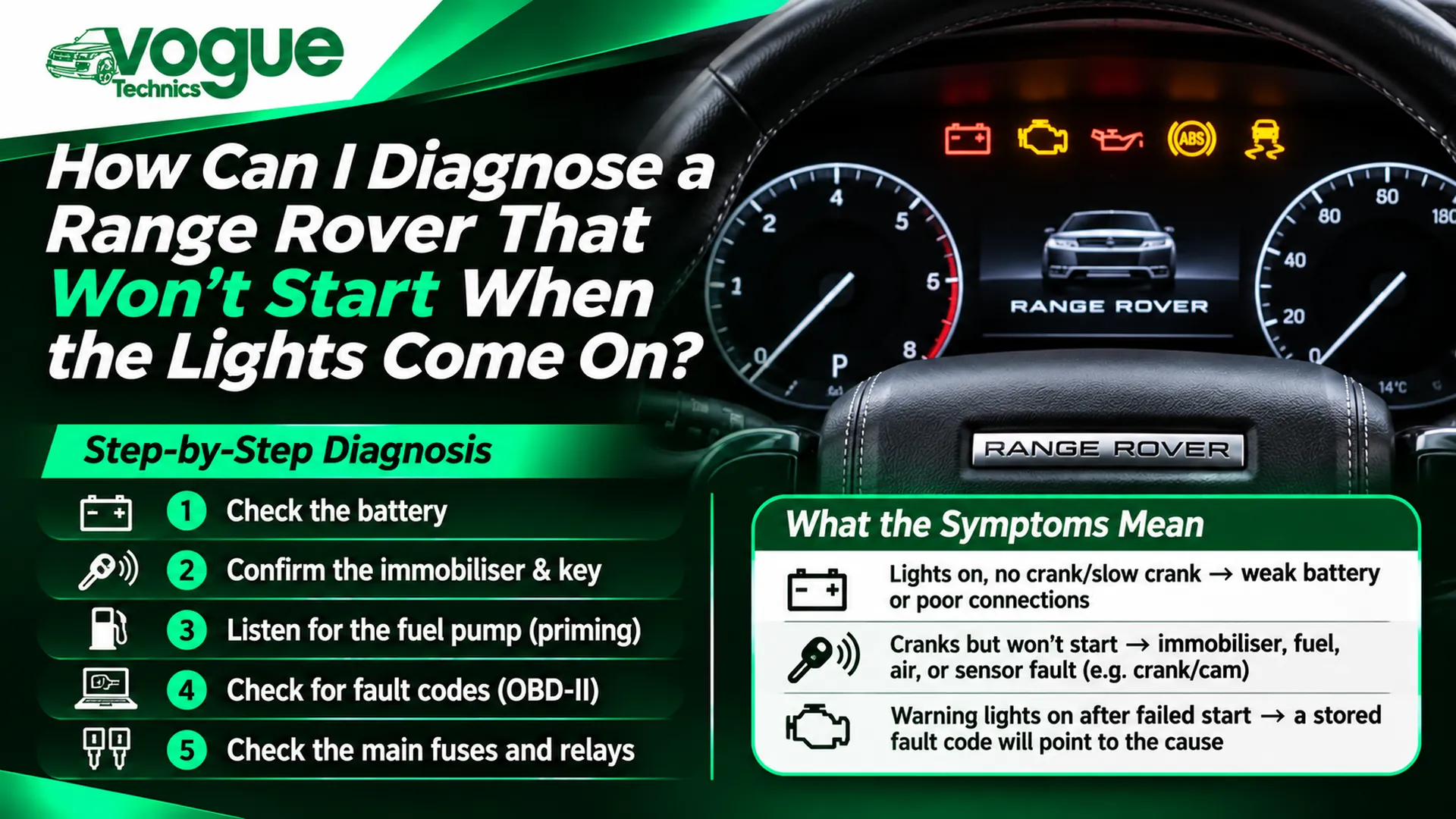
When a Range Rover won't start but the lights come on, the battery is not always the villain. Dash lights need very little power. Cranking needs a lot. That is why a car can look healthy and still fail to start.
What Safe Checks Can I Do Before Calling a Garage?
These checks are safe, take only a few minutes and give a specialist valuable clues. Do them in this order:
- Check the battery and terminals. Look for loose, corroded or dirty terminals. If you have a multimeter, resting voltage should sit around 12.4 to 12.7 volts. Anything below 12 volts suggests the battery is the problem.
- Listen for the fuel pump. Switch the ignition on (without cranking) and listen near the rear of the car. A short hum for a second or two means the pump is priming. Silence is a clue.
- Check the fuel level. It sounds obvious, but a faulty gauge or a long-parked car can mislead you.
- Check the key and immobiliser light. A flashing security light, or a key battery warning, suggests the car is not recognising the key. Try the spare.
- Read the dash messages. Warnings about the engine, transmission or security system point to where the fault sits.
After these checks, you will either have found a simple cause or have clear information to give the garage. That shortens diagnosis time and saves money.
What Does a Clicking Noise or Rapid Clicking Mean When My Range Rover Won't Start?
When a Range Rover is not starting and makes a clicking noise, the cause is usually electrical, not fuel-related. A rapid clicking sound normally means the battery does not have enough power to hold the starter solenoid engaged. A single loud click can point to a failing starter or a poor connection.
Don't keep cranking. Repeated attempts can overheat the starter, drain the battery completely, and on a car with a fuel fault, flood the engine. If it fails after two or three tries, stop and think.
Ask yourself these questions:
- Does the dash dim or reset when you press start? That points to a weak battery.
- Is the clicking from under the bonnet or from the rear? Under the bonnet suggests the starter or solenoid. From the rear could be a relay or fuel system component.
- Did the car do this once before, then recover? Intermittent faults often come from poor connections or a failing relay.
Stuck right now? Call Vogue Technics in Grays, Essex. We can talk you through the checks over the phone and arrange recovery if needed.
How Does Vogue Technics Fix a Range Rover Crank No Start in Grays, Essex?
Guesswork is the most expensive way to fix a crank-no-start. Replacing a fuel pump when the real fault is a sensor, or fitting a new battery when the charging system is failing, costs you time and money. Our approach is to prove the cause before any part is ordered.
What Does a Professional Crank No Start Diagnosis Involve?
We follow a set sequence so nothing is missed, and you receive the findings in writing:
- Full diagnostic scan: We read fault codes from the engine, immobiliser and body control modules using Land Rover-capable equipment, not just a generic reader.
- Fuel pressure test: We measure actual pressure rather than assuming the pump is working because it hums.
- Battery and charging system test: We load-test the battery and check the alternator output so the fault does not return.
- Sensor tests: We check crankshaft and camshaft sensor signals, which are common culprits and easy to misdiagnose.
- Immobiliser system check: We verify key recognition and communication between modules.
- Injector and ignition tests: Depending on the engine, we test injector operation, rail pressure or ignition components.
- Written report and quote: You get a clear explanation of what failed, why, and what it costs, before any repair work starts.
This process matters because many crank-no-start faults mimic each other. A failed sensor looks like a fuel fault. A weak battery looks like a starter fault. Testing separates them.
How Much Does It Cost to Fix a Range Rover That Cranks But Won't Start?
Costs vary by model, engine and the part involved, so these are indicative bands only. We confirm a fixed price after diagnosis.
Cause | Typical Repair | Indicative Cost Band |
| Flat or failing battery | Battery replacement and charging test | Low |
| Key or immobiliser fault | Key battery, reprogramming or receiver repair | Low to moderate |
| Crankshaft or camshaft sensor | Sensor replacement | Low to moderate |
| Fuel pump or relay | Pump or relay replacement | Moderate |
| Injector or rail pressure fault | Injector or regulator replacement | Moderate to high |
| Module or major electrical failure | Module repair, replacement and coding | High |
On older cars such as the P38 or early L322, we also give you an honest view on repair versus scrap. If the repair cost approaches the vehicle's value and other expensive faults are waiting in the wings, we will tell you so rather than let you spend money unwisely.
We also offer recovery support for owners who cannot drive to us, plus warranty cover on repairs. To book a diagnosis, call or message Vogue Technics in Grays, Essex. Tell us your model, engine, and exactly what happens when you try to start it.
Frequently Asked Questions
Why is my Land Rover turning over but not starting?
The engine is cranking but missing fuel, spark, correct timing signals or permission from the immobiliser. The most common causes are fuel pump failure, a faulty crankshaft sensor, a weak battery under load and key recognition faults.
What would cause an engine to crank but not start?
Any failure in the fuel supply, ignition or injection, engine sensors, or security system can do it. Modern engines also refuse to start if the computer does not receive a valid crankshaft signal.
How to fix crank but no start?
Start with the basics: battery, fuel level, fuel pump prime sound, key and warning lights. If those look normal, get a diagnostic scan and fuel pressure test rather than replacing parts blindly.
What is the most common problem with the Range Rover?
It varies with age. Newer models suffer electrical and sensor faults, while older ones often have fuel system wear, corrosion and battery drain.
Can I keep trying to start my Range Rover?
No. Repeated cranking can overheat the starter, flatten the battery and flood the engine. Try a couple of times, then stop.
Why won't my Range Rover start but the lights come on?
Dash lights need very little power. A battery that powers them can still be too weak to crank properly. It can also be a fuel, sensor or immobiliser fault.
Why is my Range Rover not starting and making a clicking noise?
Rapid clicking usually means low battery voltage or a poor connection at the starter solenoid. A single click can point to the starter itself.
Is a Range Rover Evoque or Discovery Sport crank no start covered by warranty?
It depends on the vehicle's age, mileage and the warranty terms. Check your policy, and ask us to provide a written diagnosis you can use to support a claim.
Conclusion
When a Range Rover cranks but won't start, the cause is rarely random. It is almost always fuel delivery, battery voltage, a sensor or the immobiliser. Whether you drive a Range Rover Sport, an Evoque, an L322, a P38, a Discovery 4 or a Discovery Sport, the smartest move is to run the safe checks, avoid repeated cranking and get the car properly tested before parts are replaced.
If your Range Rover turns over but won't start, contact Vogue Technics in Grays, Essex today. Book a diagnosis or arrange recovery, get a clear written quote, and find out exactly what your car needs to get back on the road.