
Range Rover 3.0 Diesel Timing Chain Issues: Symptoms, Causes & Trusted Repair in Essex

Heard a metallic rattle from your Range Rover the moment you start it on a cold morning? Or maybe the engine warning light flicked on and now you're staring at a fault code you don't recognise. If either of those sounds familiar, you're not alone, timing chain and timing system problems are among the most common (and most misunderstood) issues affecting the Range Rover 3.0 diesel engine, and getting a straight answer online isn't always easy.
Part of the confusion comes from the engine itself. Some guides tell you the 3.0 diesel runs a timing belt. Others insist it's chain-driven. The truth is both are right, depending on which part of the engine you're talking about, and that distinction matters when it comes to diagnosing a fault correctly instead of throwing parts at the problem.
This guide walks through exactly what's going on inside your engine, the symptoms that signal trouble, what actually causes timing chain and tensioner failure on the 3.0 TDV6 and 3.0 SDV6, and what a proper repair looks like, including realistic costs. If you're based in Grays, Essex, or anywhere nearby, we'll also cover how we approach diagnosis and repair at Voguetechnics.
Does the Range Rover 3.0 Diesel Use a Timing Chain or a Timing Belt?

Here's where most owners get tripped up, and honestly, where a lot of online advice gets it wrong too.
The Range Rover 3.0 diesel, known internally as the 306DT (and later the 30DDTX), uses a hybrid timing system. It isn't purely chain-driven and it isn't purely belt-driven. It's both, and each part does a different job.
Internal Camshaft Timing Chains Explained
Inside the cylinder heads, the camshafts are driven by internal timing chains, not belts. These chains control valve timing and are tensioned by small hydraulic tensioners that rely on consistent oil pressure to function properly.
These internal chains are designed to last the life of the engine under normal conditions. But "designed to" and "actually do" aren't always the same thing, oil starvation, tensioner wear, and chain stretch can all shorten that lifespan considerably, which we'll get into shortly.
Front Timing Belt vs Internal Timing Chain, What's the Difference?
At the front of the engine, the 3.0 TDV6 and 3.0 SDV6 also use a timing belt to drive the crankshaft timing components. This belt is a separate, serviceable item with its own replacement interval, commonly cited as every 7 years or 112,000 miles, though this varies by model year and should always be confirmed against your specific vehicle.
Here's the simplest way to remember it:
- Timing belt = front of the engine, external, has a fixed replacement interval, snaps if neglected
- Internal camshaft chains = inside the cylinder heads, not routinely replaced, but vulnerable to tensioner and oil-related wear
Most owners searching for "Range Rover timing chain issues" are actually experiencing problems with the internal camshaft chain tensioners rather than the external belt, but both systems can fail independently, and both deserve attention.
Which Range Rover Models Are Affected (L405, L494, L320, Discovery 4)
The 3.0 diesel engine family, TDV6, SDV6, 306DT, and 30DDTX, was fitted across a wide range of Land Rover and Range Rover models. If your vehicle falls into one of these categories, this timing system applies to you:
- Range Rover L405 (2012 onwards)
- Range Rover Sport L494 (2013 onwards)
- Range Rover Sport L320 (earlier generation, 3.0 diesel variants)
- Discovery 4 (L319) with the 3.0 diesel engine
- Range Rover L322 on earlier 3.0 diesel applications
Because engine specification and timing hardware can vary slightly between model years, it's always worth confirming your exact engine code before ordering parts or booking a repair.
Common Range Rover 3.0 Diesel Timing Chain Symptoms

Timing chain problems rarely appear out of nowhere. In almost every case we see, there's a progression of symptoms, and catching them early is the difference between a tensioner replacement and a full engine rebuild.
Cold Start Rattle and Metallic Noise
This is the symptom that sends most owners searching online in the first place. A metallic rattle on cold start that disappears once the engine warms up is a classic sign of a worn timing chain tensioner losing oil pressure overnight.
It's easy to dismiss because it goes away after a minute or two. Don't. This rattle is the engine telling you the tensioner isn't holding chain tension the way it should, and it will get worse over time, not better.
Rough Idle and Loss of Power
As chain slack increases, valve timing becomes less precise. You might notice:
- A rougher, less stable idle than usual
- Hesitation or delayed throttle response
- A general sense the engine has "lost its edge" compared to before
These symptoms happen because the camshaft and crankshaft are no longer perfectly synchronised, which affects combustion efficiency.
Check Engine Light and Timing Fault Codes
If the timing deviation becomes significant enough, the ECU will flag it, and the check engine light will come on.
What P0016 and P0017 Mean on a 3.0 TDV6/SDV6
Two fault codes come up repeatedly with Range Rover 3.0 diesel timing issues:
- P0016, Crankshaft/Camshaft Position Correlation (Bank 1)
- P0017, Crankshaft/Camshaft Position Correlation (Bank 2)
Both codes essentially mean the ECU has detected that the camshaft position doesn't match where it should be relative to the crankshaft, a direct symptom of chain stretch or tensioner failure. You might also encounter P0008 or P0009, which relate to similar correlation faults on specific banks.
Seeing one of these codes doesn't automatically mean you need a new engine, but it does mean the timing system needs proper diagnostic attention before you drive the vehicle any further.
What Causes Timing Chain and Tensioner Failure on the 3.0 Diesel?

Understanding the root cause matters just as much as recognising the symptoms, because it shapes what the correct repair actually looks like.
Worn Tensioners and Timing Guides
The hydraulic tensioners that keep the internal camshaft chains under proper tension rely on consistent oil pressure to work. Over time, these tensioners wear internally, lose their ability to maintain pressure, and allow the chain to develop slack.
Timing guides, the rails that keep the chain running true, wear alongside the tensioners. Once guide material starts breaking down, it can contaminate the oil system further, compounding the problem.
Chain Stretch Over Time and High Mileage
"Chain stretch" doesn't mean the metal links physically elongate. It refers to wear at each pin and bushing joint accumulating across the chain's full length, effectively increasing its overall size. On a high-mileage 3.0 diesel, this is a natural consequence of age and use, but it accelerates dramatically when oil quality or pressure has been neglected.
Low Oil Pressure and Poor Service History
This is, in our experience, the single biggest factor separating engines that develop early timing problems from engines that don't.
How Oil Change Intervals Affect Tensioner Life
The hydraulic tensioners on this engine are entirely dependent on clean oil at correct pressure. When oil change intervals are stretched too far, or when lower-quality oil is used, you get:
- Reduced oil pressure reaching the tensioners
- Sludge build-up restricting oil flow to critical components
- Accelerated wear on tensioner pistons and seals
- Faster chain and guide degradation as a direct result
A vehicle with a consistent, correct-interval service history using the right oil specification will almost always show timing symptoms later, and less severely, than one with a patchy maintenance history. This is one of the clearest, most controllable factors in preventing premature timing failure.
Timing Chain Repair, Replacement & Cost, What Grays, Essex Owners Need to Know
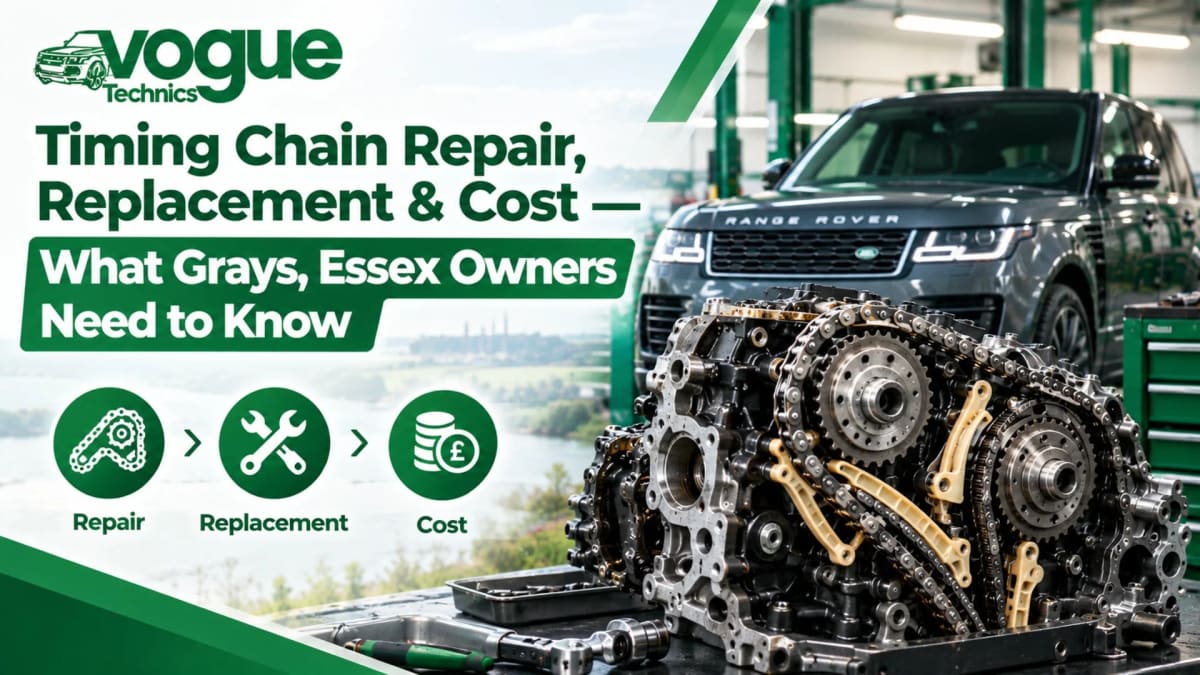
Once you're dealing with confirmed timing chain symptoms or fault codes, the question shifts from "what's wrong" to "what does fixing it actually involve."
How We Diagnose a Timing Fault at Voguetechnics
A rattle alone doesn't tell you everything, proper diagnosis combines mechanical inspection with live data. At Voguetechnics, based in Grays, Essex, our approach typically includes:
- Reading and interpreting fault codes (including P0016, P0017, and related correlation faults)
- Checking live camshaft and crankshaft correlation data under running conditions
- Physically inspecting tensioner condition and oil pressure where accessible
- Reviewing oil condition and service history to understand the underlying cause, not just the symptom
This matters because two vehicles showing the same rattle can need very different repairs, one might need a tensioner replacement, another a full timing kit, and in more severe cases, deeper engine work.
Timing Chain vs Timing Belt Replacement Cost
Costs vary depending on how far the problem has progressed and which components are affected, but here's a general comparison to set expectations:
Repair Type | What's Involved | Typical Scope |
| Front timing belt replacement | Belt, tensioner, pulleys (scheduled service item) | Moderate labour, predictable cost |
| Internal timing chain tensioner replacement | Tensioner and guide replacement per bank | Moderate to significant labour |
| Full timing chain kit replacement | Chains, tensioners, guides, sprockets | Higher labour, more parts |
| Engine-out timing repair | Required when access is severely limited | Highest cost, most involved |
Catching the problem early, at the cold-start rattle stage rather than after a check engine light and performance loss, consistently keeps repair costs lower and avoids the risk of chain-related engine damage from valve-to-piston contact.
Book a Range Rover Timing Inspection in Essex
If your Range Rover 3.0 diesel is showing any of the symptoms covered in this guide, a cold start rattle, rough idle, or a P0016/P0017 fault code, it's worth getting it looked at before the problem develops further. We work on Range Rover, Range Rover Sport, and Discovery vehicles across the L405, L494, L320, and L319 range, and we're based right here in Grays, Essex for anyone local looking for a specialist who knows this engine inside out.
Frequently Asked Questions
Does the Range Rover 3.0 diesel have a timing chain or a timing belt?
Both. It uses internal camshaft timing chains inside the cylinder heads, plus a separate front timing belt driving the crankshaft timing components. They're independent systems with different failure patterns and service requirements.
What does a failing Range Rover timing chain sound like?
The most common description is a metallic rattling noise on cold start that fades once the engine warms up. This is typically caused by a worn tensioner losing oil pressure overnight rather than the chain itself failing outright.
Can a timing chain problem damage the engine?
Yes, if left unaddressed. Significant chain slack or a skipped tooth can lead to valve-to-piston contact, which causes serious internal engine damage. Early diagnosis and repair prevent this outcome in the vast majority of cases.
What is the timing belt replacement interval on the 3.0 TDV6/SDV6?
It's commonly cited as 7 years or 112,000 miles, though this can vary by model year and specification. Always confirm the correct interval for your specific vehicle rather than relying on a general figure.
How much does Range Rover timing chain repair cost?
It depends entirely on scope, a tensioner replacement costs significantly less than a full timing kit or engine-out repair. Getting an accurate diagnosis first is the only way to know which category your vehicle falls into.
Does the engine need to be removed to replace the timing chain?
Not always. Many tensioner and guide replacements can be carried out with the engine in place, though severe cases or certain access constraints may require more extensive work.
Final Thoughts
Timing chain issues on the Range Rover 3.0 diesel are common, but they're rarely sudden. There's almost always a warning stage, a rattle, a rough idle, a fault code, before things get serious, and that window is exactly when a proper diagnosis makes the biggest difference to both your repair bill and your engine's long-term health.
If you're hearing that telltale cold-start rattle or you've had a P0016 or P0017 code pop up, don't wait for it to get louder. Get in touch with our team at Voguetechnics in Grays, Essex, and we'll give you a straight, expert diagnosis before recommending any repair.