Land Rover Engine Knocking Noise: Causes, Diagnosis and Repair in Grays, Essex
You start the engine on a cold morning and hear a metallic knock that wasn't there last week. It might fade as the engine warms up, or it might get louder as you accelerate. Either way, a Land Rover engine knocking noise is not something to ignore.
Some knocks are minor. Others mean an engine is heading toward a bill of several thousand pounds. The difference usually comes down to how quickly the noise is diagnosed. At Vogue Technics in Grays, Essex, we see these cases regularly across Discovery, Range Rover, Evoque and Velar models. This guide explains what the noise means, how to judge its seriousness, and what a proper diagnosis involves.
What Causes a Land Rover Engine Knocking Noise?
Engine knocks rarely have one cause. The sound depends on the engine type (diesel or petrol), the mileage, the service history and the model. Here is what we find most often, grouped by the vehicles owners bring in.
Why Is My Land Rover Discovery Engine Knocking, Tapping or Ticking When Accelerating?
If you drive a Discovery 3, Discovery 4 or Discovery Sport, the noise usually traces back to one of these areas:
- Fuel injectors: A worn or sticking injector causes uneven combustion, which sounds like a sharp knock under load. It is common on diesel Discoverys, especially the 2.7 TDV6 in the Discovery 3 and the 3.0 SDV6 in the Discovery 4.
- Timing chain and tensioner wear: A rattle or tap on cold start that eases as the engine warms often points here. Left alone, a stretched chain can jump a tooth and cause serious internal damage.
- Low oil pressure or degraded oil: Thin, old or low oil leaves moving parts without proper protection. The result is a Land Rover Discovery engine tapping noise that grows with revs.
- Worn big-end or main bearings: This is the serious one. It produces a deep, rhythmic knock that rises with engine speed.
Here is the practical difference between the noises you are likely to hear:
Sound | Typical Cause | Urgency |
| Light ticking at idle | Oil-starved top end, injector tick | Moderate. Book a check soon |
| Metallic tapping that rises with revs | Tappets, lifters, timing components | Moderate to high |
| Sharp knock under acceleration | Injectors, fuel quality, combustion issues | High |
| Deep, rhythmic knock from the lower engine | Bearing wear | Critical. Stop driving |
Many owners tell us the noise only appears when accelerating. That is a useful clue. Load-related knocks often point to fuelling or bearing problems rather than a harmless tick.
Why Does My Range Rover, Evoque or Velar Make a Ticking or Tapping Noise?
The same principles apply across the wider range, but each model has its own habits:
- Range Rover and Range Rover Sport: A Range Rover engine knocking noise or a Range Rover Sport engine tapping noise often comes from timing chain wear on higher-mileage V6 and V8 diesels, or from oil that has gone too long between changes.
- Range Rover Evoque: A Range Rover Evoque engine ticking noise commonly traces back to the Ingenium diesel's injectors, or to oil condition. Evoques that do mostly short urban runs are particularly prone.
- Range Rover Velar: A Range Rover Velar engine knocking noise deserves a diagnostic scan early, since newer engines are tightly monitored and the data often reveals the fault before the sound gets worse.
Not every tick is a problem. Some injectors make a light, regular click that is normal for the engine. What matters is whether the noise is new, getting louder, or changing with temperature and load. If you own an old Land Rover, a degree of mechanical noise is expected, but a sudden change always deserves attention.
How Can You Tell If a Land Rover Engine Knock Is Serious?
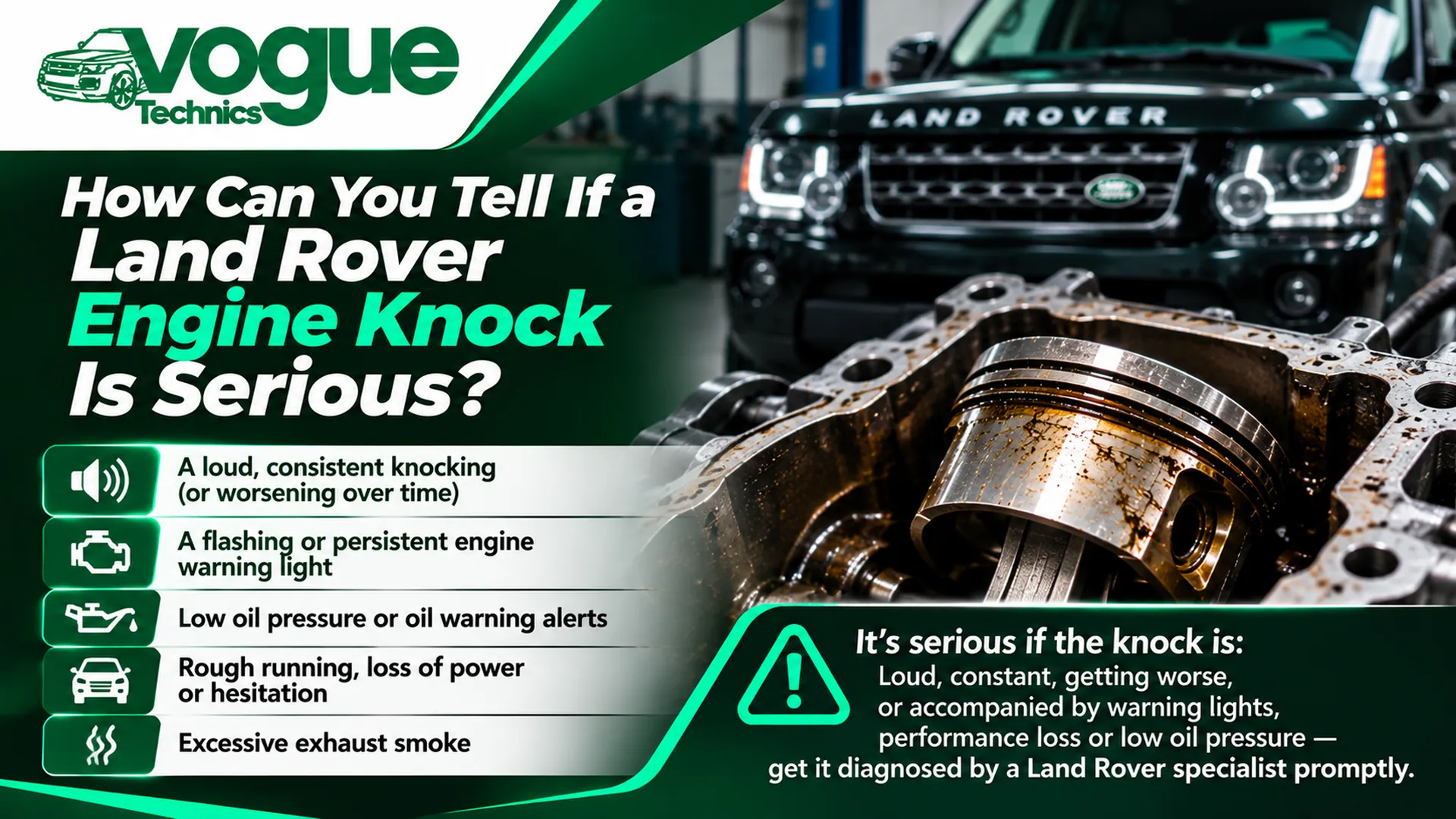
You can narrow the cause down yourself before you ever pick up the phone. A few observations will tell you a great deal, and they will make any diagnosis faster and cheaper.
Is It Safe to Drive a Land Rover With an Engine Knocking Noise?
It depends on the knock. Work through these questions in order:
- Check the oil level first. Low oil is the most common reason for a new noise, and it is the easiest thing to fix. Use the dipstick or the dash reading, with the car on level ground.
- Note when it happens. A knock at cold start that fades within a minute is usually less urgent than one that stays or worsens when warm.
- Listen for how it responds to revs. A noise that speeds up as you press the accelerator suggests something rotating inside the engine. A noise that stays constant often points to ancillary components.
- Check the dash. An oil pressure light, an engine management light or a limp-mode message changes everything.
If the oil level is correct, the light is off and the noise is faint, short, occasional driving to a garage is usually reasonable. If any of those factors are missing, the safer choice is to book recovery rather than risk further damage.
Which Warning Signs Mean You Should Stop Driving Immediately?
Stop and arrange recovery if you notice any of the following:
- A deep, heavy knock that rises and falls with engine speed
- An oil pressure warning light, even briefly
- Visible smoke from the exhaust or engine bay
- A sudden loss of power or the car going into limp mode
- Metallic debris on the dipstick or in the oil
Driving even a few more miles with a failing bearing can turn a repair into a full engine replacement. If you are in Essex or the surrounding area and you are unsure, call us before driving further. A two-minute conversation costs nothing and can save you a great deal.
How Does Vogue Technics Diagnose and Repair Land Rover Engine Knocking in Grays, Essex?
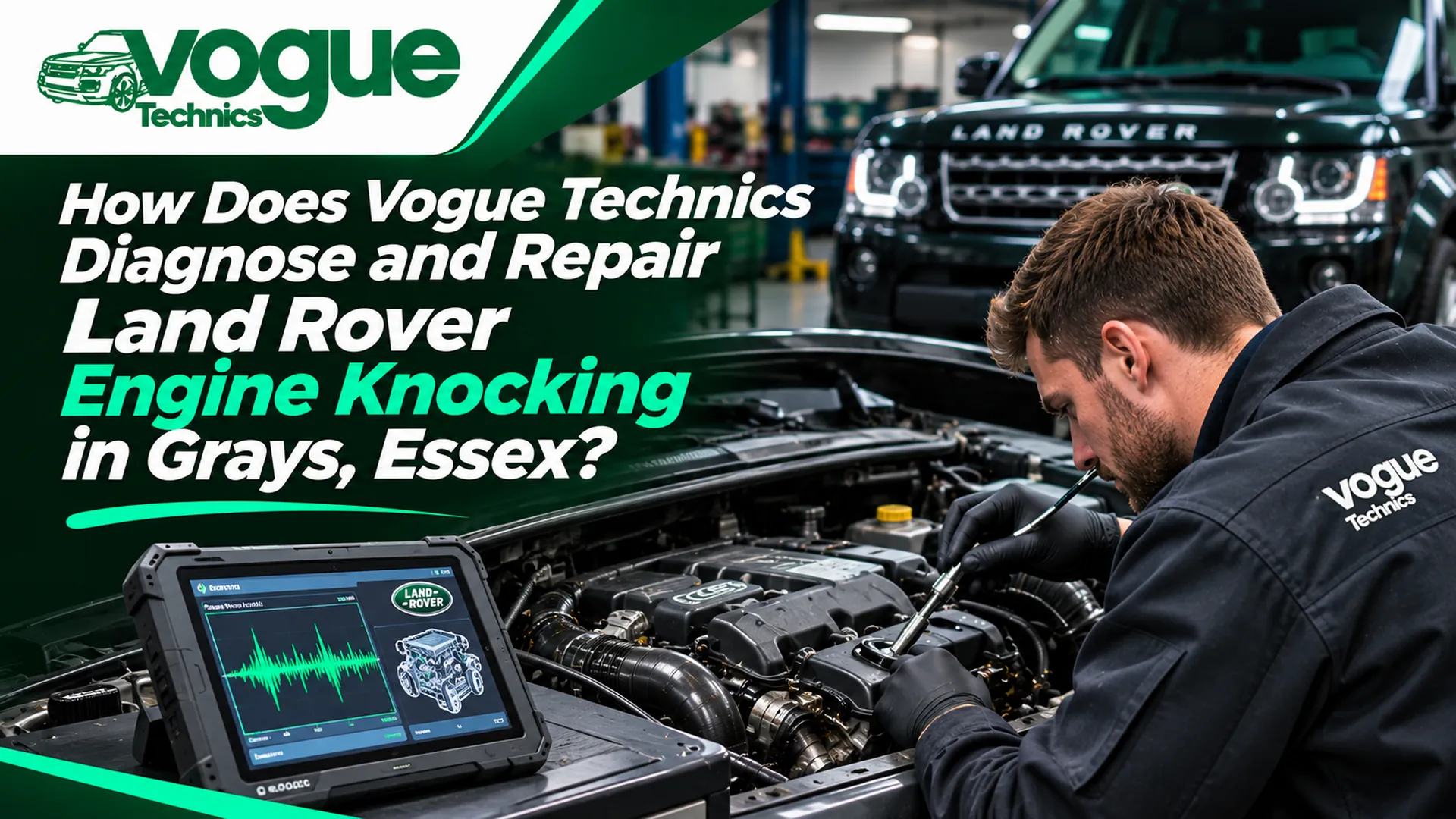
Many garages will guess at the cause and start replacing parts. We don't work that way. A knock can have six or seven possible sources, and guessing is the most expensive way to find the right one.
What Does a Professional Land Rover Engine Knock Diagnosis Involve?
Our process is methodical, and you receive the findings in writing:
- Initial road test and sound check: We listen under cold and warm conditions, at idle and under load.
- Stethoscope inspection: This pinpoints where the noise comes from in the engine, whether top end, timing cover or lower block.
- Oil level, condition and pressure test: We check for contamination, metal particles and pressure drops.
- Live diagnostic data: We read fault codes, injector balance and timing correlation using Land Rover-capable equipment.
- Physical inspection: Where the data points to a specific component, we examine injectors, tensioners and chains directly.
- Written report and quote: You get a clear explanation, photographs where relevant, and a fixed price before any repair work begins.
This approach matters because the same sound can have very different causes. A knock that sounds like a bearing might actually be an injector. A ticking that sounds harmless might be an early warning of chain wear. Proper diagnosis separates the two.
How Much Does Land Rover Engine Knock Repair Cost, and How Do You Book in Essex?
Costs vary by model, engine and the extent of the damage, so treat these as indicative ranges only. We always confirm a fixed quote after diagnosis.
Fault | Typical Repair | Indicative Cost Range |
| Oil service and level correction | Oil and filter change | Low |
| Injector fault | Injector replacement and coding | Moderate to high |
| Timing chain and tensioner wear | Chain kit replacement | High |
| Bearing damage | Engine strip and rebuild | Very high |
| Severe internal failure | Reconditioned or replacement engine | Highest |
The repair-versus-replace decision depends on the engine's overall condition and the vehicle's value. Where a repair makes sense, we will say so. Where a replacement engine is the better long-term choice, we explain why and show you the numbers before you commit.
To book a diagnosis, call or message Vogue Technics in Grays, Essex. Tell us your model, the engine type and when the noise happens. The more detail you give, the faster we can narrow it down.
Frequently Asked Questions
What does a Land Rover engine knocking noise sound like?
It is typically a metallic, rhythmic tap or knock. It can be sharp (injectors), light and fast (tappets or ticking) or deep and heavy (bearings).
Why is my Land Rover engine knocking when I accelerate?
Load-related knocking usually points to injector problems, fuel quality, timing issues or bearing wear. It needs inspection soon.
Is a ticking noise from a Land Rover engine normal?
Sometimes. Some injectors tick lightly by design. If the sound is new, louder or accompanied by warning lights, get it checked.
Can low oil cause a Land Rover engine knock?
Yes, and it is one of the most common causes. Check the level first, and top up with the correct specification of oil.
How long can I drive with an engine knock?
If the knock is deep and rhythmic, don't drive at all. For lighter noises, drive only briefly to a garage, and only if the oil level and warning lights are normal.
Is the Discovery 4 SDV6 prone to engine knocking?
Like many high-mileage diesels, it can develop injector and timing-related noises, particularly if servicing has been stretched. Regular oil changes make a real difference.
Do older Land Rovers make more noise?
Often, yes. Normal wear adds mechanical noise, but a sudden change in sound should always be investigated.
Conclusion
A Land Rover engine knocking noise is your vehicle's way of saying something has changed. Whether it is a Discovery 3, a Discovery Sport, an Evoque, a Velar or a Range Rover Sport, the best outcome comes from acting early, checking the basics and getting an accurate diagnosis rather than a guess.
If your Land Rover is knocking, ticking or tapping, contact Vogue Technics in Grays, Essex today. Book a diagnosis, get a clear written quote, and find out exactly what your engine needs before a small problem becomes an expensive one.