
BMW B47 Turbocharger Upgrade: Is It Worth It, and What Happens When the Turbo Fails?
You want more power from your 320d or 520d, so you start searching for a BMW B47 turbocharger upgrade. Then the horror stories show up: whistling turbos, limp mode, smoke at the tailpipe and four-figure bills. Which of those is real, and which is forum noise?
Here is the honest answer. A B47 can take a sensible power increase and stay reliable. A badly planned upgrade on a tired, poorly serviced engine is a different story, and that is where most failures start. This guide explains your upgrade options, why some fail, how to spot turbo trouble early, and what to do if the damage has already gone beyond the turbo. At Voguetechnics, based in Grays, Essex, we supply and fit replacement engines for UK drivers, so we regularly see what happens when upgrades go wrong.
Is a BMW B47 Turbocharger Upgrade Worth It, and What Are the Risks?
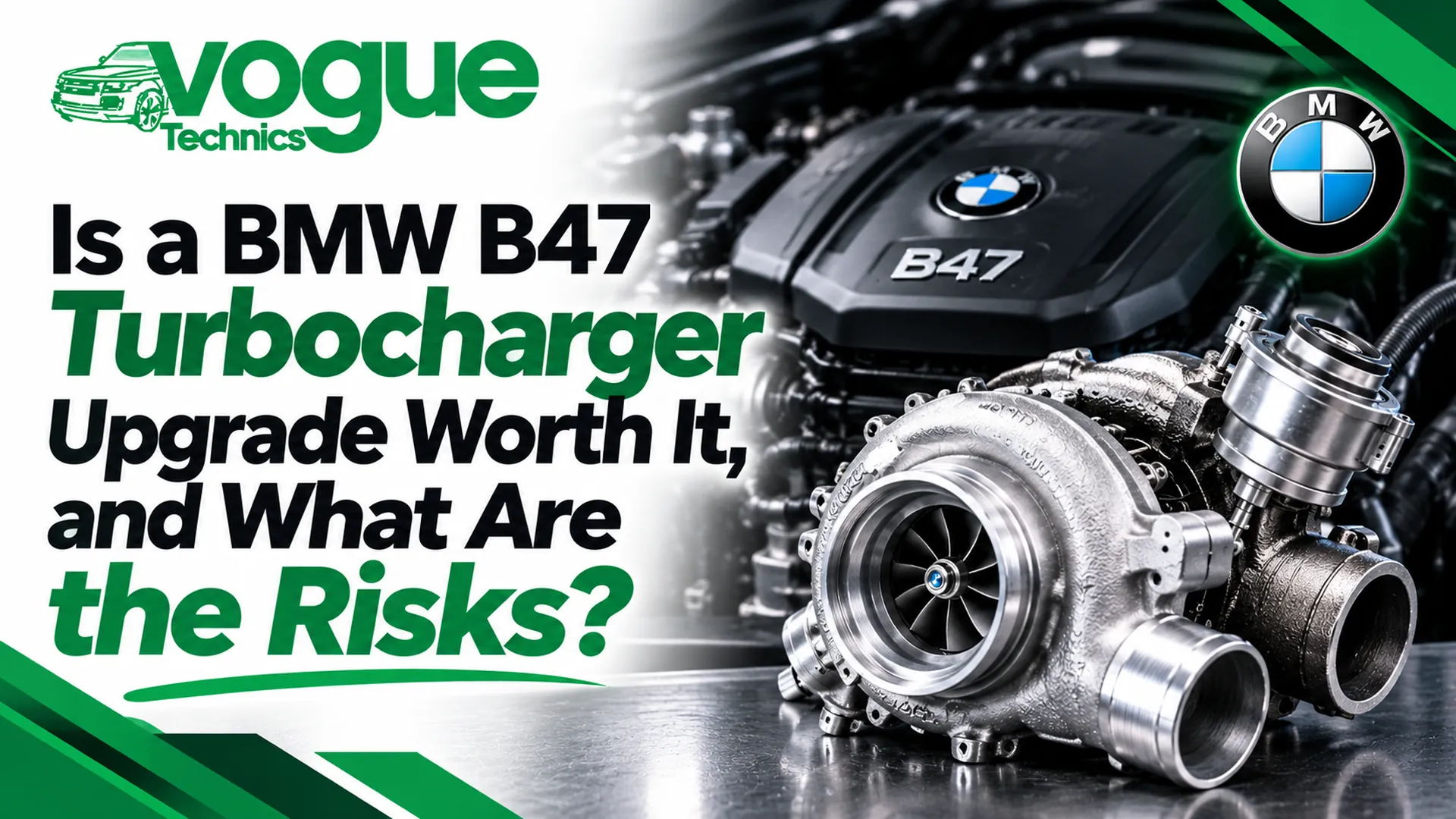
The B47 is a 2.0-litre turbo diesel that BMW introduced in 2014, and it appears in the 1, 2, 3, 4 and 5 Series, the X1, X3 and MINI diesel models. It already makes strong power for its size, which is why many owners wonder whether an upgrade is needed at all.
For most drivers, the answer is: not always. The standard turbo is well matched to the engine. Extra power is possible, but every gain puts more load on the turbo, the actuator, the oil supply and the rest of the engine. That load is the real cost of an upgrade.
Which B47 Turbo Upgrade Options Are Available (Stage 1 Remap, Hybrid Turbo, OEM Replacement), and What Does Each Cost?
Many searches for "BMW B47 turbo upgrade" are really about a remap. A remap changes the engine software and boost settings. It does not change the turbo hardware. A true turbocharger upgrade means fitting a different or modified turbo.
Option | What it involves | Typical power gain | Typical UK cost* | Reliability impact | Best for |
| Stage 1 remap | Software change only, stock turbo | Moderate gain | Low hundreds of pounds | Low to moderate, depends on tune quality | Daily drivers wanting a modest boost |
| Hybrid turbo | Larger or modified turbo, often with a remap | Larger gain | Often over £1,000 fitted | Moderate to high | Enthusiasts willing to accept more risk |
| OEM replacement | Like-for-like turbo, no power change | None | Varies by supplier and fitting | Restores original reliability | Failed turbo on a standard car |
*Costs vary widely by garage, parts quality and car. Treat these as a guide and ask for a written quote.
Before you commit, think about three things beyond price:
- Warranty and insurance. Tuning can affect manufacturer warranties, and you may need to tell your insurer about modifications. A non-declared tune can cause problems at claim time.
- Emissions and MOT. Tuning that interferes with the DPF, EGR or AdBlue system can fail an MOT and may be illegal for road use.
- The state of the engine. Tuning a worn engine rarely ends well. Get it checked first.
A real-world example: a 2016 320d arrives with a fresh remap and a whistling turbo. The owner had never changed the oil more often than the dashboard suggested, and the car had 110,000 miles. The remap did not cause the wear, but it sped up a failure that service history had already been building toward.
Why Do Some B47 Turbocharger Upgrades Fail, and Does Model Year (2014 to 2017) Matter?
When people search for a BMW B47 turbocharger upgrade failure, they are usually describing one of a few repeat causes:
- Extra boost on a stock turbo and actuator. The standard turbo works harder, runs hotter and wears faster.
- Poor tuning. An aggressive map without proper boost and fuelling control can overload the turbo and the engine.
- Weak oil supply. The turbo depends on clean oil. Dirty or old oil, or the wrong grade, damages the bearings.
- Heat. Hard driving followed by an immediate shutdown cooks the oil in the turbo.
- Skipped servicing. Tuned engines need shorter oil intervals, not longer ones.
Does the model year matter? To a degree. Early cars from 2014 and 2015 have more age and mileage behind them, so wear plays a bigger part. A 2014 BMW B47 turbocharger upgrade failure is more often a combination of age and tuning, while a 2016 BMW B47 turbocharger upgrade failure or 2017 BMW B47 turbocharger upgrade failure more often points to a service history or tune quality problem, since those cars are newer. Always check mileage and history, not just the year.
One clarification, since it comes up in searches: you may see references to a 2012 BMW B47 turbocharger upgrade failure. The B47 did not exist in 2012. BMW diesels from that period used the older N47 engine, which has different weaknesses, including its timing chain location. If your car is a 2012 model, make sure the advice you follow is written for the correct engine.
What Are the Symptoms of BMW B47 Turbo Failure, and What Causes It?
A turbo rarely fails without warning. Learning the signs early can save you hundreds, and sometimes the engine itself.
What Are the Warning Signs of BMW Turbo Failure (Power Loss, Whistling, Blue or White Smoke, Limp Mode)?
If you have searched for BMW turbo failure symptoms, this table gives the quick version.
Symptom | Likely cause | Urgency |
| Sudden loss of power or slow acceleration | Boost leak, actuator fault or worn turbo | Medium |
| High-pitched whistle or siren noise | Worn bearings or a leaking pipe | Medium to high |
| Blue or grey smoke | Oil passing through the turbo seals | High |
| Thick white smoke | Coolant issue, possibly EGR cooler related | High |
| Limp mode with a warning light | Boost or sensor fault codes | Medium |
| Metallic grinding or rattling noise | Damaged turbine or compressor wheel | Urgent, stop driving |
If you hear metallic noises or see oil smoke, stop driving. Debris from a damaged turbo can travel into the engine, and a repair that started as a turbo job can become an engine replacement.
A common scenario: an owner ignores a faint whistle for a few weeks. The turbo shaft wears, oil seeps into the intake and the engine starts to smoke. By the time the car reaches a garage, the problem is bigger and the quote is higher.
Which Other B47 Faults Mimic Turbo Failure (EGR, DPF, Boost Leaks, Actuator Faults)?
Not every power loss means a BMW B47 turbo failure. Many BMW B47 turbo problems turn out to be something cheaper, and a proper diagnosis saves you paying for a part you don't need. Check these first:
- EGR valve or cooler faults. Carbon build-up and leaks can cause limp mode and coolant loss.
- Blocked DPF. Short journeys clog the filter, reduce power and trigger regeneration issues.
- Boost leaks. A split hose or loose clamp can imitate a failing turbo.
- Turbo actuator or sensor faults. The turbo may be fine while the electronics are not.
- Fuel and injector issues. Poor fuelling can feel like a lack of boost.
Always ask for a scan of stored fault codes and a physical inspection before agreeing to BMW B47 turbo replacement. It is also worth asking what other BMW B47 engine problems the garage found, because turbo wear is often a symptom of an underlying cause, such as oil starvation.
How Can You Prevent B47 Turbo Problems After an Upgrade (Oil Spec, Cool-Down, Servicing)?
Most turbo problems can be avoided with habits that cost almost nothing. Follow this checklist:
- Use the correct BMW LL-grade oil and change it earlier than the dashboard suggests. Many specialists recommend roughly every 5,000 to 7,500 miles on a tuned car.
- Let the engine warm up before using full power.
- Allow a short cool-down after a hard drive before switching off.
- Check for boost leaks and inspect hoses and clamps regularly.
- Keep the DPF and EGR healthy with regular longer journeys.
- Don't ignore warning lights. Small faults grow quickly on a tuned engine.
These habits matter even more if you plan to keep the car long term. They also tie directly into overall engine life, which we cover in our guide on BMW B47 engine life expectancy.
Should You Replace the Turbo or the Whole Engine, and What Does It Cost in the UK?
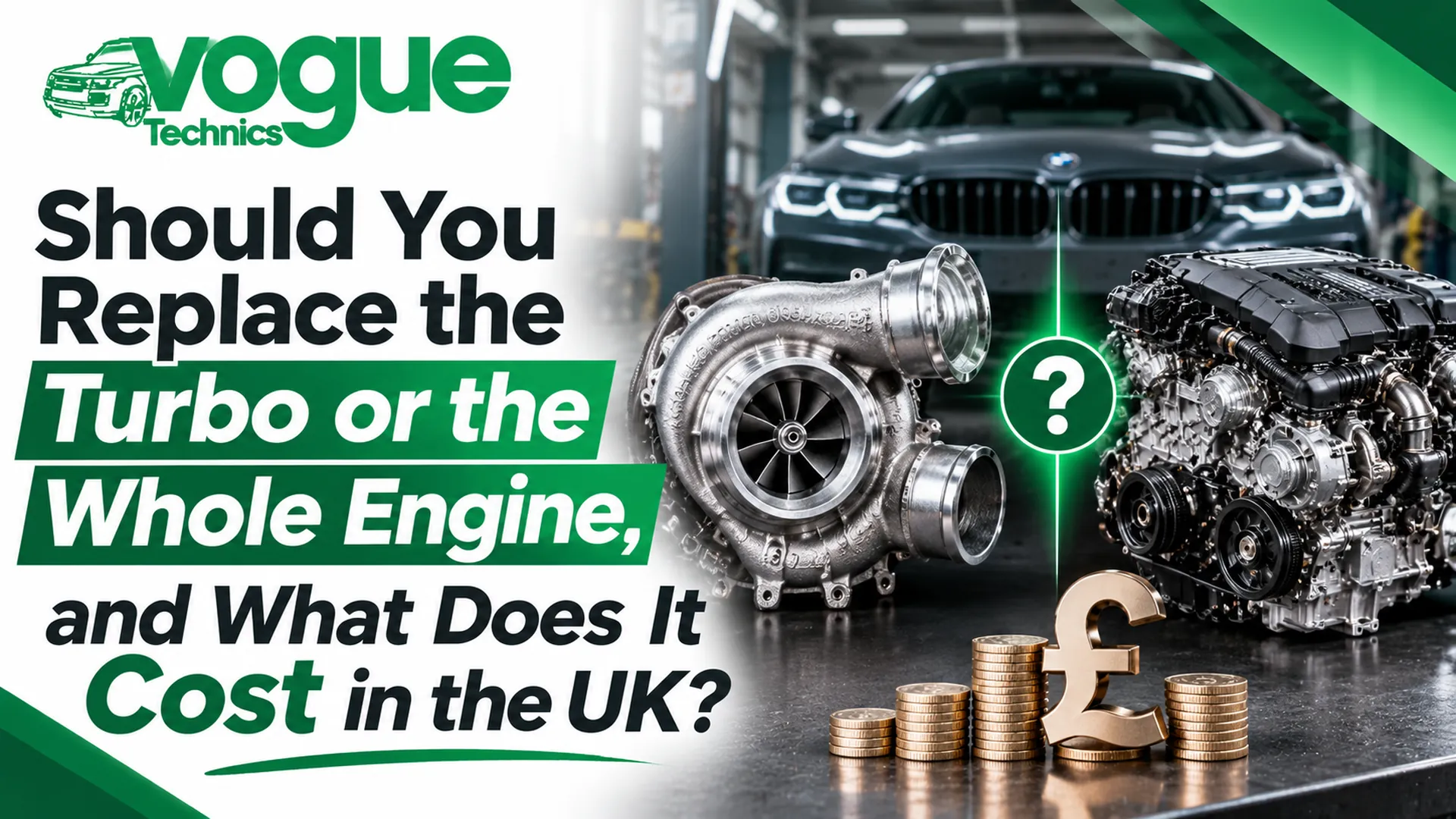
Replacing the turbo is the right call when the rest of the engine is sound. Replacing the engine becomes the better choice when the turbo failure has caused wider damage.
How Much Does BMW B47 Turbo Replacement Cost in the UK, and When Does a Replacement Engine Make More Sense?
Costs vary by car, part quality and labour, so use these as general guidance only:
Repair route | What it covers | Cost level | When it makes sense |
| Turbo replacement only | New or reconditioned turbo, fitting | Lower | Turbo failed, engine undamaged |
| Turbo plus related repairs | Turbo, oil feed, intercooler pipes, EGR or DPF work | Medium | Turbo failure with supporting faults |
| Replacement engine | Tested used or reconditioned B47, fitting | Higher | Metal debris, bottom-end damage or repair cost close to the car's value |
A replacement engine makes more sense in situations like these:
- Metal fragments have entered the intake or the engine.
- There is oil contamination, or low oil pressure after the failure.
- The engine has high mileage and several faults at once.
- The repair estimate is close to what the car is worth.
At Voguetechnics, we supply B47 engines from our base in Grays, Essex, and we explain the numbers openly so you can choose between repair and replacement with confidence. Here is what to expect:
- We identify the correct engine from your registration, such as B47C20 or B47D20.
- Engines are tested before supply.
- A warranty covers the unit.
- Fitting can be arranged, and we advise on what else is worth replacing while the engine is out.
Get your free quote: enter your registration on our quote form and we will come back with options matched to your car. [Link to engine quote page]
Frequently Asked Questions
Can a turbo upgrade damage a B47 engine?
It can, mainly when the tune is aggressive, the car is poorly serviced or the engine is already worn. A conservative tune on a healthy engine carries far less risk.
Is the B47 turbo a common failure point?
Not especially on well-maintained cars. Failures usually trace back to oil quality, boost leaks, actuator faults or tuning.
Does a remap or upgrade affect my warranty or insurance?
It can. Tuning may void parts of a manufacturer warranty, and you should declare modifications to your insurer.
How long does a B47 turbo last?
With regular oil changes and careful driving, many last well over 100,000 miles, and some last the life of the engine.
What are the first signs of BMW turbo failure?
Power loss, a rising whistle, oil smoke and limp mode are the most common early warnings.
Is a BMW B47 turbo replacement worth it on a high-mileage car?
Yes, if the engine is otherwise healthy and the history is good. If other faults are stacking up, compare it against a replacement engine before deciding.
Final Verdict: Should You Upgrade Your B47 Turbo?
A BMW B47 turbocharger upgrade can work well when it is planned carefully, tuned conservatively and backed by disciplined servicing. It goes wrong when owners add power to an engine that is already worn or neglected.
If your turbo has already failed, or you suspect the damage has spread, speak to Voguetechnics. Enter your registration for a free, no-pressure engine quote and we will help you decide between repair and replacement, based on your car and budget.